Sæmundur the Wise: the Icelandic priest who outwitted the devil at the Black School
In Iceland, the priest Sæmundur Sigfússon, who really lived in the 11th century, became the hero of a tale: he studied at a school where the devil kept the last pupil, and he left it by cunning. See what is history and what is folklore.
In Iceland, the name Sæmundur the Wise, in Icelandic Sæmundur fróði, appears in two very different places. In one, he is a priest and scholar of the 11th century, a historical figure who founded a school. In the other, he is the hero of folk tales in which he outwits the devil in various ways. The separation between the two is a good example of how the memory of a real person can become legend.
What is really known
Sæmundr Sigfússon lived between 1056 and 1133. He was a priest and scholar. He studied abroad, and it was once thought in France, but scholars now consider it more likely that it was in Franconia. He founded a school at Oddi, which lasted a long time, and he belonged to the Oddaverjar clan. He wrote, it seems, a work in Latin on the history of the Norwegian kings, which has been lost. Later authors, such as Snorri Sturluson, used it, and the poem Nóregs konungatal summarises it. For centuries, the Poetic Edda was also attributed to him, but that is no longer accepted.
The Black School
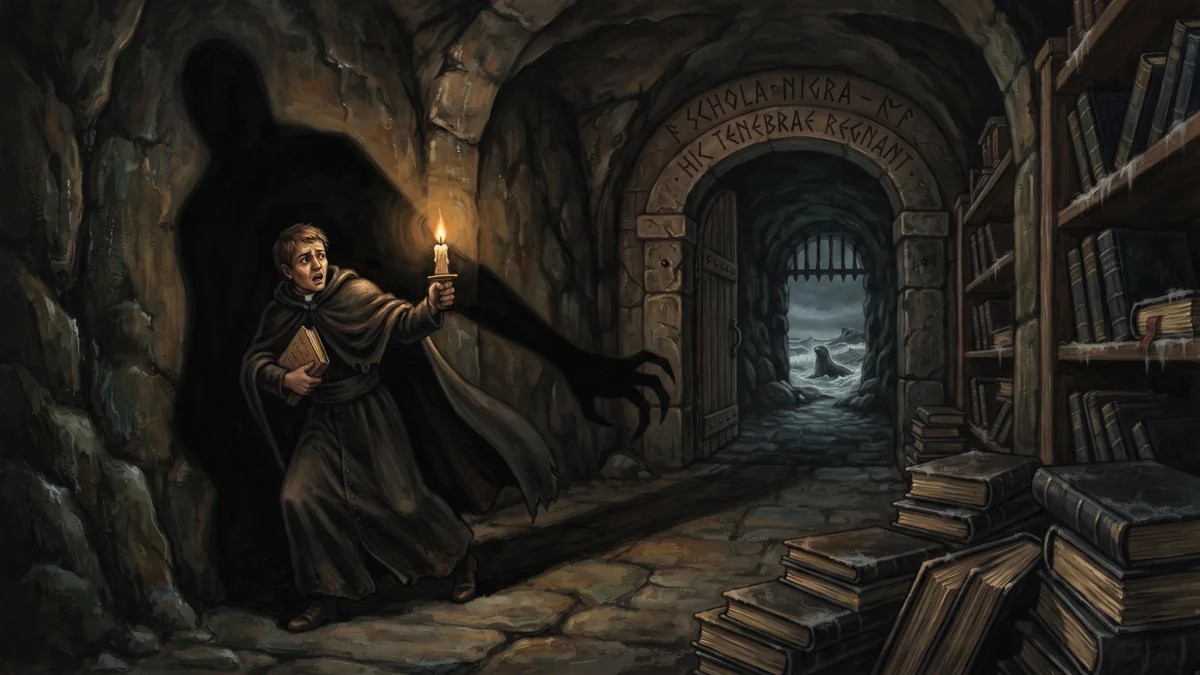
In folklore, Sæmundur went to study the dark arts at the so-called Black School, the Svartiskóli. According to the versions, there was no master: the books appeared in the morning or were written on the walls. Over the door one read: “You may come in; your soul is lost.” Pupils could stay only three years. At the end they drew lots to see who would be last to leave, and that one was taken by the devil. The lot always fell on Sæmundur.
According to one version, Bishop Jón offers him an escape plan, on condition that he return to Iceland and live as a good Christian. As they leave, the devil grabs the bishop’s cloak, and the bishop escapes. Sæmundur is bound to a deal and hides for three days, which he manages. In a variant, he sews a leg of mutton into his cloak. The devil grabs it and Sæmundur drops the cloak and runs, saying: “He grabbed, but I slipped away!” In other versions of this type of tale, it is the last pupil’s shadow that the devil seizes.
The seal
Another story says Sæmundur made a pact with the devil to be carried home, from Europe to Iceland, in the form of a seal. On arrival, he struck the seal on the head with the Bible and stepped onto dry land, safe, and the devil was tricked again.
What remains
The tale derives from an international type, that of the devil’s school, which exists in other countries. What Iceland did was to link the story to a scholar who really existed and who travelled abroad. A reputation for knowing a great deal, in times when travel was rare, could lead people to imagine that such a man had made some bargain.
To escape the maze of the Black School before the devil reaches your shadow, searching for the exit among the corridors, play The Black School.
Sources.
- Wikipedia (English), "Sæmundr fróði Sigfússon", with the sources it cites (Stephen Flowers, *Icelandic Magic*; Stephen Mitchell, *Witchcraft and Magic in the Nordic Middle Ages*; Jón Hnefill Aðalsteinsson, "Sæmundr Fróði: a medieval master of magic", 1994)
- Jón Árnason (ed.), *Íslenzkar þjóðsögur og æfintýri* (1862–1864), tales of Sæmundur