Dorestad: the great port of the Rhine and the Viking raids from 834 to 863
A Frankish trading town on the banks of the Lower Rhine was attacked almost every year from 834. See what the page consulted says about trade, the raids and why it was abandoned.
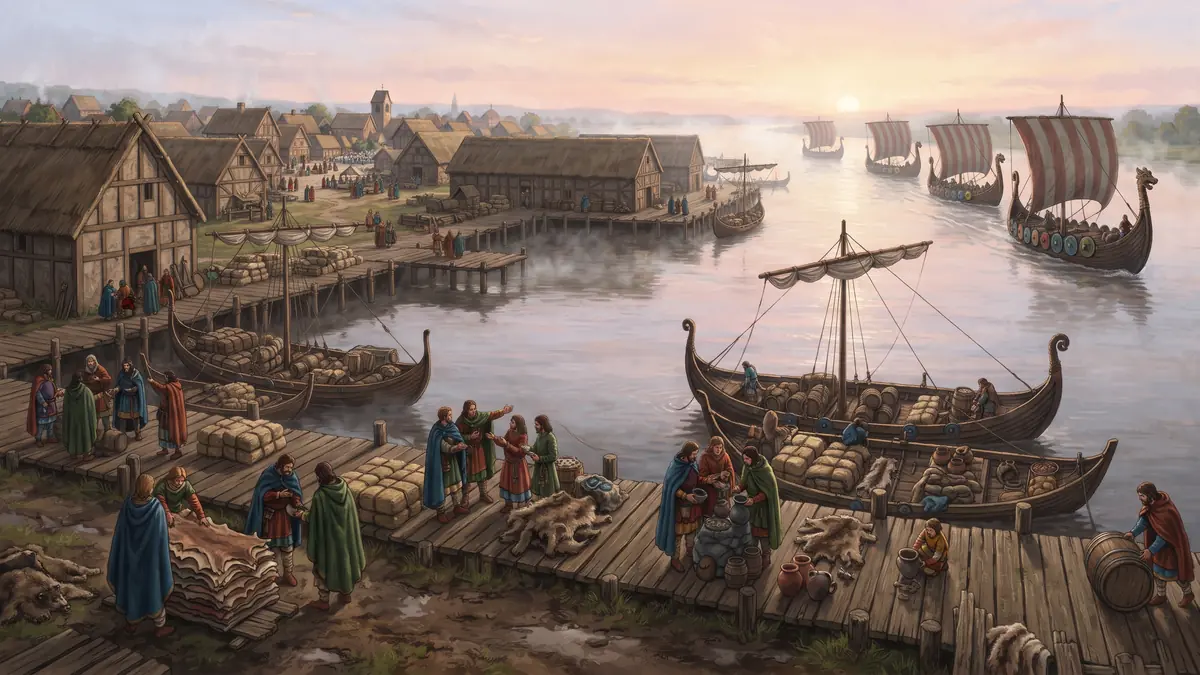
If the name Dorestad is less known than that of Lindisfarne, its commercial weight was far greater. It was the main trading hub between the North Sea and the Rhine hinterland, and that is why the Viking raids against it are so revealing.
The place
Dorestad stood on the western bank of the Lower Rhine, where the river splits into the Kromme Rijn and the Lek. Its remains lie under today’s Wijk bij Duurstede. It was the main clearing-house between the North Sea region and the hinterland of the Rhine and the Moselle, with links to England, southern Scandinavia and northern France.
Trade and coinage
At first, goods of low volume and high value arrived, such as oil, lead, tin and Frisian cloth. Later came honey, furs, amber, spices, ivory and garum. Frisian merchants dominated, but under the Franks, from the early 8th century, bulk goods came to be taxed. Gold coins of about 650 carry the inscription “Dorestat fit”, and silver ones, from about 800, the name “Dorestado”. Minting is said to have ceased by about 855.
The raids
The page lists raids in 834, 835, 836, 837, 846, 847, 850, 857 and 863. The Annales Bertiniani speak of the Northmen falling on Frisia “with their usual surprise attack” and record: “the Norsemen plundered Dorestad again”. The page argues that the attacks were political pressure and may have worked as a form of tribute, and observes that there is no archaeological evidence of sacking or burning.
What archaeology shows
The large excavations of the 1960s and 1970s revealed a ribbon settlement about 3 km long and 250 hectares, with an estimated 2,000 to 3,000 inhabitants. There was a two-metre road along the riverbank, jetties 6 to 7 m wide, some up to 200 m long, and rectangular merchants’ houses. Each merchant had a house, storage, quay, ship and well, with no communal storage.
The decline
No new jetty was built after the first quarter of the 9th century, and the town was abandoned by the end of that century. The main cause cited is the silting of the Lower Rhine. In 839, Lothair I granted western Frisia, including the Dorestad area, as a fief to the Viking warlord Rorik, which the page sees as a likely final blow. Some scholars argue that the Franks deliberately dismantled it, but this is presented as a thesis.
What can be said with care
The page disagrees with the common idea that the Vikings caused the fall of the town. The date of foundation, the origin of the name and the size of the population are also uncertain: the estimates are presented as estimates.
To swap neighbouring goods on the quay, joining three or more of a kind, until you reach the target before the swaps run out, play The quay of Dorestad.
Sources.
- Frisia Coast Trail, "The Batwing Doors of Dorestad. A Two-Way Gateway of Trade and Power" (trade, coinage, raids, archaeology and decline)
- *Annales Bertiniani* (quoted in the text above)
- Es, W. A. van and Verwers, W. J. H. (2010), "Early medieval settlements along the Rhine", listed as further reading