Huginn and Muninn: Odin's ravens, in the sources and in the finds
Two ravens fly every day over the world and return to tell Odin what they have seen. See what the Poetic Edda, the Prose Edda and the Heimskringla say about them, and what archaeology allows us to suppose.
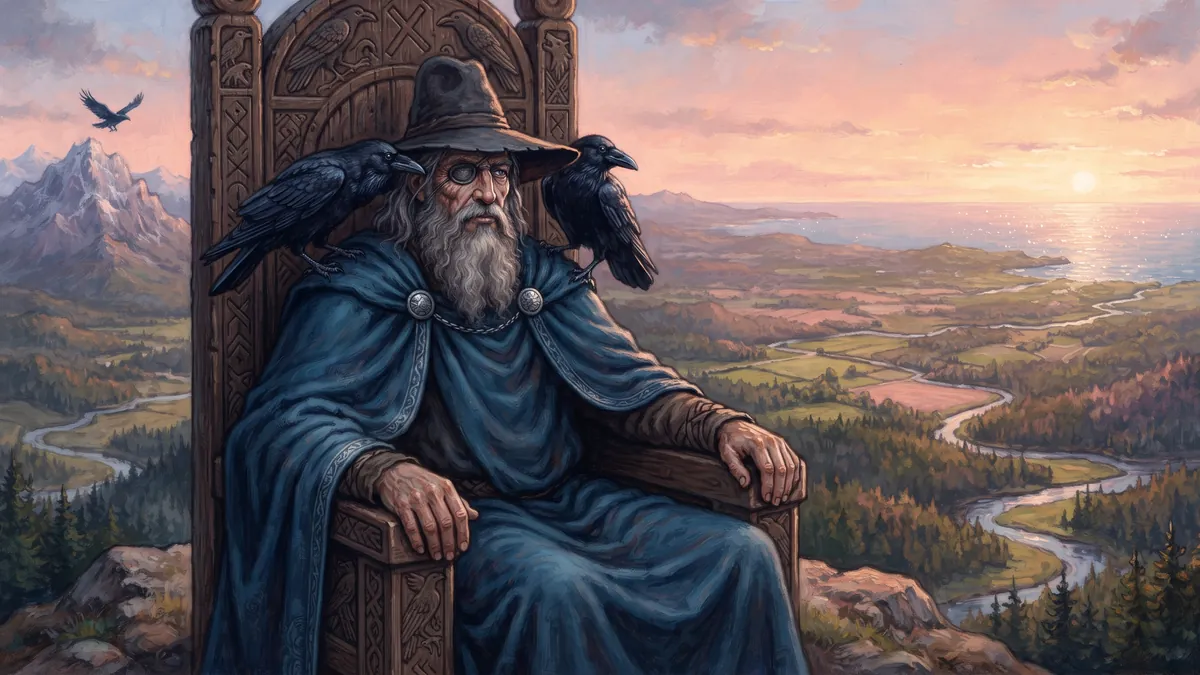
Few images from Norse mythology are as easy to recognise as Odin with two ravens on his shoulders. They are called Huginn and Muninn, and the medieval sources say less about them than one might imagine, but enough to show where the image comes from.
What the sources say
In the poem Grímnismál, of the Poetic Edda, Odin, disguised as Grímnir, says the ravens fly every day over Midgard. He fears Huginn may not return, and fears even more for Muninn. In the Gylfaginning (ch. 38) of the Prose Edda, the narrator called High explains that the ravens sit on Odin’s shoulders, tell him everything they see and hear, set out at dawn and return at dinner-time. From this comes the epithet “raven-god”. In the Ynglinga saga (ch. 7) of the Heimskringla, a humanised Odin has two ravens to which he gave speech; they fly over the land and bring him news, which makes him very wise. The Skáldskaparmál (ch. 60) lists both names among poetic names for ravens, and a verse in Óláfr Þórðarson’s grammatical treatise has Huginn seeking hanged men and Muninn slain bodies.
What the names mean
Huginn comes from hugr, which covers thought, perception, mood and desire. Muninn comes from munr, which covers care, intent, will, memory and curiosity. The names are close, something like “mind and will”, and the root of Muninn is related to English mind.
Images of birds beside Odin
There are many finds read as Odin with birds. On gold bracteates of the Migration Period, 5th to 6th century, a man on horseback with a spear appears beside one or two birds. On helmet plates of the Vendel era in Sweden, 6th and 7th centuries, a rider with spear and shield is flanked by two birds. The Bejsebakke brooches in Denmark form a pair in the shape of ravens, worn one on each shoulder. Fragments of the Oseberg tapestry show two black birds over a horse, and Anne Stine Ingstad read them as Huginn and Muninn above a cart with an image of Odin. A silver figure found at Lejre in 2009 shows Odin on a throne with two birds, which the Roskilde Museum identifies as the ravens.
What can be said with care
None of these readings is uncontested. Rudolf Simek thinks it unlikely that the names were coined before the 9th or 10th century and sees the ravens as derived from older raven symbolism, such as the raven banner. John Lindow proposes comparing them with the shaman’s trance journey. Anthony Winterbourne links them to guardian spirits in animal form. These are hypotheses, not conclusions.
To guide a raven between stones and trees, tapping to make it flap its wings, until it completes a round over Midgard, play A round over Midgard.
Sources.
- Wikipedia, "Huginn and Muninn" (primary sources, meaning of the names, archaeological finds and modern interpretations)
- *Poetic Edda*, "Grímnismál" (stanza on the ravens)
- Snorri Sturluson, *Prose Edda* (*Gylfaginning*) and *Heimskringla* (*Ynglinga saga*)