Joukahainen and Väinämöinen: the singing contest of the Kalevala
At the beginning of the Kalevala, a young man challenges the old singer Väinämöinen and ends up sinking into a bog. See what the page consulted says about the promise of the sister, the revenge and the origins of the name Joukahainen.
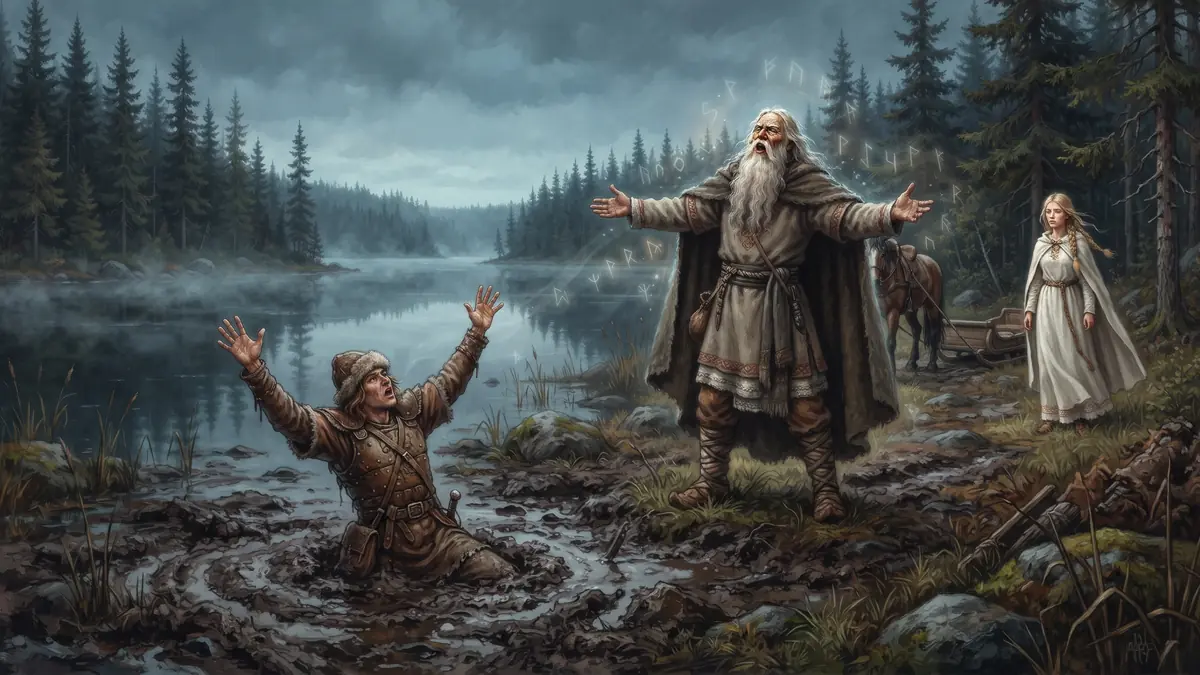
Before being a national poem, the Kalevala is a collection of scenes in which song counts for more than the sword. The most famous is the singing contest between the old Väinämöinen and the young Joukahainen.
The challenge
The page consulted tells that Joukahainen challenges Väinämöinen after the two collide with their horses. The contest is one of song, and Väinämöinen wins.
The bog
Väinämöinen sings Joukahainen into a mire, which swallows him. Trapped, the young man begs to be released and promises to give Väinämöinen his sister, Aino. The page does not list other offers, such as sword, crossbow or fields, which appear in other versions or passages.
Aino’s refusal
Aino refuses to marry Väinämöinen and drowns herself rather than accept. The sequence is a chain of consequences: a lost challenge leads to a promise, the promise to a death and the death to a revenge. To understand the weight of the scene, it is worth reading the article about her on this site, in which the same story is seen from the young woman’s perspective.
The revenge
Furious, Joukahainen ambushes Väinämöinen with a crossbow. He misses the target but kills his horse, and Väinämöinen falls into the icy waters of Pohjola. Väinämöinen’s mother tries to stop him. The page does not tell what happens after that.
The name and the readings
The page does not describe Elias Lönnrot’s compilation. It notes that John Martin Crawford’s English translation of 1888 anglicised the name as “Youkahainen”. Scholars have proposed different readings: Emil Nestor Setälä linked the name to Sámi words for snowfall and solidifying and saw Joukahainen as a god of ice and snow; Kaarle Krohn saw him as a human hero; Risto Pulkkinen called him a shaman of a swan clan.
What the contest shows
In the account, power lies in song: Väinämöinen uses no weapon, and the challenger is defeated by the sung word. Joukahainen’s revenge, by contrast, uses a crossbow, and it is the weapon that misses its target. This is a reading of the plot, not a statement of the source. Pohjola, the northern region where Väinämöinen falls, reappears in many other passages of the poem, as in the stories of Louhi and the Sampo, which the site also tells.
What can be said with care
The page does not give the numbers of the cantos (runot) in which the scene takes place, and so they are not given here. What the source supports is the sequence: challenge, song, bog, promise of the sister, death of Aino and ambush. The three readings of the name are hypotheses of scholars, not findings.
To return the ball in a duel, like a duel of songs, until you score seven points before your rival, play The duel of songs.
Sources.
- Wikiwand, "Joukahainen" (character of the *Kalevala*, name and interpretations)
- *Kalevala*, translated by W. F. Kirby (Project Gutenberg)