Sieidi: the sacred stones of the Sámi and the offerings left before them
Among the Sámi, rocks that stood out in the landscape were places of offering and respect. See what a research article says about two sieddit in Alta, the offerings and the role of the missionaries.
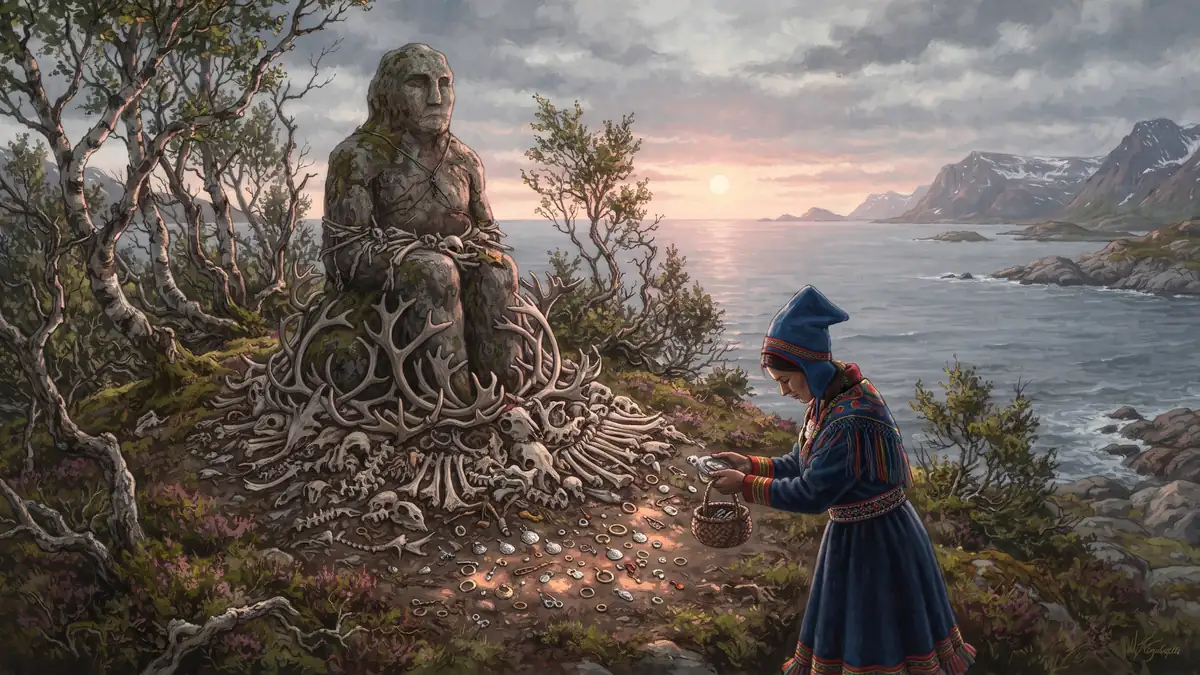
In many places in northern Scandinavia, a rock that stood out in the landscape was not just a rock. Among the Sámi, such formations were places of offering and respect, called in North Sámi sieidi (plural sieddit), tied to religious thought before Christianity.
What the article describes
The article consulted says that offerings were part of daily life, of life transitions and of the worldview. They took place where families lived, during hunting and fishing, and at specific sites for larger community ceremonies. Sieddit are often large blocks, sometimes split by ice or lightning, or other rock formations that stand out.
Two examples in Alta
Áhkku, “the Old Woman”, is a rock formation by the sea, on the Komsa promontory in Alta, about 7 to 8 m high, now partly hidden by birches. Fállegeađgi, “the Falcon Stone”, lies inland, on a plateau near the river Falkelva, and consists of three large boulders, one split by a narrow crevice. It lies on an ancient reindeer migration route.
The offerings
The article’s sources describe animal offerings, such as reindeer antlers and fish bones. Keilhau (1827) saw reindeer antlers and fish bones in front of Áhkku. Qvigstad, in the early 20th century, reported recently slaughtered reindeer calves and many antlers at Fállegeađgi. Other offerings continued into the 20th century and, in some places, until today: food, alcohol, tobacco, coins and small jewellery. Recent deposits at Áhkku and Fállegeađgi include toys, food wrappers, coins, antlers and reindeer remains.
Missionaries and sources
The lists of sites in use were gathered in the 17th and 18th centuries by priests and missionaries, whose main aim was, according to the article, “revealing and destroying them”. Among the early sources named are Niurenius (written 1640), Olsen (1715), Randulf (1723), Kildal (1730), Högström (1747) and Leem (1767). Missionary activity greatly reduced conspicuous animal offerings in the 17th and 18th centuries, but did not stop them entirely.
The research
The article cites, among later documentation, Qvigstad (1926), Hallström (1932), Manker (1957) and Mebius (1968, 1972), and, in more recent work, Äikäs (2015) on the sieddit and Salmi and colleagues (2015, 2018) on animal offerings, together with Äikäs and Salmi (2013) on coins and syncretism.
What can be said with care
The early sources copied one another and do not always make clear whether they describe the region where the author lived. They were also written by people who wanted to destroy these practices and may be biased. Practices varied greatly from place to place, so it is risky to speak of “the” sieidi as a uniform tradition. Some modern deposits are hard to interpret, and it is not known whether they continue a Sámi tradition.
To throw, adjusting the angle and the force, offering stones at the sacred stone, hitting it five times with eight stones, play The sacred stone.
Sources.
- *Religions* (MDPI), vol. 11, no. 7, art. 317 (2020), "Introduction" (sieidi, offerings, historical sources and modern research)
- Äikäs (2015), Salmi et al. (2015, 2018) and Äikäs and Salmi (2013), cited in the article
- Keilhau (1827) and Qvigstad (early 20th century), cited in the article, on Áhkku and Fállegeađgi