Åsgårdsreia: the Wild Hunt that Norway heard passing in midwinter
Ghost riders, barking hounds and a storm: this is the Wild Hunt, in the North called Åsgårdsreia or Oskoreia. See what is attested, and when, and how much of Grimm's thesis about Odin is hypothesis.
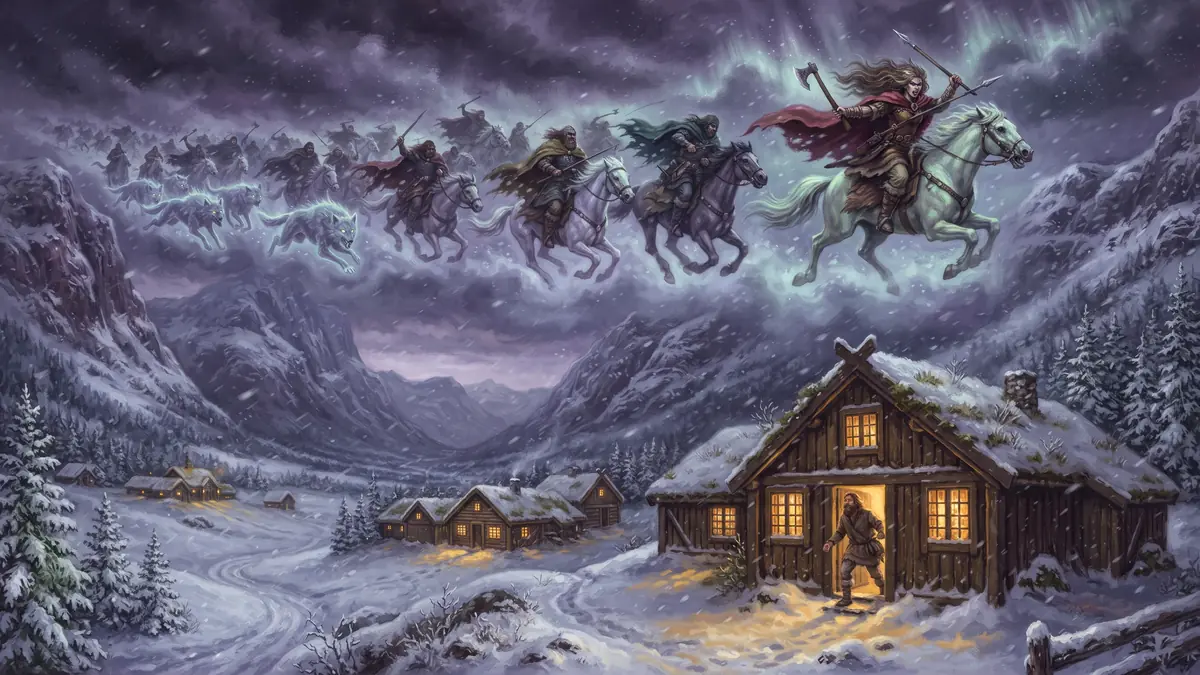
All over northern and western Europe, many people told that on certain nights a band of ghostly riders with hunting hounds passed through the sky. This is the Wild Hunt, and in the North it has names of its own. The source consulted lists, for Norway, Oskoreia, usually read as “the Asgard ride”, and Åsgårdsrei, attested in Trøndelag, besides Oensjægeren, “Odin’s hunters”, and, in Swedish, Odens jakt, “Odin’s hunt”, and Vilda jakten, “the wild hunt”.
The names
The origin of the first element of oskorei is debated: it may be Åsgard, oska, “thunder”, or Old Norse ǫskurligr, “dreadful”. A hypothetical form Ásgoðreið has been proposed. Only rei, “ride”, is beyond dispute. At the head of the band, in a ballad about Sigurd Svein, rides Guro Rysserova, “Guro Horsetail”, also called Guro Åsgard. In Scandinavia, the leader is Odin. Odin’s hunt was heard more than seen, and its signs were barking dogs and a change in the weather, sometimes war and unrest.
Earliest attestations
The oldest the article lists is from January 1091, by the English monk Orderic Vitalis, of St Evroul in Normandy, who reports a cavalcade he calls “Herlechin’s troop”. In 1127, the Peterborough Chronicle describes black huntsmen on black horses and goats, with jet-black hounds, seen near Peterborough and Stamford, for nine weeks. Around 1270, Alfonso X’s Estoria de España already speaks of the “Wild Hunt” in Spain.
Grimm’s thesis
Jacob Grimm, in Deutsche Mythologie (1835), popularised the term Wilde Jagd and argued that the leader was a survival of the god Wodan, who became a demonic figure, and that it was a “solemn march of gods” turned into a host of demons after Christianisation. The historian Ronald Hutton notes that twentieth-century folklorists criticised the method for ignoring the “dynamic and evolving nature of folklore”. Lotte Motz noted, in 1984, that the motif is concentrated in Germanic-speaking areas, and other scholars show similar motifs across northern, western and central Europe, which weakens the thesis of a pagan survival. Hans Peter Duerr (1985) said the sources do not show whether the hunt was a demonic reading of natural phenomena or a description of ritual processions.
Beliefs without a firm date
Some customs are recorded without certain dating, such as throwing bread and steel to ward off the hunt, in Småland and Älghult, and the belief that Odin travels in a one-wheeled cart. The painting Åsgårdsreien (1872), by Peter Nicolai Arbo, shows the hunt, but, according to the article, with Thor leading, not Odin.
What is hypothesis
The article marks as conjecture the link with Grimm’s thesis, the etymology of oskorei, Höfler’s theory (1934) of ritual warrior bands and the idea that medieval hunt legends shaped the witches’ sabbath, which Hutton says has been “fundamentally challenged”. The article does not describe a Norwegian Christmas tradition; it only notes that the Dutch Sinterklaas may have been influenced by the hunt, which is a theory.
To capture the rival’s pieces on a 6-by-6 board, as in a hunt through the night, play The Åsgårdsreia hunt.
Sources.
- Wikipedia, "Wild Hunt" (Scandinavian forms, earliest attestations, Grimm's thesis, scholarly debate)
- Orderic Vitalis (1091) and the *Peterborough Chronicle* (1127), cited in Wikipedia
- Jacob Grimm, *Deutsche Mythologie* (1835), Ronald Hutton, Lotte Motz (1984) and Hans Peter Duerr (1985), cited in Wikipedia