Beaivi: the Sámi sun, the daughter in a carriage of reindeer bones and the rings on the drums
Among the Sámi, the Sun is also a deity, tied to spring and reindeer. See what the article consulted says about Beaivi, the drums, the offerings and why several claims still lack a source.
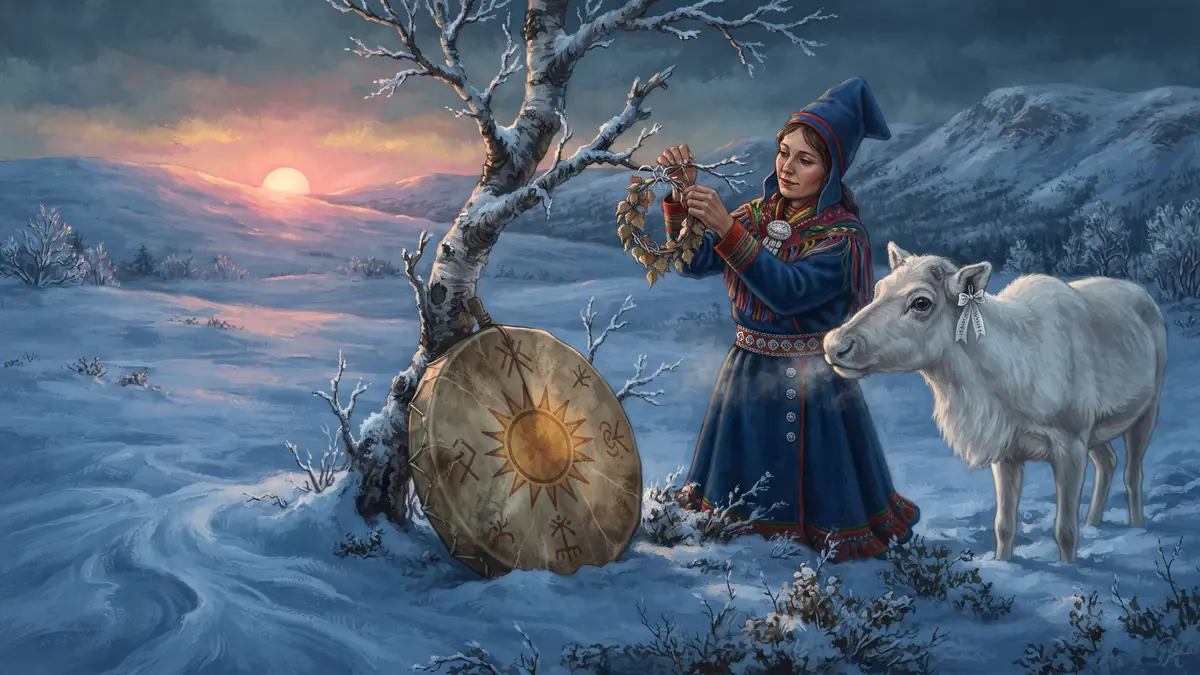
In Sámi religious thought, the Sun is not only a star: it is also a deity, and the same word serves for both. This is Beaivi, also written Beiwe, Bievve, Beivve or Biejje. The source consulted describes her as linked to the sun, spring and sanity, and to the fertility of plants and animals, especially reindeer.
Woman or man
The deity is female in southern Sápmi and male among the Skolts and on the Kola Peninsula. The article cites Samuel Rheen, who considered her the mother of all living things, but gives no year. The basic description rests on Herman Hofberg (1879), in Lapparnes hednatro, and Rafael Karsten (1952), in Samefolkets religion.
On the drums
On northern drums, the Sun appears as a circle near the top. On southern drums, it is a square in the centre with four lines spreading out, called “nealja beaiwe labikje”, the “four straps of the Sun”. The article cites Jelena Porsanger and the Encyclopaedia of Saami Culture, of the University of Helsinki, for the material on drums and myths.
The Sun’s family
When female, Beaivi travels across the sky with her daughter, Beaivi-nieida, in an enclosure covered with reindeer bones or antlers, bringing spring. When male, he goes with his wife, a Sámi woman. In the northern joik epic, the Son of the Sun, Beaivebártni, marries the daughter of a giant, and their sons, the Gállábártnit, are said to be the beginning of humanity. The article recalls that Gustaf von Düben recorded the myth of the first humans, Njáveš and Háhčeš.
The offerings
According to Holmberg (1915), the offerings aimed at light, warmth, reindeer fertility and prosperity, and also help against mental illness, summer headaches and getting lost. Butter was smeared on doorposts in the season of the sun’s return. Rings of leaves were pinned up at the summer solstice, and in Norway a “sun porridge” was eaten and offered. A twentieth-century account, from Eanodat, describes a cake of flour and reindeer blood hung on a birch at the turn of spring.
Sacrificed animals had to be female and, if possible, white, with a white string tied around the ear. Reindeer, sheep and goats were sacrificed, and parts of the body were threaded onto bent sticks or placed in birch rings, with other rings dipped in blood.
What the article marks as uncertain
Several sentences are flagged as “citation needed”: the importance of the sun cult in the north, the daughter travelling in the carriage of reindeer bones, prosperity as a purpose and the link between winter darkness and madness. The burning of more than 40 altars in Ofoten in 1722 by the missionary Sigvard Kildal, and a wooden pole in Norway, also appear with a “said to”. The custom of offering copper rings at a spring on New Year’s day could only have happened in the south, where the sun rises on that date, and that is the article’s own reasoning, not a source’s.
What can be said with care
The Sámi sun deity is described differently by region, period and recorder, usually missionaries and ethnographers. What the sources suggest is a Sun tied to life, spring and the reindeer; the rest calls for caution.
To touch the suns in order from 1 to 16, as fast as you can, play Beaivi’s suns.
Sources.
- Wikipedia, "Beaivi" (name, drums, Beaivi-nieida, offerings, white reindeer, sources)
- Holmberg (1915), Hofberg (1879), Karsten (1952) and Porsanger (Encyclopaedia of Saami Culture), cited in Wikipedia