Harald Hardrada: from the field of Stiklestad to the Varangian Guard and death at Stamford Bridge
Half-brother of the holy king Olaf, Harald fled wounded, served in Kiev and in Constantinople and returned to be king of Norway. See what each source says, and what scholars themselves mark as tradition.
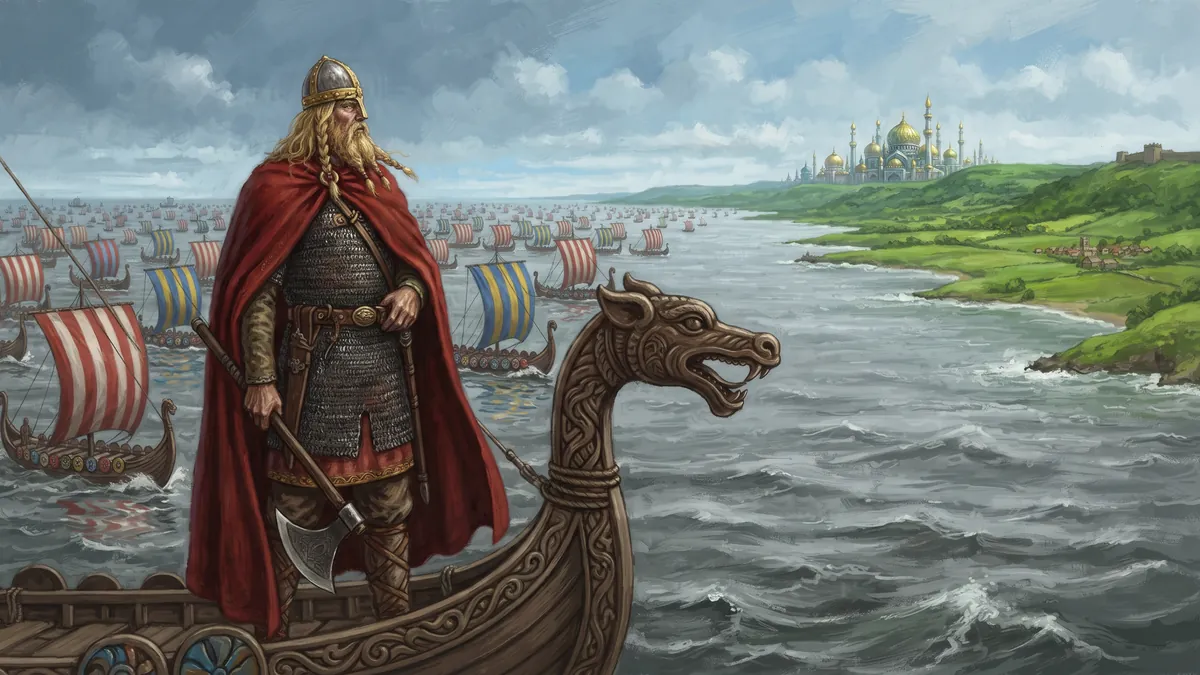
Few Norse kings lived a life of travel as long as Harald Sigurdsson, known as Hardrada. Born around 1015 in Ringerike, Norway, son of Åsta Gudbrandsdatter and the petty king Sigurd Syr, he went from battle to exile, to an emperor’s service and to the throne, and died invading England. The account below follows the source consulted, which marks carefully what is fact and what is tradition.
Stiklestad and the flight
At fifteen, Harald fought beside his half-brother Olaf Haraldsson at Stiklestad, on 29 July 1030. Olaf died, and Harald, wounded, escaped with help from Rögnvald Brusason, went to a farm in eastern Norway and passed into Sweden.
Kievan Rus’
About a year later he reached Rus’, probably Staraya Ladoga. Yaroslav the Wise made him a captain. Morkinskinna says the prince welcomed him mainly because he was Olaf’s brother. Harald probably took part in the campaign against Poland in 1031.
Byzantium
Around 1033 or 1034 he reached Constantinople with about five hundred men and joined the Varangian Guard. Snorri says he became “leader over all the Varangians”. The skald Þjóðólfr Arnórsson says he fought in eighteen great battles and took part in capturing eighty Arab strongholds. The article comments that Blöndal and Benedikz see no reason to doubt the figure of eighty, but that Harald probably did not hold independent command.
In Sicily, in 1038, under George Maniakes, he fought at Messina, Rometta and Syracuse. In 1041 he was present at the Byzantine defeats in Italy and Bulgaria, from where came the epithet “Bulgar-burner”, given by his skald. Kekaumenos, in the 1070s, calls him “Araltes” and says he received low court ranks, besides praising his loyalty to the empire.
As for Jerusalem, the sagas describe fighting, but Kelly DeVries questions the chronology, and the trip may have been peaceful. As for the imprisonment after the death of Michael IV in December 1041, the sources disagree on the reason: treasure fraud, assault on a noblewoman or murder. Morkinskinna says a rich widow helped him escape in 1042. The blinding the sagas attribute to Michael V was probably carried out by Harald as an officer of the guard.
King of Norway
He married Elisiv, daughter of Yaroslav, around 1044 or 1045. He returned through Sweden, reaching Sigtuna in late 1045 or early 1046, and in 1046 agreed to rule jointly with Magnus the Good. Magnus died in 1047, and Harald kept Norway. He made war on Sweyn Estridsson in Denmark almost every year until 1064, or 1065 according to Morkinskinna; he sacked Hedeby in 1049 and won the naval battle of Nissa on 9 August 1062.
The epithet
“Harðráði” is usually rendered “Hardrada”. Its meaning is debated: hard in counsel, severe, tyrannical. Judith Jesch calls the form “Hardrada” a “bastard Anglicisation”, and older sources from the British Isles use “Fairhair”. The article says it is unclear whether the nickname was used in his lifetime.
1066
Tostig Godwinson invited him to invade England. On 20 September 1066, at Fulford, he defeated Earls Morcar and Edwin, and York surrendered on 24 September. On 25 September, at Stamford Bridge, Harold Godwinson surprised him, and Harald was killed by an arrow to the throat. The article estimates his forces at ten to fifteen thousand men and marks the berserker and the single defender of the bridge as tradition.
What is tradition
Among the points the article treats as uncertain are the descent from Harald Fairhair, the marriage to a “Maria”, the trip to Jerusalem and the blinding of Michael V.
To trap a fox on a cross-shaped board with thirteen geese, without letting it eat too many, play The fox and the geese.
Sources.
- Wikipedia, "Harald Hardrada" (birth, Stiklestad, Rus', Varangian Guard, reign, 1066, sources and epithet)
- *Heimskringla* (Snorri Sturluson) and *Morkinskinna*, as reported by Wikipedia
- Kekaumenos, *Strategikon* (1070s), as reported by Wikipedia