Njörðr: the god of the sea and wealth who married Skaði and could not stand the mountains
Among the Vanir, Njörðr is the lord of wind, sea and fishing. See what the Norse sources say about him, the failed marriage to Skaði and the exchange of hostages with the Æsir.
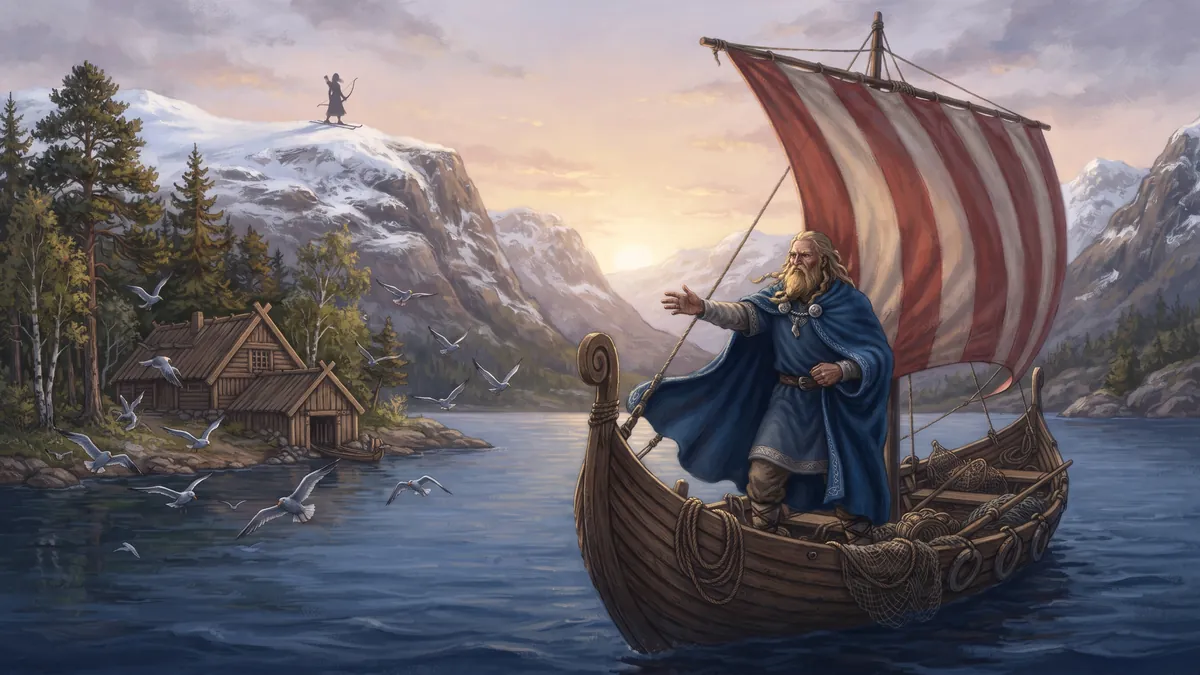
Few Norse gods have a territory as clear as Njörðr’s. According to the source consulted, he is linked to the sea, seafaring, fishing, wind, wealth and the fertility of crops. He belongs to the Vanir and lives at Nóatún, a name that points to ships. At the same time, the sources show a god who came from outside and never quite fitted in among the Æsir.
What the sources say
In the Poetic Edda, Grímnismál (stanza 16) places Njörðr’s hall at Nóatún and calls him a “prince of men” without malice. Vafþrúðnismál counts him among the survivors of Ragnarök. In Lokasenna he and Loki trade insults, and Þrymskviða calls Freyja the daughter of Njörðr.
Snorri Sturluson, in Gylfaginning (ch. 23), says he rules the course of the winds and calms sea and fire, and that he should be invoked for sailing and fishing. He adds that Njörðr is so rich that he can give land and goods to those who ask. In Heimskringla, Ynglinga saga presents him as a priest of the sacrifices by Odin’s choice and, after Odin’s death, as king of the Swedes; he dies in his bed, and his son Freyr succeeds him. In the saga of Håkon the Good, the Yule toast to Njörðr and Freyr asks for good harvests and peace.
The hostage
According to Ynglinga saga (ch. 4), after the war between Æsir and Vanir the two sides exchange hostages: the Vanir send Njörðr and Freyr, and the Æsir send Hœnir. Gylfaginning says Njörðr is not descended from the Æsir but comes from Vanaheimr. In Lokasenna (stanza 34), Loki taunts him precisely for having been sent east as a hostage.
The marriage to Skaði
Skáldskaparmál tells that Skaði, daughter of the giant Þjazi, could choose a husband from among the gods by looking only at their feet. She hoped to pick Baldr and ended up with Njörðr. According to Gylfaginning, she wanted to live at Þrymheimr, her father’s home, while he preferred Nóatún, near the sea. The deal was nine nights in one place and three in the other; the Codex Regius version speaks of nine winters in each.
Njörðr returned to Nóatún complaining that the mountains were hateful to him and that the howling of wolves sounded ugly beside the song of swans. Skaði answered that she could not sleep on the sea bed because of the screeching of the birds, and that a gull woke her every morning. She went back to the mountains, where she skis and hunts. Ynglinga saga (ch. 8) gives another version: she refused to lie with him and later married Odin.
Children and contradictions
Freyr and Freyja are children of Njörðr and his sister, whom the sources do not name. Ynglinga saga says such a union was accepted among the Vanir and forbidden among the Æsir. Skírnismál (stanza 2), however, names Skaði as Freyr’s mother, which contradicts the story of the sister. Sólarljóð also gives Njörðr nine daughters by an unknown mother.
The name and the debate
The name comes from Proto-Germanic *Nerþuz. Many scholars link it to Nerthus, the goddess described by Tacitus in the Germania, in the first century. The article records that the shift from feminine to masculine is explained in two ways, one grammatical and one religious, and that some see two different beings in the two names. Place names with the god’s name appear in Sweden, Norway and Iceland, such as Njarðvík.
What can be said with care
Almost everything we know comes from texts written in the thirteenth century, centuries after the conversion. What comes from the sources is the outline of a god tied to the sea and to wealth; the rest, such as an old popular devotion, is hypothesis.
To roll dice risking the gain of a voyage, banking your points in harbour before reaching 50, play The harbour dice.
Sources.
- Wikipedia, "Njörðr" (attestations in the Poetic Edda, the Prose Edda and Heimskringla; marriage to Skaði; etymology; scholarly debate)
- *Gylfaginning* (ch. 23) and *Skáldskaparmál*, by Snorri Sturluson, as reported by Wikipedia
- *Ynglinga saga* (chs. 4 and 8), in *Heimskringla*, as reported by Wikipedia