Sigtuna: Sweden's first real town, with coins, aligned plots and more than 40 runestones
Founded around 980 on the shore of Lake Mälaren, Sigtuna replaced Birka and minted the first Swedish coins. See what the articles consulted say about its streets, crafts, runes, churches and the origins of its inhabitants.
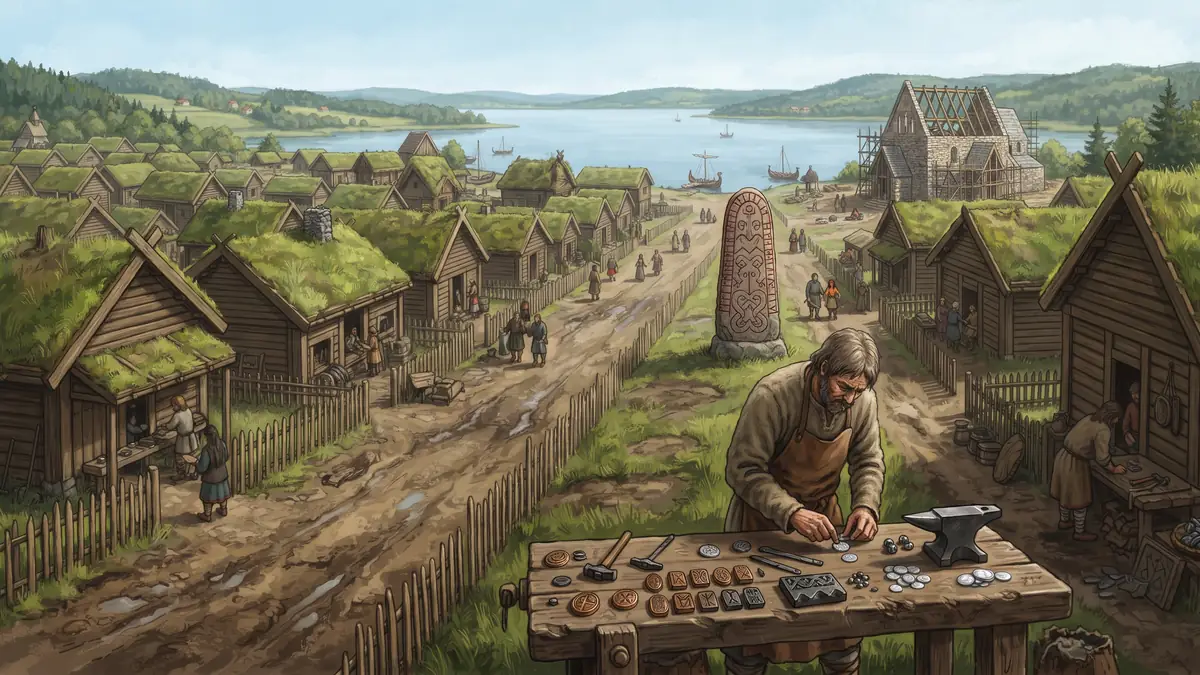
Before Stockholm, the most important town on Lake Mälaren was Sigtuna. Founded around 980, it is described by the medieval.eu article consulted as “the first proper town in medieval Sweden”. Tree-ring dating of some central buildings, dendrochronology, points to 981.
From the lake to Birka
Birka was abandoned between 960 and 970, and the article thinks Sigtuna was probably its successor, with the role of controlling access to Uppland. It lies about 30 km from Gamla Uppsala and Birka, on the northern coast of the Mälaren archipelago. A royal complex at Fornsigtuna, about 4 km to the west, dates from 750–800 and is seen as a forerunner. On who founded the town, the source consulted notes that the sources cite Eric the Victorious or Olof Skötkonung; the medieval.eu article calls these sources vague and conflicting and mentions hypotheses such as Harald Bluetooth or a magnate called Skagul Toste.
The first coins
Olof Skötkonung, son of Eric, minted there what the article calls the first Swedish coins. The mint was excavated in the 1990s, with at least 200 dies identified. The dates given for the coinage vary, 995–1015 and c. 995–1030, within the same article. The author estimates millions of coins and a few tons of silver, perhaps from Danegeld paid in England, but with uncertainty. The English design suggests the mint masters came from there, and the earliest coins call him “King of Sigtuna” before “King of the Swedes”.
Streets and plots
Long, regular plots of 20 to 40 metres lay on either side of the main street, with alleys of 1.5 to 2.5 metres. More than 180 houses have been demonstrated by archaeology. Around 1050, the halls moved to the back of the plots, with workshops and smaller houses at the front. The earliest buildings were half-timbered, and later ones log-built with turf roofs. The author sees in this regular layout a sign of planning. Baltic Ware ceramics appear from about 1010, which some attribute to potters from Kiev, something the article marks as hypothesis.
Stones and runes
More than 40 runestones or fragments have been found, and about 17 still stand, mostly along the path to a presumed assembly on a hill. Two mention members of a “Frisian Guild”, Albod and Torkel, whom the article says were Scandinavian tradesmen. A runic inscription on a bone, from about 1100–1200, says: “The King is generous with food”.
Churches and bishopric
The first services were held in the halls of the plots. About 25 burial grounds, to the north, held about a thousand graves from 980 to 1050. Six or seven stone churches came later along Prästgatan. In 1064, Adalvard the Younger is recorded as the first Swedish bishop in Sigtuna, and in 1070 Adam of Bremen called it a “Civitas Magna”. In 1164 an independent archbishop was appointed at Uppsala. The ruins of St Per, St Olof and St Lars still exist; St Lars is regarded by some as the cathedral, which is disputed.
Who lived there
A study of about 38 people buried in six Christian cemeteries, using DNA, bones and strontium isotopes in teeth, concluded that about half came from outside the Mälaren region, from places such as Norway, the British Isles, Germany and Ukraine. The researchers speak of a “cosmopolitan” population. The text notes that cremated dead cannot be analysed, so the sample covers only Christian burials, and that it is not known whether the migrants were servants, slaves or traders.
What can be said with care
The source consulted says that in 1187 raiders from the Baltic pillaged the town, but excavations have not verified the destruction. In the thirteenth century the town lost importance, partly because the land rose and navigation became difficult.
To sort what arrives at the workshop, sending each piece to the left or to the right, play Sigtuna’s workshop.
Sources.
- medieval.eu, "Sigtuna – a powerful political and cultural centre in Sweden c. 980–1200" (foundation, coins, plots, runes, churches, population)
- Ancient Origins, "First Swedish City was Metropolis of Viking-Era Immigrants" (DNA and isotope study of about 38 individuals)
- Wikipedia, "Sigtuna" (location, church ruins, decline, 1187)