Thorfinn the Mighty: the earl of Orkney who, according to the saga, became earl at five
The Orkneyinga saga makes Thorfinn Sigurdsson a warrior earl with lands in Scotland. See what the page consulted separates between what the saga says, what other sources confirm and what historians debate.
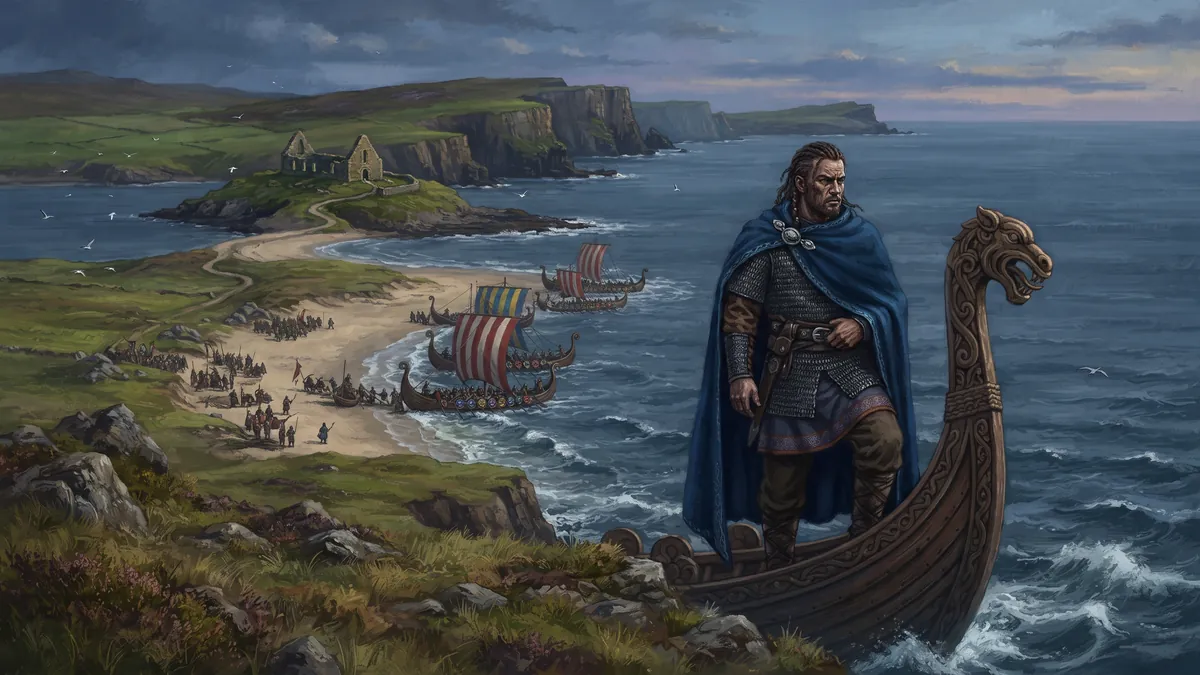
Thorfinn Sigurdsson, son of Earl Sigurd Hlodvirsson, is one of the most colourful figures in the Orkneyinga saga, written in Iceland in the early thirteenth century. The saga presents him as a strong earl, a warrior and a traveller. The source consulted is careful to separate what the saga tells from what other sources confirm.
The child who became an earl
Thorfinn was the youngest of five sons of Sigurd and the only one of his marriage to a daughter of Malcolm II, king of the Scots. According to the saga, Sigurd died at the battle of Clontarf, on 23 April 1014, a date the article calls reliable. Before that, the five-year-old boy was sent to his maternal grandfather, who fostered him. After Clontarf, the half-brothers Einar and Brusi divided Orkney and Shetland, and Malcolm gave Thorfinn lands in Caithness and Sutherland, with Scottish advisers.
The article points out a problem: if Thorfinn was five in 1014, he would have been about eleven in 1020, too young for what the saga tells. Historians therefore assume an earlier birth, which is inference, not documented fact.
A divided realm
Sumarlidi died in bed, probably by 1018. Einar died in 1020, killed by Thorkel Fosterer, Thorfinn’s foster-father. King Olaf Haraldsson took a third of the islands, and the Icelandic annals record the submission in 1021. After Stiklestad, in 1030, Brusi gave the king’s third to Thorfinn, and when Brusi died, between 1030 and 1035, Thorfinn ruled alone.
“Karl Hundason”
The saga tells that a king of the Scots, Karl, claimed Caithness and that Thorfinn defeated him in a sea battle off Deerness and then at “Torfness”, probably Tarbat Ness, before marching to Fife. The historian Thomson dates the conflict to 1029–1035. Karl’s identity is unresolved: Duncan I, Malcolm, Macbeth and even a nephew of Thorfinn have been proposed. Anderson called the story “fabulous”, and Muir notes that the name means something like “son of a dog”, so it would not be a real name. The patronymic “Hundason” is an addition by the saga author; the verses of the skald Arnór jarlaskáld call the enemy only “Karl”.
Rögnvald and the end of the dispute
Around 1037, his nephew Rögnvald Brusason returned with the support of Magnus the Good, and the partnership turned into war. The saga tells that Rögnvald was killed by Thorkel Fosterer, betrayed by the barking of his dog. Thomson calls the narrative “saga fiction” with stock episodes.
Church, Rome and death
Thorfinn was raised a Christian. The saga says he travelled to Rome and met Emperor Henry III, probably from 1048, and Crawford suggests that the “legate” from Orkney in Adam of Bremen is himself. The saga also says he founded Christ Church at Birsay, where he had his residence and was buried. On the date of his death, the article cites several guesses, between 1058 and 1074, and finds the late 1050s or about 1064 more plausible. His sons Paul and Erlend succeeded him.
What can be said with care
The article considers the saga “generally credible” but hard to corroborate in its details, and written centuries after the events. Clontarf, the submission to Olaf in 1021 and the death of Gillacomgain, in 1032, in the Annals of Ulster, have support in other sources. The marriage to Ingibiorg and the campaign in Fife, on the other hand, are treated as saga.
To carry a ray of light from one beacon to the other, turning mirrors, play Thorfinn’s mirrors.
Sources.
- Wikipedia, "Thorfinn the Mighty" (parents, rule, Karl Hundason, Rögnvald, Rome, death, "tradition vs. corroboration" table)
- *Orkneyinga saga* and *Heimskringla* (Saint Olaf's saga), as reported by Wikipedia
- Thomson (2008), Woolf (2007), Muir (2005) and Crawford (1987), cited in Wikipedia