Torksey, 872–873: the winter camp of the Great Army that looked like a town on the move
In Lincolnshire, detectorists and archaeologists found more than a thousand objects in a field where the Great Army spent the winter. See what the University of Sheffield and Archaeology magazine say, and where the figures differ.
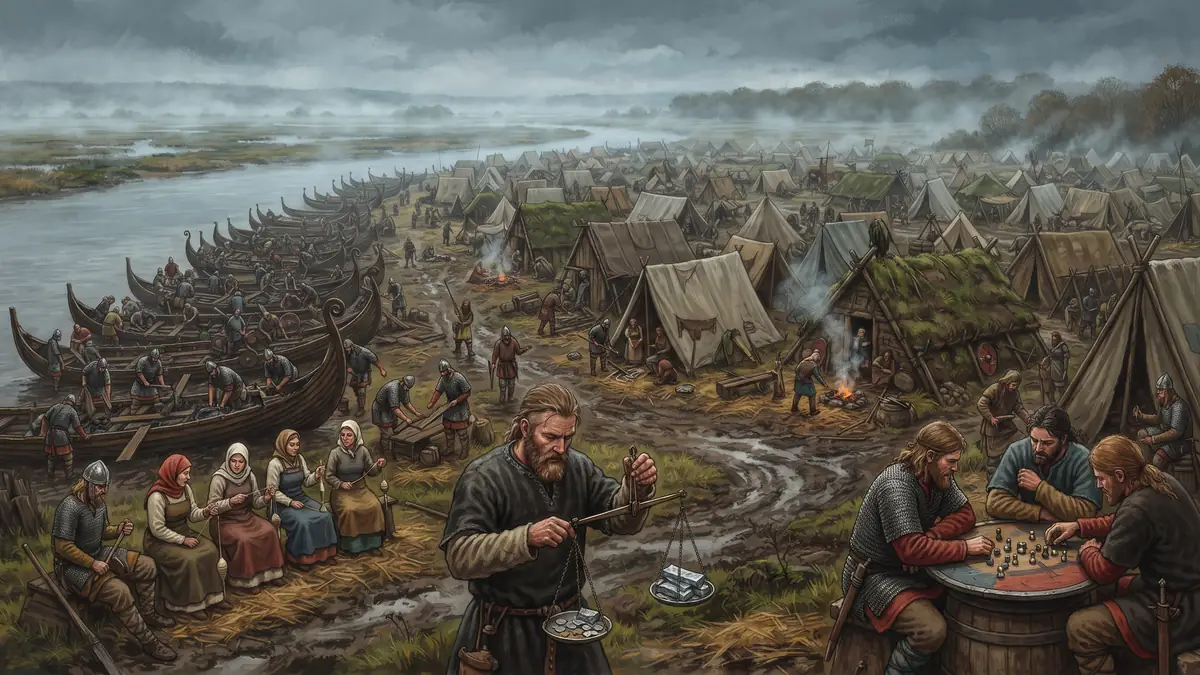
During the winter of 872–873, the Great Army, the Viking force attacking England, halted on the banks of the River Trent, at Torksey, Lincolnshire. What archaeologists found there, largely through amateur detectorists, helps us see the camp as more than a military base. The two sources consulted, the University of Sheffield, via ScienceDaily, and Archaeology magazine, agree on the essentials and differ on some numbers.
The place
According to the University of Sheffield, the camp was at least 55 hectares, bigger than many towns of the time, including York. Archaeology speaks of about 136 acres, some 55 hectares, spread over six present-day fields, on the east bank of the Trent, north of the village of Torksey. In the ninth century it was a natural island, ringed by the river and marsh.
Who was there
Dawn Hadley (University of Sheffield) and Julian Richards (University of York) lead the project. According to them, there were thousands of warriors, but also women, children and people who traded and manufactured. Richards says the activity across the fields indicates a force “at least in the thousands”, with great organisation, and Hadley calls the place “almost like a town on the move”.
What was found
The University of Sheffield speaks of more than a thousand finds, among them more than 300 coins, with more than 100 Arabic silver dirhams, more than 50 pieces of chopped silver and rare “hackgold”, more than 300 lead gaming pieces, iron tools, spindle whorls, needles and fishing weights. Archaeology speaks of more than 120 dirhams, many cut up, and says Torksey has the largest concentration of dirhams in Britain or Ireland, at least 60 pieces of hacksilver and a dozen of hackgold, and several hundred weights. The difference in the counts shows that figures change with the year of the research.
What the camp shows
The Vikings repaired ships, melted looted silver and gold into ingots for trade, manufactured, traded, feasted and played games. Spindle whorls and textile tools suggest the presence of women, but Archaeology says it cannot be known whether they were Scandinavian women who came with their families or captives. Three iron ploughshares may be scrap or show plans to seize agricultural estates, according to Richards.
Jane Kershaw, of the University of Oxford, doubts the locals would have traded willingly and thinks trade was mostly among members of the army, possibly coerced. Hadley and Richards allow for some trade with the Anglo-Saxons.
From plunder to control
Richards recalls that earlier the Vikings attacked coastal monasteries and returned to Scandinavia in winter. In the late ninth century they came in larger numbers and stayed, which he sees as a sign that they meant “to control and conquer”. Archaeology notes that the Anglo-Saxon Chronicle describes the army in exaggerated terms, with thousands dead in one day’s battle against Wessex.
And Repton
The following winter, 873–874, the army was at Repton, where excavations from 1974 to 1993 found a small, heavily defended enclosure. Around a charnel mound, at least 264 people, mostly adult males, were radiocarbon-dated to that winter. Cat Jarman, of Bristol, suggests the army repaired ships there and prepared for the next season’s attacks.
What can be said with care
The picture of Torksey comes from detector finds, not from the excavation of a whole town, and the number of people is an estimate. Even so, the gaming pieces, balances and cut coins show an army that manufactured, measuring silver, and amused itself in winter.
To find, among similar pieces, the one that is different, in ever harder rounds, play Torksey’s odd piece.
Sources.
- University of Sheffield, via ScienceDaily (18 May 2017), on the Torksey camp (Hadley and Richards, *The Antiquaries Journal*, 2016)
- Archaeology, "The Viking Great Army" (March–April 2018 issue)
- Dawn Hadley (Sheffield), Julian Richards (York), Jane Kershaw (Oxford) and Cat Jarman (Bristol), cited in both pieces