Ullr: the god of skis and the bow, of whom almost no stories remain
Ullr has a hall of yews, a shield that is a "ship" and dozens of place names, but hardly any myth. See what the sources say and what scholars propose to fill the gap.
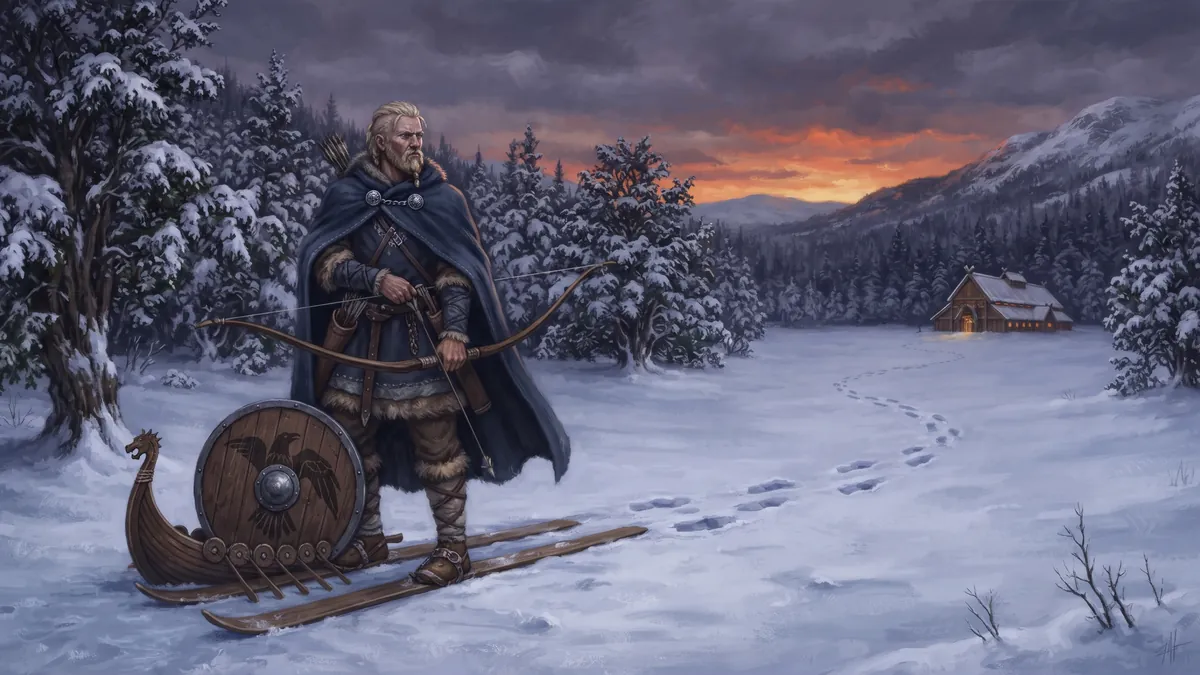
Ullr is one of the most curious cases in Norse mythology: a god whose name is scattered across dozens of places in Norway and Sweden and who has almost no stories. What the sources show is a god tied to snow, the bow, hunting and perhaps the sun, with more clues than plot.
Sif and Thor
According to the source consulted, Snorri Sturluson, in Gylfaginning (ch. 31), says Ullr is the son of Sif, with a father who is not named. That makes him Thor’s stepson, and skaldic poetry confirms the relationship: the poem Haustlöng, Eilífr Goðrúnarson’s Þórsdrápa and a fragment by Eysteinn Valdason call Thor Ullr’s stepfather.
What the poetry leaves
In Grímnismál, Ullr’s hall is called Ýdalir, “yew dales”, a name that appears nowhere else. Since yew was used to make bows, and ýr, “yew”, can mean bow, the article sees a link between the god and the bow as likely. Another stanza of the same poem mentions him in an obscure, possibly ceremonial context. In Atlakviða he is tied to oaths sworn on a ring. The article notes that these two poems are the only Eddic ones that mention him and that many consider them among the oldest.
In Skáldskaparmál, Snorri lists kennings that call Ullr the god of skis, bow, hunting and shield. A shield can be “Ullr’s ship”, in expressions such as askr Ullar and far Ullar, of unknown origin. One hypothesis is that the first skis or sledges looked like shields. The article notes that Snorri tells no myth about him, perhaps because he knew none.
Outside the written Norse world
Saxo Grammaticus, in the twelfth century, speaks of an Ollerus, a cunning wizard who supposedly ruled in Odin’s place for ten years when Odin was exiled. It is a euhemerised version, treating the god as a man. Earlier, a third-century inscription on the Thorsberg chape, owlþu-þewaz, may attest the name, as “servant of Owlþuz” or “he who has glorious servants”.
The place names
Place names are the strongest part of the evidence. They appear in Norway and Sweden, not in Denmark or Iceland: Ullern, Ullensvang, Ullinsakr, Ullevi, Ultuna and many others. At Lilla Ullevi, in the Stockholm region, excavations found a cult site associated with the name, with about 65 amulet rings nearby. The article marks the origin of some names, such as Ullsfjorden, as uncertain.
The name
Ullr comes from Proto-Germanic Wulþuz, “glory”, linked to Latin vultus and to Celtic terms that revolve around “seeing”. The meaning is thought to have shifted from “appearance” to “glory, wealth”.
What is proposed, and how cautiously
Some scholars see in Ullr an old god whose importance declined before northern Norway was settled, and others link him to a sky god, to Njörðr, or even to the Vanir. The article presents all of this as proposals. On Viktor Rydberg’s hypothesis that Ullr ruled the Vanir in the war with the Æsir, Rudolf Simek says it “has no basis in the sources whatsoever”.
Today the god has become a patron of skiers, with medallions and even a week-long festival in Breckenridge, in the United States, since 1963. That is modern reception and has nothing to do with the ancient sources.
To slide across the ice, unable to stop halfway, until you reach the marker in few moves, play Ullr’s ice.
Sources.
- Wikipedia, "Ullr" (etymology, attestations, place names, theories)
- *Gylfaginning* (ch. 31) and *Skáldskaparmál*, by Snorri Sturluson, as reported by Wikipedia
- Molin (2015), de Vries (1970b, 1977) and Simek (1993), cited in Wikipedia