Frigg: Odin's wife who made everything swear to spare Baldr, except one thing
Frigg is Odin's wife, Baldr's mother and the lady of the hall Fensalir. See what each source says about her, from Paul the Deacon to the Prose Edda, and where scholars admit doubt, especially about the link with Freyja.
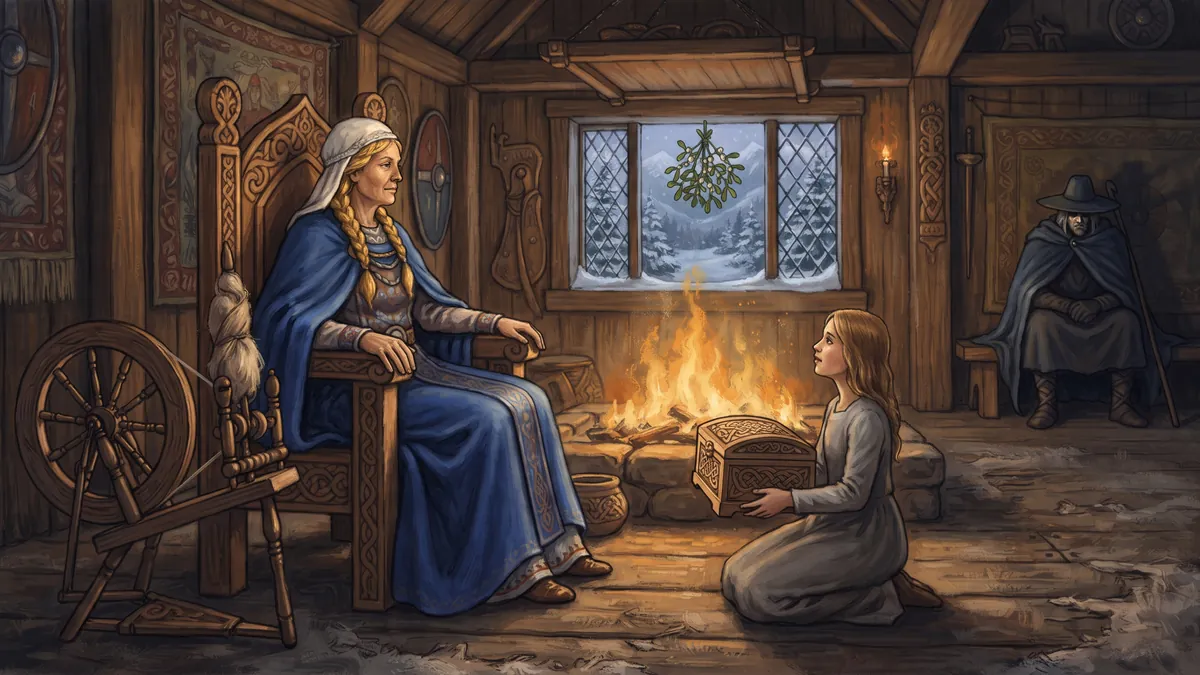
Among the goddesses of the North, Frigg is the hardest to see up close. She appears in many sources, almost always beside someone else: her husband Odin, her son Baldr, Loki’s band. The source consulted describes her as Odin’s wife, Baldr’s mother and the chief of the ásynjur, the goddesses of the Æsir.
The name and Friday
The name Frigg, in Old Norse, has relatives in Frija, in Old High German, in Frea, among the Lombards, and in Frige, in Old English. All come from a feminine form of Proto-Germanic frijaz, tied to Sanskrit and Avestan words meaning “own, dear”. Hence Friday: in English it is “Frige’s day”, and Old High German had frîatac. The article says both day names arose when the Germanic peoples translated the Latin dies Veneris, “day of Venus”, around the third or fourth century.
The Lombards
The oldest source where she appears with some plot is the Origo Gentis Langobardorum, from the seventh century, taken up by Paul the Deacon in the eighth. There, Frea, wife of Godan, advises the Winnili people. She has Godan’s bed turned to face east, and the Winnili become the Lombards, the “long-beards”. The Second Merseburg Charm, from a tenth-century manuscript, calls on Frija and Volla to heal Baldr’s horse.
In the Poetic Edda and the sagas
In the Völuspá, Frigg is named three times: she weeps for Baldr in Fensalir, Odin is the “beloved of Frigg” and his death is the “second grief of Frigg”. In the prose introduction to the Grímnismál, Odin and Frigg wager, from the seat Hliðskjálf, on two foster sons, Agnar, aged ten, and Geirröðr, aged eight. Frigg sends her maid Fulla to warn Geirröðr about a wizard, Grímnir, whom he then tortures for eight nights. In the Lokasenna she trades insults with Loki. In the Ynglinga saga, by Snorri, the brothers Vili and Vé take Frigg while Odin is travelling, and he takes her back on his return. In the Völsunga saga, she hears the prayers of the childless king Rerir and tells Odin.
The Prose Edda and the death of Baldr
In the Gylfaginning, Frigg is the daughter of Fjörgynn, the highest of the ásynjur, after whom only Freyja ranks, and she lives in Fensalir. Baldr has bad dreams, and Frigg obtains oaths from fire, water, iron, stones, diseases and animals that they will not hurt him. She only left out the mistletoe, which she judged too young. Loki finds out and gets the blind Höðr to throw a sprig of mistletoe at Baldr, who dies. Frigg asks who will ride to Hel to ransom him. The attempt fails through sabotage at a cave called Þökk, perhaps by Loki in disguise. Nanna sends Frigg a linen robe, and Fulla a ring.
The handmaidens
Snorri lists Frigg’s servants. Fulla carries her ash-wood box, looks after her shoes and keeps her secrets. Lofn has leave to join men and women together. Hlín protects those Frigg wishes to keep from danger. Gná carries messages through various worlds.
Frigg and Freyja
Some scholars see a special link between the two because of what they share, and some propose that they were a single goddess in Proto-Germanic times. The name Freyja is only doubtfully attested outside Scandinavia, while Frigg’s is reconstructed for the Germanic peoples in general. The article cites Stephan Grundy, who calls the question “a difficult one”, and says that the few sources from before the Viking Age make it harder to answer.
What remains uncertain
Frigg’s association with the Earth is ambiguous, since Jörð is personified separately. The folk etymology that ties her to “Frigida”, from Snorri’s prologue, is not a correct derivation. And almost everything we know comes from texts written centuries after the cult, by Christians.
To find the matching pairs among turned-over pieces, in few tries, play Frigg’s pairs.
Sources.
- Wikipedia, "Frigg" (names, Friday, Origo Gentis Langobardorum, Paul the Deacon, Merseburg, Poetic Edda, Prose Edda, Ynglinga saga, Völsunga saga, handmaidens, Frigg and Freyja)
- Snorri Sturluson, Prose Edda (Gylfaginning and Skáldskaparmál), cited in the article