The Vale of York Hoard: 617 silver coins found by father and son with a metal detector
On 6 January 2007, near Harrogate, David Whelan and his son Andrew found, 30 cm deep, a Viking hoard of 617 coins and 65 other items. See what the source consulted gathers and what nobody knows about who buried it.
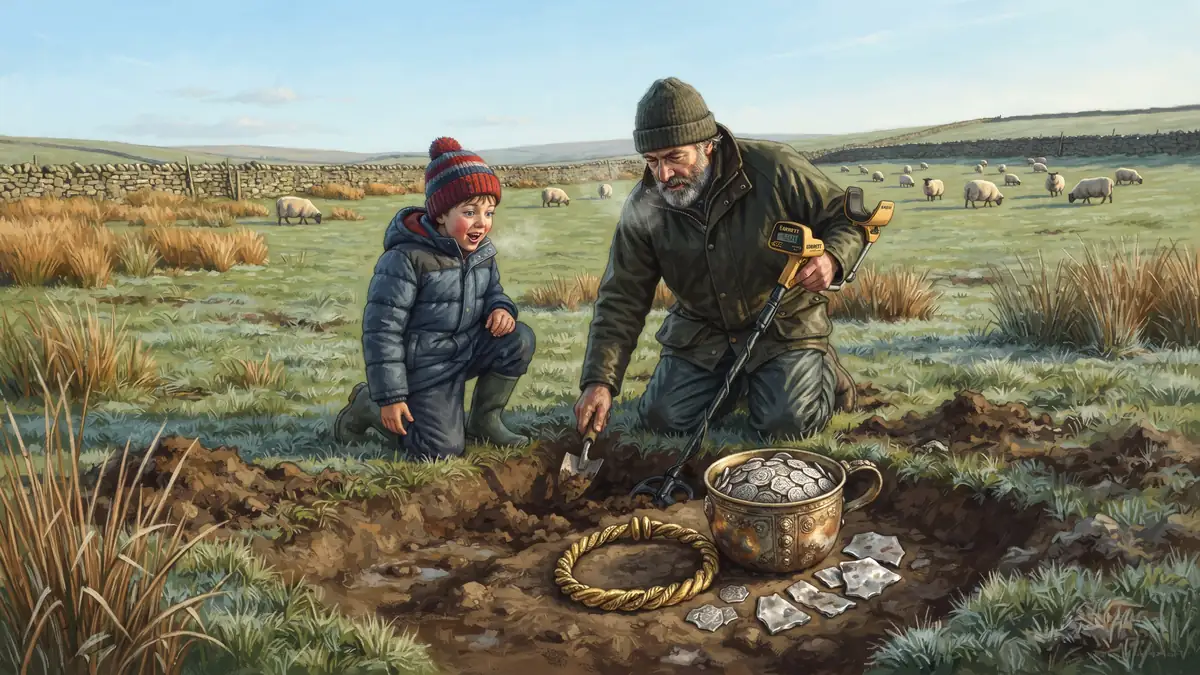
On 6 January 2007, David Whelan and his son Andrew, using metal detectors in a field near Harrogate, in North Yorkshire, found about 30 centimetres deep what became known as the Vale of York Hoard. According to the source consulted, the find was reported to Amy Cooper, the Finds Liaison Officer.
What was there
The hoard held 617 silver coins and 65 other objects. Among them were a gilded silver vessel lined with gold, of Carolingian origin, in northern France, with parallels in the Halton Moor cup; a rare gold arm ring, possibly Irish; cut silver, the so-called hacksilver; and a lead chest. The coins are from the late ninth and early tenth centuries, and bear Islamic, Christian and pagan Norse symbols.
When it was buried
The deposit is dated to about 927–928. The first theory ties the burial to the unrest after Athelstan took Northumbria, in 927, but nobody knows who buried the hoard or why.
Where it came from
The objects come from very distant places: Samarkand, North Africa, Afghanistan, Russia, Ireland, Scandinavia and continental Europe. It is the kind of set that shows how silver travelled in the Viking world, over great distances and through many hands.
Law and museum
On 19 July 2007, the treasure inquest valued the set at £1,082,000. It was bought jointly by the York Museums Trust and the British Museum, with support from the National Heritage Memorial Fund, the Art Fund and the Friends of the British Museum. The final price paid does not appear in the article. The hoard is displayed at the Yorkshire Museum.
Importance
It is the largest Viking hoard found in Britain since Cuerdale, in 1840. The Staffordshire Hoard, of 2009, is larger. The British Museum called it “the most important find of its type in Britain for over 150 years”.
What the coins tell
That the coins bear Islamic, Christian and pagan Norse symbols shows that silver circulated between very different worlds. And that part of it is cut up, as hacksilver, indicates that the value lay in the metal and not only in the whole piece. The article presents these data as a description of the contents, without drawing from them a story of the owner.
What remains uncertain
The article does not explain on what occasion or by whom the hoard was buried, and it is not known whether the owner planned to return. Nor is it known how each object came to be there. The only certainty is the date of the discovery, the place and what was taken from the ground, and everything else remains open to question.
To find silver coins that pop up from the earth, before they vanish, play The Vale of York coins.
Sources.
- Wikipedia, "Vale of York Hoard" (discovery, contents, dating, treasure inquest, acquisition, origin of objects)