Týr: the god who put his hand in the wolf's mouth and gave his name to Tuesday
Týr gave his right hand to Fenrir so the gods could chain him. See what the source consulted gathers about him, from Tacitus to the runes, and why some scholars think he was once a far more important god.
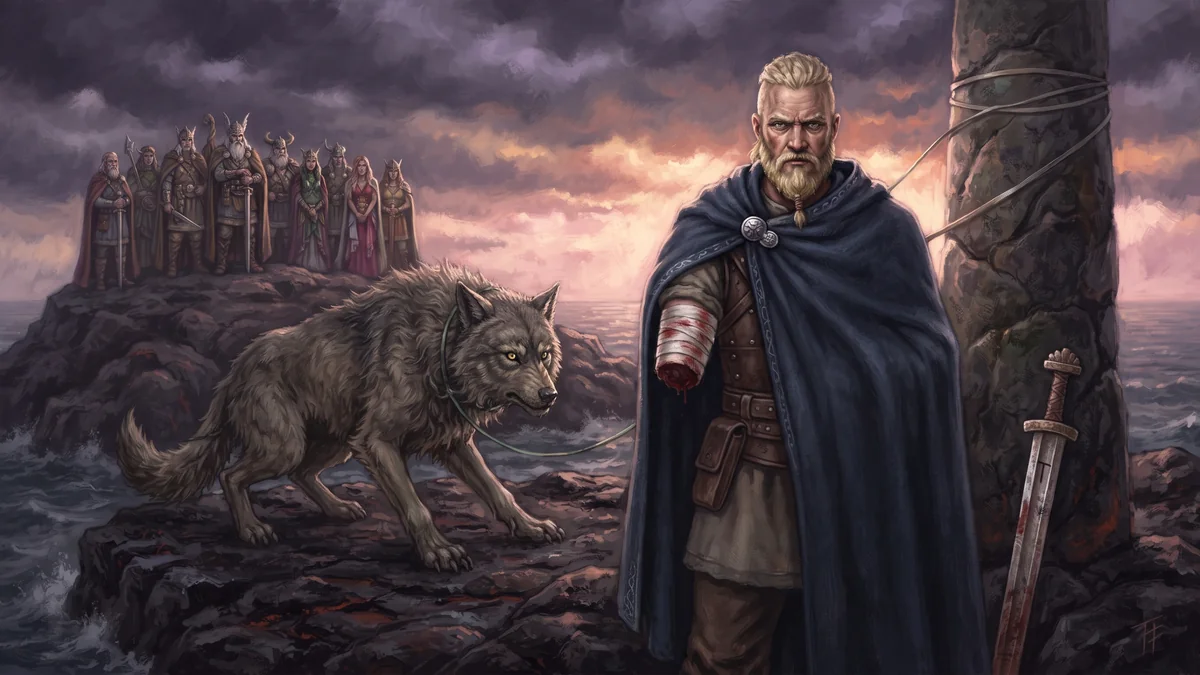
Týr is a god of Germanic mythology and a member of the Æsir. What defines him most is a gesture: according to the source consulted, he sacrifices his right hand to the wolf Fenrir, who bites it off when the gods bind him. And he is fated to die at Ragnarök fighting the dog Garmr. The Prose Edda says each will be the other’s death.
The name
Týr, in Old Norse, comes from Proto-Norse Tīwaʀ, and has relatives in Old English Tīw and Old High German Ziu. All go back to Proto-Germanic Tīwaz, meaning “God”, and from there to an Indo-European root tied to the daytime sky. In Norse poetry, tívar means “the gods”, and týr means “a god”. Some argue that Tīwaz was an epithet that replaced the god’s original name, so the link with a sky god is disputed.
In Latin, in England and in the week
Tacitus, in the Germania, says the Suebi worshipped Mercury (Odin), Hercules (Thor) and Mars, probably Tīwaz. On a third-century votive altar at Housesteads, on Hadrian’s Wall, Frisian soldiers dedicate an offering to “Deo Marti Thincso”, the “Mars of the thing”, the assembly. The epithet translates a Germanic Þingsaz. Jordanes, in the sixth century, writes that the Goths worshipped a “Mars” with human sacrifice. As for the week, Tuesday comes from Old English tīwesdæg, “Tīw’s day”, a copy of Latin Martis dies.
In the Norse sources
In the Hymiskviða, Týr is the son of the giant Hymir, and goes with Thor to fetch a cauldron. In the Sigrdrífumál, the valkyrie tells Sigurd to carve victory runes on his sword and invoke Týr’s name twice. In the Lokasenna, he attends the feast despite having one hand and defends Freyr against Loki, who mocks the lost hand. Týr answers that Loki misses Fenrir, who will stay bound until Ragnarök.
In the Gylfaginning, Snorri describes him as very brave and with power over victory. The Æsir had put his hand in Fenrir’s mouth as a pledge for the chain Gleipnir. He is also the only god who dares to feed the wolf while young. In the Skáldskaparmál, the nicknames “the one-handed As” and “feeder of the wolf” appear. The father is Hymir in one text and Odin in another.
Objects and places
A gold bracteate from the Migration Period, found at Trollhättan, in Sweden, may show Týr losing his hand to a beast, and there are similar ones in Denmark and Hamburg. A Viking Age monument at Sockburn, in Durham, may depict Týr and Fenrir. In 2019, a silver button was found in Hornsherred, Denmark, that perhaps shows the fight. Among place names are Tyrseng, in Jutland, Tislund, in Denmark, and Tysnes, in Norway. The rune ᛏ, tiwaz, bears his name, and an eighth-century skull fragment from Ribe may carry the name Týr.
What remains uncertain
Because of the etymology and the few sources, some scholars think Týr once had a far more central role. Hermann Reichert argues that Odin displaced Týr from his pre-eminent position. The runologists MacLeod and Mees doubt that the invocation in the Sigrdrífumál refers to the god himself, and think it may relate only to the rune.
To switch off all the lights in a network of links, by tapping and changing the neighbours, play Týr’s links.
Sources.
- Wikipedia, "Týr" (etymology, Tacitus, Housesteads altar, Hymiskviða, Sigrdrífumál, Lokasenna, Gylfaginning, Skáldskaparmál, runes, archaeology, scholarly debate)
- Snorri Sturluson, Prose Edda, and the Poetic Edda, cited in the article