The draugr, the dead who do not stay in the mound: what the Icelandic sagas tell
The draugr is, in the Icelandic sagas, the dead who leave the grave, strong, foul-smelling and hard to beat. See what the source consulted gathers on Kárr the Old, Glámr, Víga-Hrappr, the expulsion by "door-doom" and how a draugr was undone.
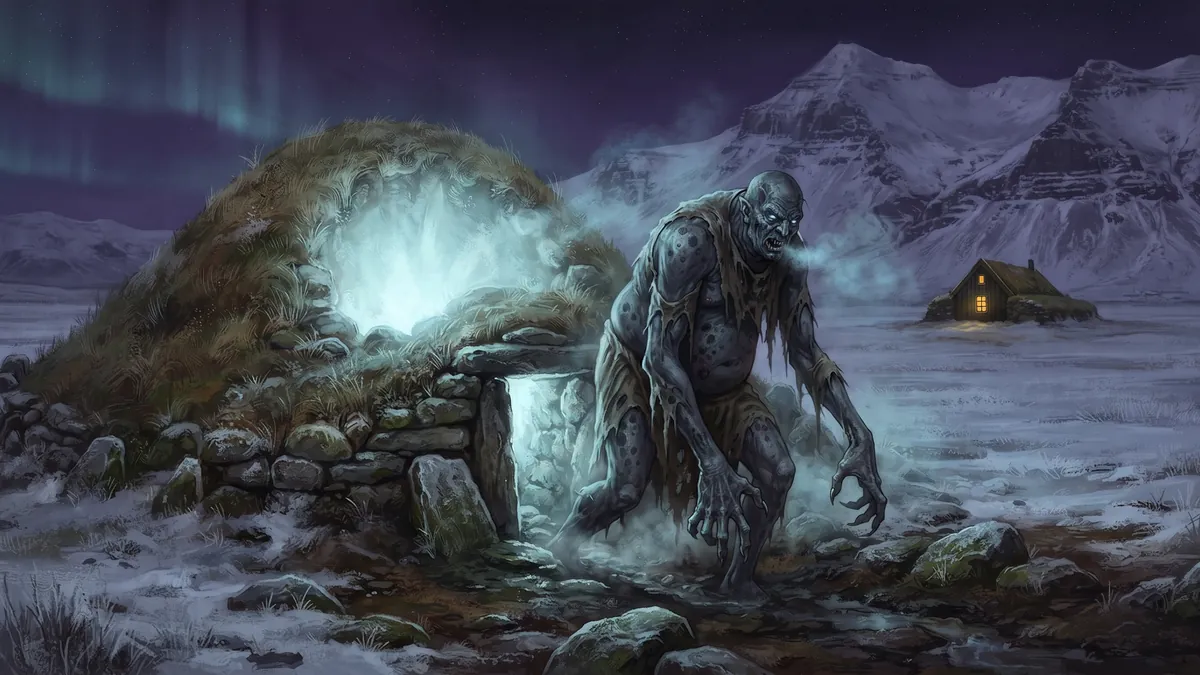
The draugr is, according to the source consulted, a dead person of the Icelandic sagas who does not stay in the grave. What the text brings are cases from different sagas, and each shows one facet.
The sources
In Grettis saga, Kárr the Old is explicitly called a draugr and is entombed in a mound that reeks horribly. Glámr, in the same saga, is a ghost the text never calls a draugr, although modern scholars often do. In Laxdæla saga, Víga-Hrappr roams his farmstead instead of staying in the grave. He can shapeshift into a seal and sink into the ground to escape. In Eyrbyggja saga, Þórólfr bægifótr, “Lame-foot”, spreads a deadly haunting, and the “door-doom” is used to expel draugar from a house. There is also Þráinn, in Hrómundar saga Gripssonar, and, in Harðar saga, a barrow with a deadly stench.
The look
The article gives the draugr superhuman strength, a death-blue or corpse-pale appearance and a strong stench of decay. Glámr’s body was found swollen and dark.
Glámr
Glámr died on Christmas Eve and afterwards caused havoc, driving some people to faint or lose their minds. Grettir defeated him in a wrestling struggle, and Glámr cursed him before dying.
How to deal with a draugr
Weapons often fail, and heroes tend to wrestle the draugr back into its grave. Iron can wound it, but usually does not stop it. The usual remedy is to behead the body, burn it and scatter the ashes at sea, so that it does not return. Breaking the posture of a seated or upright corpse is sometimes necessary, but risks the evil eye.
The mounds
Draugar usually dwell in burial mounds, often guarding treasure. A related figure, the haugbúi, “mound-dweller”, cannot leave the grave and attacks only those who trespass. A draugr’s presence may be marked by a glow coming from the mound, like foxfire.
Terms
Draugr is the dead who walks; haugbúi is the mound-dweller, who attacks only those who trespass; the “door-doom” is the expulsion procedure of Eyrbyggja saga, which the article only mentions, without describing.
What remains uncertain
The article warns that the text of Grettis saga does not call Glámr a draugr, and that modern scholars do so on their own. This shows that the category “draugr” is, in part, a modern convention applied to different accounts. The sagas have different authors and periods, and do not form a single body of belief.
To contest seeds with a draugr, at a table at the foot of the mound, play The seeds of the mound.
Sources.
- Wikipedia, "Draugr" (Grettis saga, Laxdæla saga, Eyrbyggja saga, Hrómundar saga Gripssonar, Harðar saga; traits, Glámr, means of dispersal, burial mounds)