Surtr, the fire giant of Muspelheim: what the sources say about Ragnarök
Surtr is the jötunn who guards Muspelheim and, at Ragnarök, comes from the south with fire and a bright sword. See what the source consulted gathers on the sources, the battle with Freyr, the Surtshellir cave, the island of Surtsey and what scholars debate.
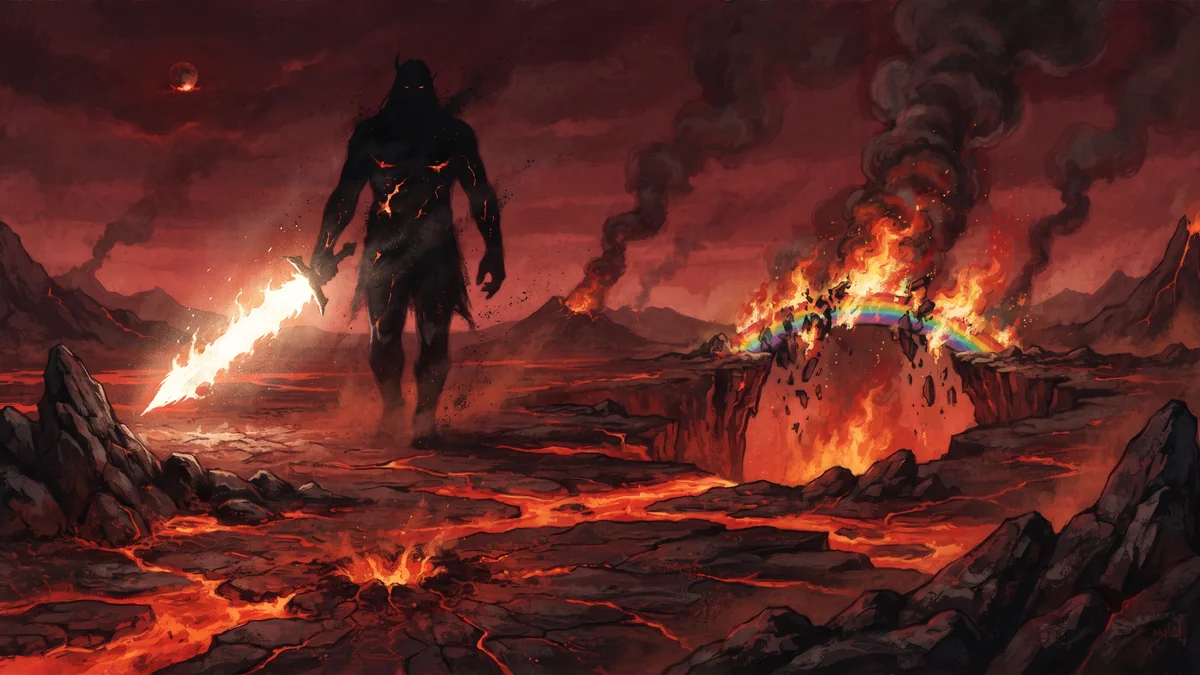
Surtr is, according to the source consulted, a jötunn, a giant, and the guardian of Muspelheim, one of the two realms said to exist before time, alongside Niflheim. The name is Old Norse for “black”, or more narrowly “swart”.
The sources
He appears in the Völuspá, the Vafþrúðnismál, the Fáfnismál and the Fjölsvinnsmál, which are poems of the Poetic Edda, and in the Gylfaginning and the Skáldskaparmál by Snorri Sturluson, of the thirteenth century.
Ragnarök
The Völuspá says Surtr comes from the south with flames and a very bright sword. The Gylfaginning puts him at the head of the “sons of Muspell”, who cross the Bifröst bridge to the field Vígríðr. The Vafþrúðnismál describes that field as “the ordained field”, a hundred leagues in each direction. Surtr fights Freyr, called “Beli’s bane”. According to the Gylfaginning, Freyr falls because he no longer has the sword he gave to Skírnir. Afterwards, Surtr sets the earth on fire. Líf and Lífthrasir survive hidden in Hoddmímis holt. In the sources, then, a world ends, not everything.
Minor details
The Fáfnismál gives the island of the battle the name Óskópnir. The Fjölsvinnsmál may name Sinmara as Surtr’s wife, but the line is obscure and the reading depends on an emendation of the text. The Skáldskaparmál, in an account that reduces the gods to men, links “Surt’s fire” to the burning of Troy.
Places with his name
Surtshellir is a volcanic cave in western Iceland that bears his name, and the Landnámabók describes a journey singing poems to a giant who was said to live there. Excavations between 2001 and 2013 found signs of ritual activity, not of outlaws, from 65 to 100 years before Iceland’s conversion, around the year 1000, which may suggest a cult. Surtsey, the volcanic island that appeared in 1963 off Iceland, was also named after him. The character also appears in Marvel comics and in the film Thor: Ragnarok, of 2017, modern versions that do not come from the medieval sources.
What scholars debate
Rudolf Simek thinks the concept is old and links the southern origin to Surtr’s tie to fire and heat. Phillpotts saw in him an inspiration from Icelandic eruptions, perhaps a volcano demon. Orchard suggests that the Gylfaginning description may echo the angel with the flaming sword guarding Eden. Lindow notes that the name may suggest a charred appearance.
What remains uncertain
None of these readings is definitive, and the article does not treat the link to volcanoes as fact. Each source adds a piece: the Völuspá gives the fire and the sword, the Gylfaginning the army and the bridge, the Vafþrúðnismál the field. What they support, together, is simpler: a guardian of fire, from the south, who in the end burns the world.
To spread the flames across a field of colours, play Surtr’s flame.
Sources.
- Wikipedia, "Surtr" (Völuspá, Vafþrúðnismál, Gylfaginning, Skáldskaparmál; Surtshellir; Surtsey; theories of Simek, Phillpotts, Orchard and Lindow)