Thralls: the enslaved people of the Viking Age, between the free karl and the noble jarl
Thralls (þrælar) were the enslaved people of Viking Age Scandinavia, below the karl, the freeman, and the jarl, the noble. See what the source consulted gathers on how someone became a thrall, what they did, how they could be freed and how slavery ended.
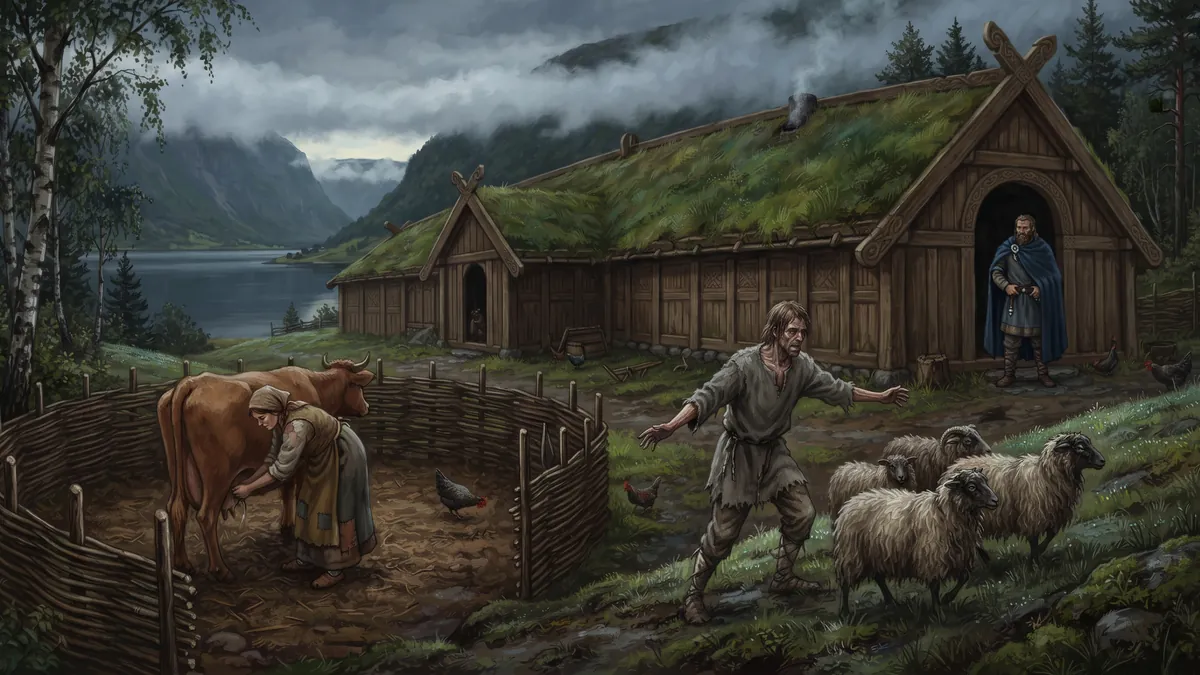
According to the source consulted, the thrall (in Old Norse, þræll) was an enslaved person or serf in Scandinavia in the Viking Age, below the karl, the freeman, and the jarl, the noble. The article cites the Rígsþula for this three-step order. The word comes from a Germanic root meaning “runner”.
How someone became a thrall
There were four paths. The first was inheritance: children of thralls were born thralls. The second was entering of one’s own will, through poverty or debt, in a process called flatföring. The third was sentencing for a crime, for life or for a limited time. The fourth was capture in war: at first local, and later, with raids abroad, an important source.
How many there were
Some estimates speak of up to thirty enslaved people per household, but most families had only one or two. The article gives no total for the region.
The work
Men tended livestock, fished and worked in the forests. Women cooked and milked the cows, and a minority were concubines. Some thralls had special roles: the bryte governed a farm in place of an absent owner, and the fostre or fostra, raised among the owner’s children, could marry free people, and the children of those unions were born free.
Value before the law
The death of a freeman was compensated with a weregild of about 200 solidi. The death of an enslaved person was treated as a loss of property, compensated by the value of the worker. The article itself also says that thralls were given a wergeld as a penalty for unlawful killing, which sits badly with the explanation of property loss, and the text does not resolve that tension.
Freedom
Erling Skjalgsson set each thrall a fixed value and ransom, and they could buy their freedom with a year or two of earnings. Owners could free them in a will or against payment. The freedman, the leysingi, still owed allegiance to his former owner and had to vote as he wished. Full freedom took at least two generations, and, if a freedman died without descendants, the former owner inherited his property.
The end of slavery
Iceland’s Gray Goose Laws allowed slavery until 1270, but the last mention is around 1122 to 1133. Denmark phased it out in the twelfth century. The landslov of Magnus Lagabøte, of 1274, in Norway, no longer recognised it. Sweden abolished it county by county, ending in 1335.
What remains uncertain
The article gives no price in shillings for a thrall. The figures of thirty enslaved people per household are estimates, and the tension over the value of an enslaved person’s life before the law, seen above, was left unanswered.
To measure four and four with jugs of 8, 5 and 3 measures, play The thrall’s jugs.
Sources.
- Wikipedia, "Thrall" (definition and social order according to the Rígsþula, origins, labour, freeing, leysingi, end of slavery)