The valravn, the knight-raven of Danish folklore: the ballad and Jens Bille's notes
The valravn is a supernatural raven of Danish folklore, and the ballad "Valravnen" tells of a knight turned into a raven. See what the source consulted gathers on the ballad, the manuscripts, the 1893 account and the hypotheses of Grundtvig and Grimm.
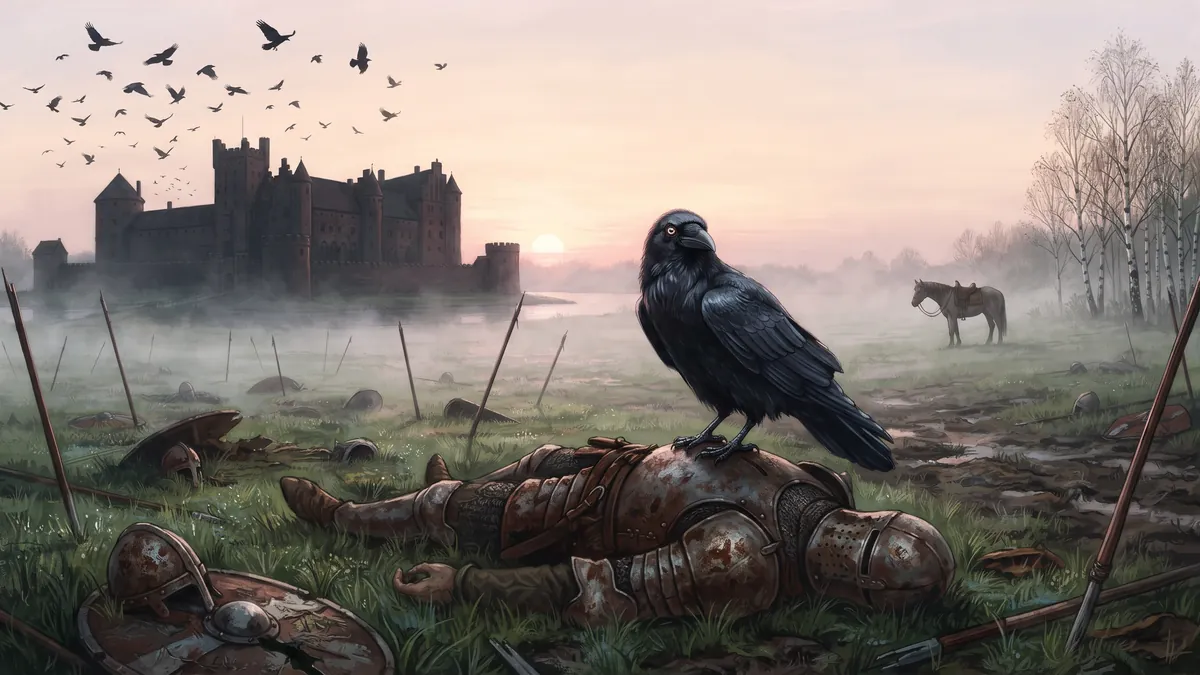
The valravn is, according to the source consulted, a supernatural raven of Danish Renaissance folklore. The article describes it as the “knight who was transformed into a raven” in the folk ballad “Valravnen”.
The ballad
By the article, the curse can be broken only by consuming a boy’s blood. In one version of the ballad, B, a raven kills the infant son of a nobleman, piercing his chest and drinking half his heart-blood, and then becomes a knight, and the child is brought back to life. It is a harsh plot, best read as folklore, and the article does not explain the mechanism of the transformation beyond this.
The manuscripts
The earliest version is in Jens Bille’s handwritten notes, dated 1555 to 1559, although the ballad probably arose in the late Middle Ages. Svend Grundtvig gathered the texts in Danmarks gamle Folkeviser, of 1856.
The 1893 account
In Evald Tang Kristensen’s collection of folk tales, of 1893, there is an account in which ravens that eat the corpse of a slain leader after a battle become valravne, and whoever eats the heart gains human thought and superhuman strength. The article says this is the only known source of the idea that valravne are ravens with human speech linked to battlefields. The account came from Peder Johansen, a mill worker from Skanderborg.
Hypotheses
Grundtvig suggested that “Verne”, in one of the versions, may relate to Old English were, “man”, as in werewolf. Jacob Grimm saw the wild raven taking “exactly the place” of the devilish troll in Danish songs and proposed an Old High German equivalent, walahraban.
Two families of stories
The ballad and the 1893 account tell different things: in the ballad, a knight becomes a raven and needs blood to return; in the account, ordinary ravens become valravne by eating the heart of a dead leader. The article treats them as part of the same folklore, but they are not the same story. Both Grundtvig and Grimm offered hypotheses of language, not proofs.
Odin
Ravens recall Huginn and Muninn, Odin’s ravens, and the article lists them as related entries. But it does not claim a direct link, and neither does this article.
What remains uncertain
The age of the belief is doubtful: the ballad is of the late Middle Ages, and the idea of the battlefield raven comes from a single account of 1893. The sense of “Verne” is a hypothesis. There is no way to say, from these texts, that the valravn was a general belief.
To guide a knight-raven over every square of a board, play The knight-raven.
Sources.
- Wikipedia, "Valravn" (ballad "Valravnen", Jens Bille 1555-1559, Evald Tang Kristensen 1893, Svend Grundtvig 1856, Jacob Grimm)