The Danelaw, the "law of the Danes" in England: the treaty, the Five Boroughs and the place-names
The Danelaw was the part of England under Scandinavian law after the treaty between Alfred and Guthrum. See what the source consulted gathers about the name, the treaty, the Five Boroughs, the place-names in -by and -thorp, the reconquest in the 10th century and the doubts that remain.
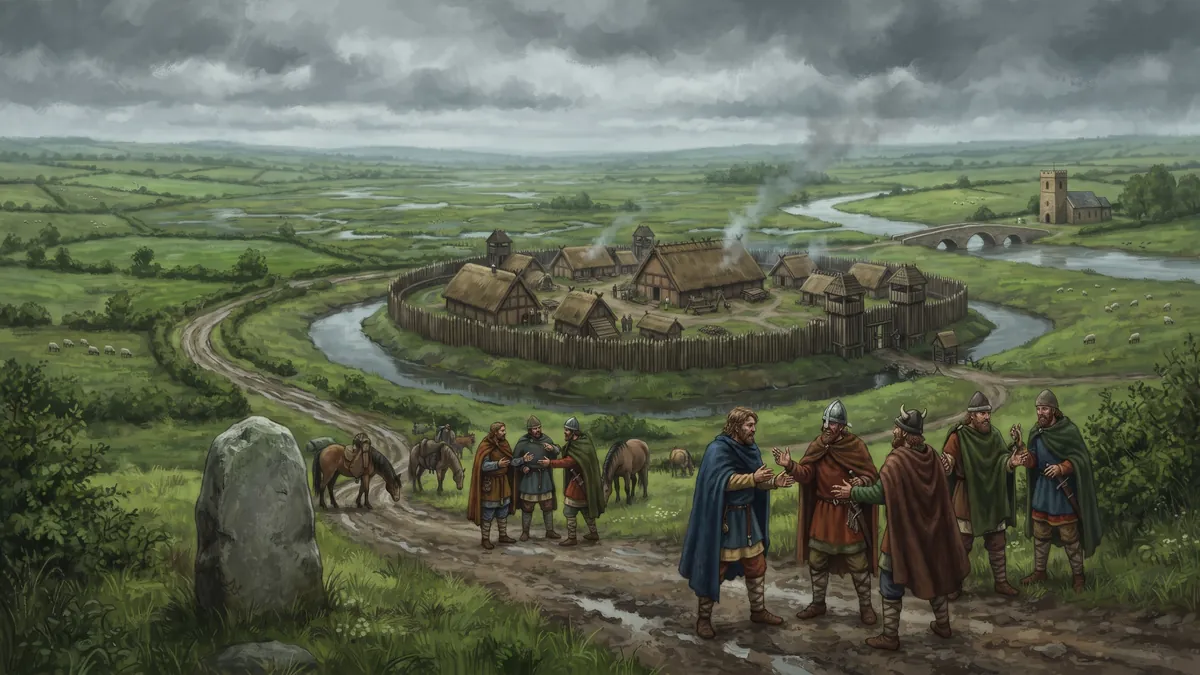
The Danelaw is the name given to the part of England where Scandinavian law applied. The source consulted gathers what is known about the name, the treaty that created it, the fortified towns and the marks it left.
The name
Danelaw first appears in the early 11th century, in the Old English form Dena lage. The term did not come to designate a geographical area until that century. In Old English, Dene, “Danes”, usually refers to Scandinavians of any kind, not only Danes.
The treaty
The treaty between Alfred and Guthrum followed Guthrum’s defeat at the battle of Edington in 878 and the earlier treaty of Wedmore. It set the boundaries of the two kingdoms and provided for peaceful relations. The Danes gained self-governance in return for loyalty to England. Guthrum was baptised, and Alfred was his godfather. The article places the formalisation between 878 and 890; some historians suggest it was concluded around 886, when Alfred reoccupied London.
The Five Boroughs
Leicester, Nottingham, Derby, Stamford and Lincoln, fortified towns, had special importance in the Danelaw and became known as the Five Boroughs. They roughly outline the modern East Midlands. Four of them became county towns; Stamford did not, possibly because of the neighbouring territory of Rutland.
The place-names
Norse endings such as -by, “village”, -thorp, “hamlet”, and -howe are common in the north of England and the East Midlands. Many names such as Kirby and Kirkby probably come from the Old Norse kirk, “church”, plus -by.
The reconquest
In the 910s, Edward the Elder and his sister Æthelflæd conquered Danish territories in the Midlands and East Anglia. Some jarls kept their lands after submitting. In 917, Essex and East Anglia accepted Edward as overlord, and Leicester submitted in 918. Viking rule effectively ended when Eric Bloodaxe was driven out of Northumbria in 954.
Terms
Jarl is a Scandinavian nobleman; borough is a fortified town; overlord is one who receives the submission of other chiefs; Dene is the Old English word for Scandinavians. These terms appear throughout the article and help in reading the history of the Danelaw.
A rough map
According to the article, the Danelaw roughly covered Yorkshire, the central and eastern Midlands and East Anglia. This is an approximate drawing, and the text itself warns that archaeological sites do not confirm it precisely.
What remains uncertain
The exact date of the treaty is not known, and the location of the battle of Cynuit is disputed. Archaeological sites do not clearly match the boundary defined by the texts, which may come from misattributed finds, from movements of people or from the treaty being ignored. The article also marks as lacking a citation the description of the Danelaw’s extent north of a line between London and Chester.
To fight over, token by token, the last piece of each borough, play The Five Boroughs.
Sources.
- Wikipedia, "Danelaw" (origin of the name, treaty of Alfred and Guthrum, Five Boroughs, extent, place-names, reconquest by Edward the Elder)