Garmr, the hound that howls before Gnipahellir: what the Norse sources tell
Garmr is a wolf or dog tied to Hel and to Ragnarök, the "blood-stained guardian" of the gate of the dead. See what the source consulted gathers about the Völuspá refrain, the Baldrs draumar, the Gylfaginning, the duel with Týr and the debate about Fenrir and Cerberus.
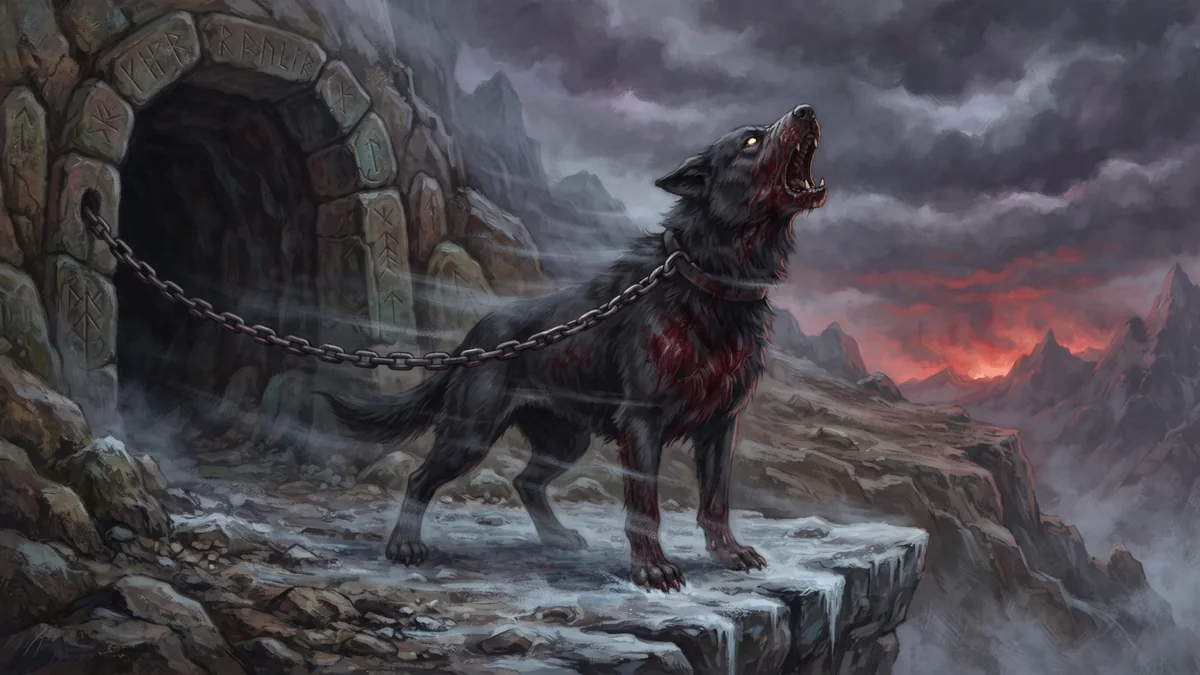
Garmr, also written Garm, is a wolf or dog of Norse mythology tied to Hel and to Ragnarök. The source consulted describes him as a “blood-stained guardian” of the gate of Hel. Below is what the text gathers from each source.
The sources
The Grímnismál, a poem of the Poetic Edda, mentions Garmr. In the Völuspá, Garmr’s howl forms a refrain that repeats at decisive points in the poem and announces Ragnarök. The repetition helps explain why he came to be associated with the end of the world.
In the Baldrs draumar, Odin rides to Hel and meets on the way a blood-stained hound that howls. The dog has no name in the poem, but scholars sometimes identify it as Garmr.
In the Gylfaginning, part of the Prose Edda, Garmr breaks free of his bonds at Gnipahellir, fights Týr, and the two kill each other.
Garmr and Fenrir
Some scholars equate Garmr with Fenrir, the wolf who also breaks free at Ragnarök. The article does not settle the question and presents it as a debate. Another frequent comparison is with Cerberus, the hound of the dead in Greek mythology.
The name
The origin of the name Garmr is uncertain. Bruce Lincoln links Garmr and Cerberus to a Proto-Indo-European root meaning “to growl”. Daniel Ogden argues that the two names come from different roots, and so sees no established link between them.
Terms
Gnipahellir is the cave where Garmr is bound, according to the Gylfaginning; Hel is the realm of the dead; Týr is the god with whom Garmr fights; Ragnarök is the end of the world announced by the Völuspá refrain. The article also uses the word “refrain” for the howl that returns in the poem, which helps show why the dog became tied to the idea of a warning.
Wolf or dog
The article itself hesitates in naming the species and speaks of a “wolf or dog”. That hesitation is not carelessness: in the sources it cites, the animal is described by its acts, the howl, the blood, the bonds and the duel, not by a definition.
What each source adds
The Völuspá gives the howl as a warning of the end; the Baldrs draumar gives a meeting of Odin with a blood-stained hound on the road to Hel, without naming it; the Gylfaginning gives the bonds at Gnipahellir and the deaths of Garmr and Týr, each at the other’s hand. The three sources do not contradict one another, but each shows only one moment.
What remains uncertain
Almost everything said of Garmr comes from a few lines. The dog of the Baldrs draumar is not named, and identifying it as Garmr is a choice made by the reader. The idea that Garmr and Fenrir are the same figure is one hypothesis among others, and the relation to Cerberus depends on a root that one scholar accepts and another rejects. That is why the article is careful: it sets out the sources and the doubts side by side.
To repeat a sequence of howls echoing at the cave mouth, play Garmr’s howls.
Sources.
- Wikipedia, "Garmr" (Grímnismál, Völuspá, Baldrs draumar, Gylfaginning; Fenrir; Cerberus; etymology)