Hœnir, the god who helps make humans and relies on Mímir: what the sources say
Hœnir is one of the Æsir, with few appearances in the sources: the making of Ask and Embla, a role as hostage among the Vanir, a Faroese ballad and a hypothesis that ties him to birds. See what each text offers and what stays uncertain.
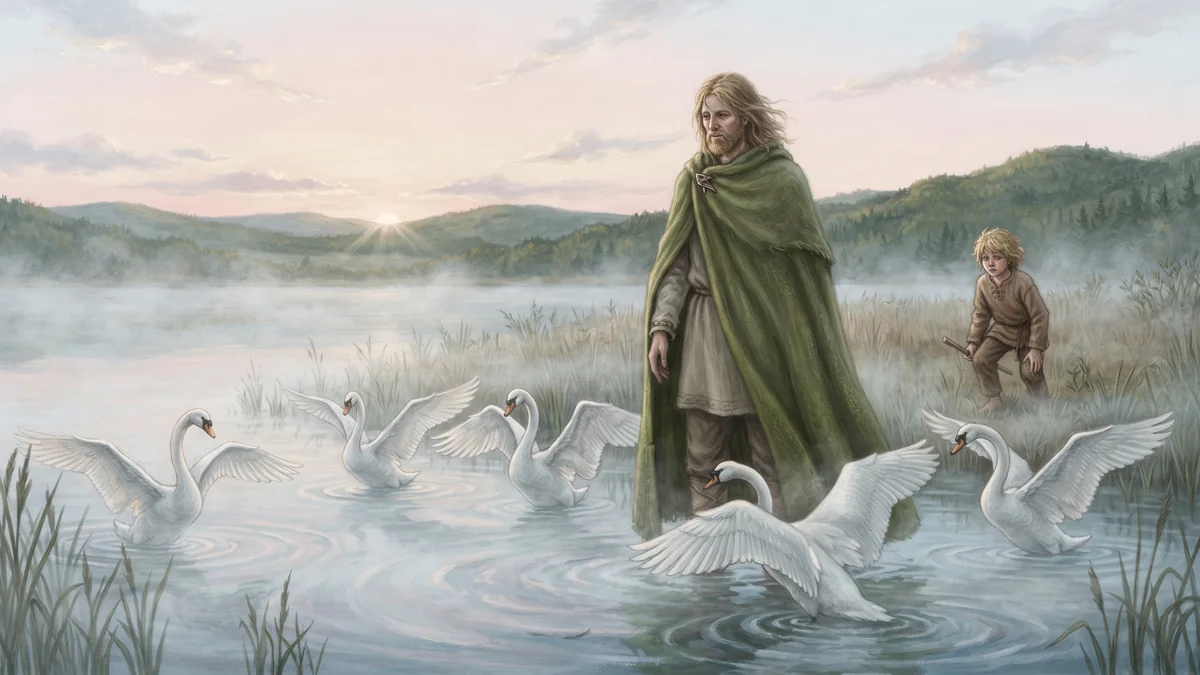
Hœnir is one of the Æsir, the principal gods of Norse mythology, and a figure with few appearances. The source consulted for this piece gathers what the sources say about him: a passage on creation, a stay as hostage, a protective role in a ballad from the Faroe Islands and a hypothesis that ties him to birds. It helps to read each point separately, because the texts do not agree with one another.
One of three who made humans
In the Völuspá, Hœnir is one of three gods who, with Odin and Lóðurr, create the first human beings, Ask and Embla. The article describes him as assisting Odin and Lóðurr in that act. The same text says he is one of the few gods who survive Ragnarök.
What Snorri tells
The Prose Edda says that Hœnir gave reason to humankind; the article cites MacCulloch (2005) for this. In the Gylfaginning, however, the account of creation names Vili and Vé in place of Hœnir. Because Snorri Sturluson knew the Völuspá, the article notes that Hœnir may be another name for Vili, and it presents this only as a possibility.
The hostage among the Vanir
According to the Ynglinga saga, after the war between the Æsir and the Vanir, Hœnir and Mímir were sent to the Vanir as hostages to seal a truce. On arrival in Vanaheim, Hœnir was described as large and handsome, and the Vanir judged him well suited to be a chief, so they made him one at once. But he was indecisive and depended on Mímir for every decision. When Mímir was absent, Hœnir answered with noncommittal grunts.
Other appearances
Hœnir has minor roles in the Haustlöng and the Reginsmál. In a medieval Faroese ballad, Lokka táttur, he protects a farmer’s boy by summoning seven swans. For that ballad the article cites Joseph S. Hopkins (2021).
The name and the birds
Scholars link the name Hœnir to the epithets langifótr, “long-legs”, and aurkonungr, “mud-king”, and to words in other languages: the Greek κύκνος, “swan”, and the Sanskrit śakuna, “bird of omen”. Viktor Rydberg and others, including Gudbrand Vigfusson, read these clues as pointing to the stork. As support the article lists the European folk legend that storks deliver babies and Hœnir’s role in the Faroese ballad, where he calls on swans.
Terms
The Æsir are the main group of gods, and the Vanir are the other group, with whom the Æsir went to war. The Völuspá is the poem that names Hœnir among the makers of humans, and the Ynglinga saga is the one that tells the story of the hostage. Lokka táttur is the Faroese ballad of the seven swans. Langifótr is an epithet meaning “long-legs”. These few terms sum up everything the article claims: a helper at the creation, a chief who does not decide alone, a protection carried out by birds and a name that may come from them.
What remains uncertain
The idea that Hœnir and Vili are the same god is a possibility raised from Snorri’s knowledge of the Völuspá, and nothing more. The link between the name and the stork is a scholars’ hypothesis, argued by Rydberg in 1886, and the article presents it as a hypothesis. There are also no manuscripts or annotated editions of the poems here: this piece rests on a single encyclopedic article, and anyone who wants to go further has to open the Völuspá, the Ynglinga saga and the Faroese ballad.
To live, in miniature, the situation of someone who negotiates without being able to decide alone, play The hostage and the exchanges.
Sources.
- Wikipedia, "Hœnir" (Völuspá, Prose Edda, Ynglinga saga, Haustlöng, Reginsmál, the ballad Lokka táttur, etymology and the stork hypothesis; relies on MacCulloch, Hopkins and Rydberg)