The Battle of Fulford, 1066: Harald Hardrada and Tostig against the earls of northern England
On 20 September 1066, south of York, Harald Hardrada and Tostig defeated the earls Edwin and Morcar at Fulford, five days before Stamford Bridge. See what the source records and which numbers remain in doubt.
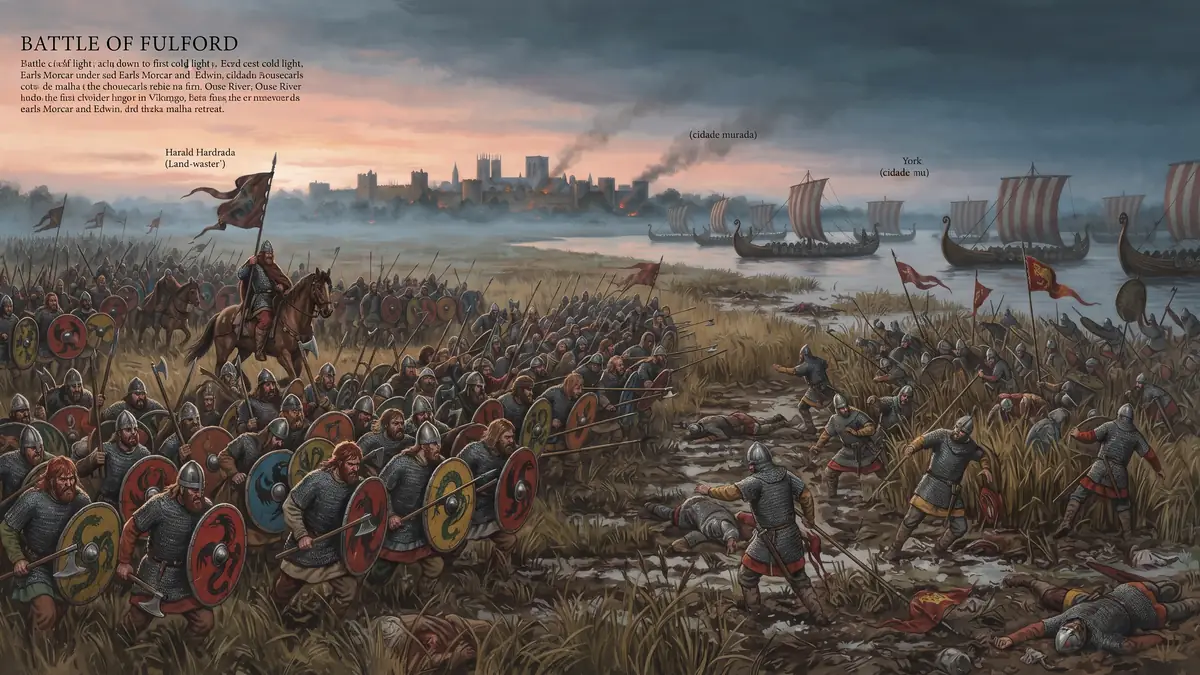
The Battle of Fulford was fought on 20 September 1066, south of York, in England. On one side was the Norwegian army of Harald Hardrada, allied with Tostig. On the other, the forces of the earls Edwin and Morcar. The source consulted for this piece describes the terrain, the forces and the consequences. This piece separates what the source states from what it marks as uncertain.
The terrain
The battle was beside the River Ouse, at a place with a marsh called Fordland. The Norwegian fleet was at Riccall, from where the troops marched to the fight. The exact site of the battlefield is not confirmed.
The forces
The source estimates the Norwegians at about 10,000 men, of whom about 6,000 would have been deployed for the fight. On the English side, the estimates are 3,000 plus 1,800 men, or 5,000. These numbers are estimates, not counts. Adding up the parts, the estimates put the two sides in a similar order of magnitude on the field: about 6,000 Norwegians in formation against 4,800 or 5,000 English. That is why the source speaks of uncertain numbers, and this piece does not decide who had the numerical advantage.
The result
The Norwegians and Tostig won, and York surrendered. Five days later, at Stamford Bridge, King Harold of England faced the invaders. The source recalls that Harold marched about 190 miles (some 300 kilometres) to the north. After Stamford Bridge came the battle of Hastings.
What came after
The order of events, according to the source, is short and hard: Fulford, the surrender of York, Stamford Bridge and then Hastings. In a few weeks, the kingdom faced the attack from the north and the battle in the south. Fulford is thus the first step in a sequence of fights, not an isolated episode.
Disagreements
Orderic Vitalis gives a different version of Tostig’s route. The source does not resolve the difference, and makes clear that the old accounts do not always agree.
Terms
An earl was the title of a great English regional lord. The Ouse is the river near York. Riccall is the place where the fleet was anchored. Stamford Bridge is the battle that came after. Hastings is the battle in which Harold was defeated, further south.
What remains uncertain
The exact site of Fulford is uncertain. The numbers of combatants are estimates, and vary. Tostig’s route is told differently by Orderic Vitalis. The old accounts were written by chroniclers, generally after the events and often with bias towards one side, and so the details of the battle, such as the order of the lines and the moment of defeat, should not be taken as certain.
To order banners of different heights so that each line shows the right count, play The line of banners.
Sources.
- Wikipedia, "Battle of Fulford" (date, Harald Hardrada, Tostig, Edwin and Morcar, River Ouse, Fordland marsh, Riccall, York, Stamford Bridge, Hastings, numbers, Orderic Vitalis)