Emma of Normandy: the queen who married two kings of England and mothered two more
Emma of Normandy, born around 984, was queen of England twice: she married Æthelred in 1002 and Cnut in 1017. See her life, the Encomium that praises her and what the legend of the fire added later.
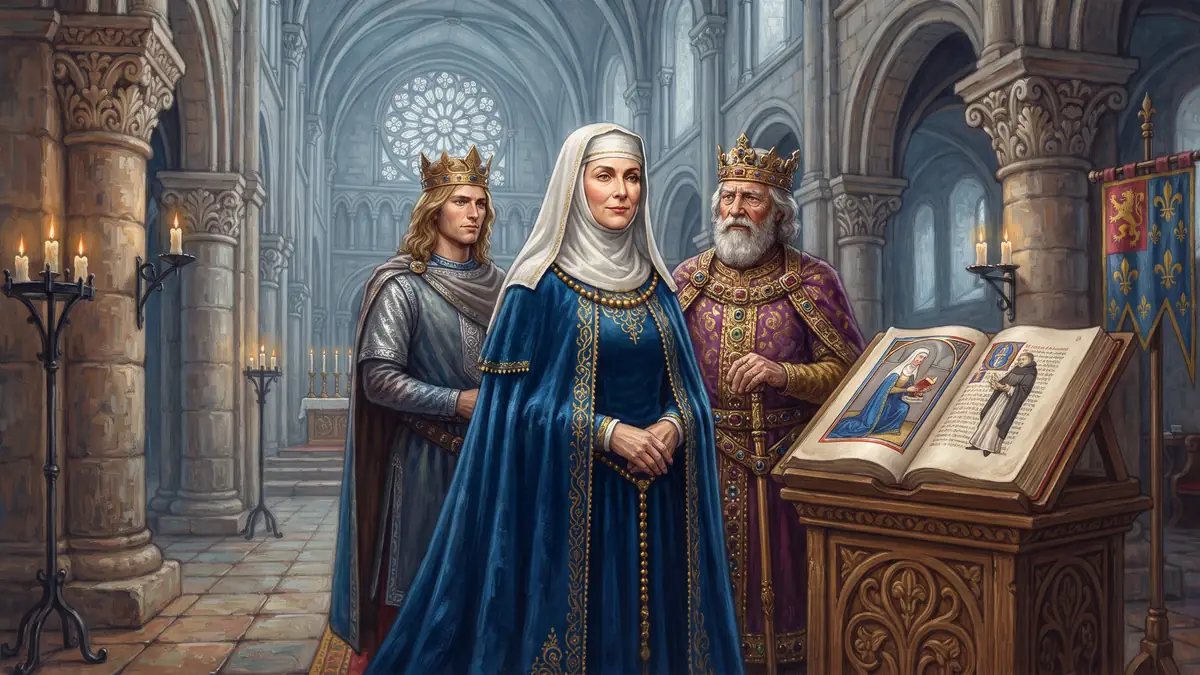
Emma of Normandy was queen of England, married to two kings, and mother of two others. Born around 984, daughter of Richard I of Normandy and of Gunnor, she lived in a time of invasions, exiles and changes of dynasty. The source consulted for this piece summarises her life and the work that praises her. This piece separates what the source states from what it presents as debated or as late legend.
Two crowns, two kings
In England, Emma came to be known as Ælfgifu. She married King Æthelred in 1002. In 1013–1014, in exile, she lived outside England. In 1017, she married Cnut and was queen of England. The source notes that she was also queen of Denmark, in 1018, and of Norway, in 1028, through her husband’s reign.
The children
From her marriages were born Edward the Confessor, Alfred and Goda, and also Harthacnut and Gunhilda. Alfred was blinded in 1036. The source says it is debated whether the one responsible was Harold Harefoot or Godwin. Harthacnut reigned from 1040 to 1042. Edward was crowned in 1043 and took his mother’s lands, but later relented.
The Encomium
Emma is remembered through the Encomium Emmae Reginae, a text in praise of the queen. The source cites Tyler and Keynes among the scholars of the work, but does not say who wrote it. It also cites the Courtenay Compendium, found in 2008.
How to read Emma
Emma appears in sources of different kinds: a text of praise, the Encomium, a late legend, the ordeal by fire, and modern scholarship. Each kind of source answers a different question. The first shows the image that was meant to be given of the queen, the legend shows how she was remembered centuries later, and modern studies try to separate one from the other. So this piece treats none of them as the complete portrait.
Death and legend
Emma died on 6 March 1052, in Winchester. Later it was told that she had gone through an ordeal by fire to defend herself against an accusation. This legend appears only in the 13th century.
Terms
An encomium is a text in praise of someone. Ælfgifu is the English name by which Emma became known. Exile is a forced departure from the country. Ordeal by fire is a medieval ritual of judgement, in which the person had to face fire to prove innocence.
What remains uncertain
The authorship of the Encomium is not given by the source, and this piece does not guess it. Whether Harold or Godwin was responsible for Alfred’s blinding is debated. The legend of the ordeal by fire is much later than Emma’s life, and so should not be taken as fact. The Encomium is a text of praise, written to enhance the queen, and so its view of events is not neutral.
To link towns by roads at the lowest cost, play The queen’s roads.
Sources.
- Wikipedia, "Emma of Normandy" (birth, Ælfgifu, marriages to Æthelred and Cnut, children, the exile of 1013–14, Encomium Emmae Reginae, Courtenay Compendium, Alfred in 1036, Harthacnut, Edward the Confessor, death in 1052, the legend of the ordeal by fire)