Höðr, the blind god: the mistletoe dart, the death of Baldr and the two versions of the story
Höðr, son of Odin, is the blind god who shoots the mistletoe dart that kills Baldr. See what the Prose Edda tells, how Saxo Grammaticus changes everything and what remains uncertain about his fate.
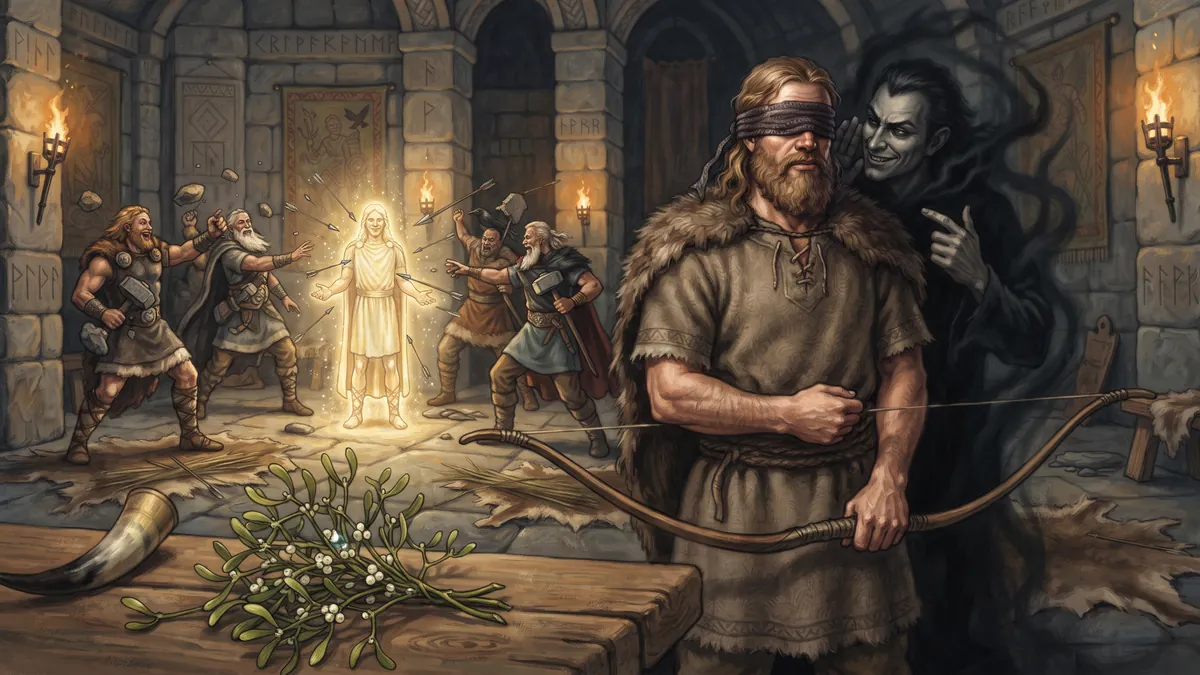
Höðr, in Old Norse Höðr, is a blind god of Norse mythology, a son of Odin. He is known for a single act, which ties him to the end of Baldr, the best loved of the gods. The source consulted for this piece gathers what the Prose Edda, the Poetic Edda and the work of Saxo Grammaticus say about him. This piece separates what each text states from what scholars only suppose.
The mistletoe dart
In the Prose Edda, in the chapters of the Gylfaginning devoted to Baldr, Höðr is blind and therefore takes no part in the game in which the gods throw things at Baldr, whom nothing can hurt. Loki tricks him and puts a dart made of mistletoe in his hand. Höðr throws it, and Baldr dies. The chapters that tell this story and its consequences are, according to the source, numbers 23 to 32 and 49 to 54. The Skáldskaparmál, another part of the same work, also carries poetic expressions, the kennings, which use the name of Höðr to mean warriors.
Váli’s revenge
Odin has another son, Váli, fathered with Rindr. Váli grows up in a single day and kills Höðr. So the death of Baldr is paid for with another death, but the source does not say that Höðr was wicked: in this account he is the instrument of Loki’s plot.
After Ragnarök
According to the Völuspá and the Gylfaginning, Baldr and Höðr return after Ragnarök, the end of the world. The Vafþrúðnismál, however, lists the survivors (Víðarr, Váli, Móði and Magni) without mentioning Höðr or Baldr.
Another version: Saxo Grammaticus
In book 3 of the Gesta Danorum, Saxo tells something very different. Hotherus is there a mortal hero, and it is he who kills Balderus, in a rivalry over Nanna. Later Bous, son of Othinus and Rinda, kills Hotherus. In this version there is no mistletoe and no divine blindness: it is a conflict between warriors.
Other mentions
The text Hversu Noregr byggðist makes Höðr ruler of Haðaland, in Norway. The name is linked to the word höð, meaning “battle”. The source also cites a hypothesis by Rydberg about the poem Húsdrápa, by Ulfr Uggason, composed around 990, but this piece does not go into its details.
Terms
Gylfaginning is the first part of the Prose Edda, written in the 13th century. A kenning is a poetic expression that names something by means of something else. Mistletoe is the parasitic plant used for the dart. Ragnarök is the final battle of the gods.
What remains uncertain
The source leaves open the fate of Höðr in the Gylfaginning, where the story of the return after Ragnarök is not fully clear. The term “brothers” for Baldr and Höðr is also disputed, and his role in the warrior kennings is not well explained. No pagan account has reached us from an author of the time, and what we have was written after the conversion to Christianity.
To find out who tells the truth and who lies at a table full of statements, play Who is lying?.
Sources.
- Wikipedia, "Höðr" (Prose Edda, Poetic Edda, Saxo's Gesta Danorum, Váli, Ragnarök, etymology, Hversu Noregr byggðist)