Holger Danske, or Ogier the Dane: from Charlemagne's knight to the hero who sleeps at Kronborg
Holger Danske, or Ogier the Dane, already appears in the Chanson de Roland, around 1060, and in Denmark becomes the hero who sleeps beneath Kronborg. See the figure's path, the works that took him up and what remains uncertain.
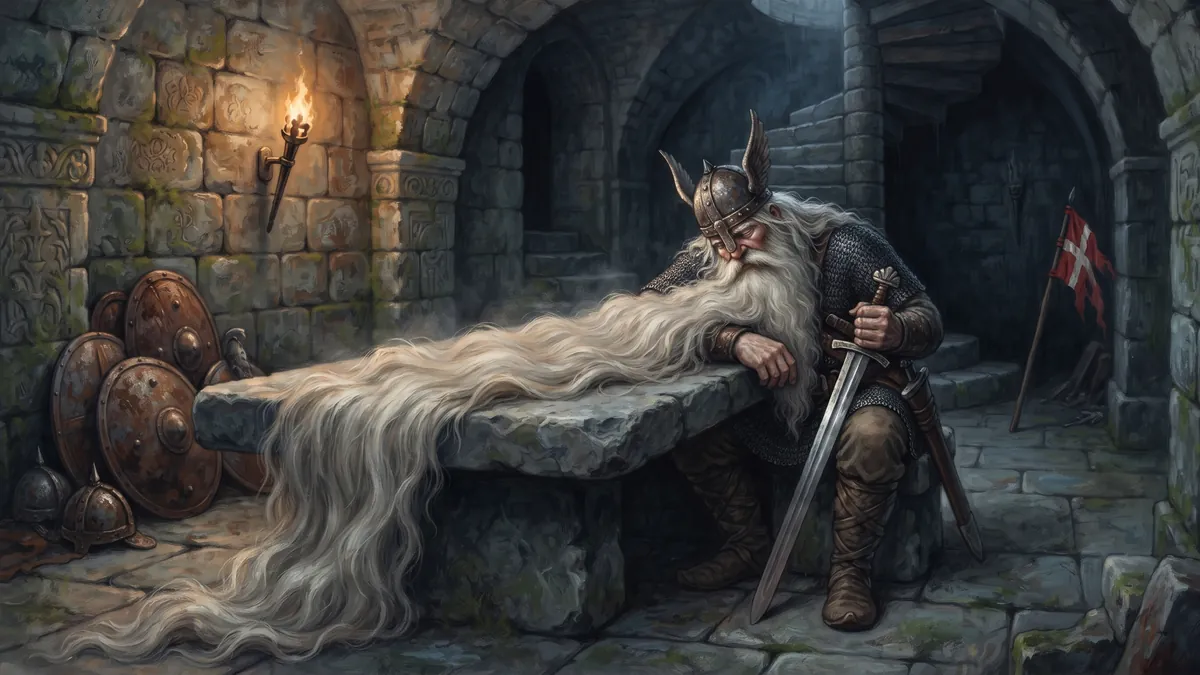
Holger Danske, in the French form Ogier the Dane, is a character who crosses centuries and countries: he begins as a knight of Charlemagne in the French songs and becomes, in Denmark, the hero who sleeps and wakes when the country is in danger. The source consulted for this piece gathers the works in which he appears, the legend of Kronborg and the discussions about a possible historical model. This piece separates what the works record from what is tradition.
From the French songs
The first appearance is in the Chanson de Roland, around 1060, where he is called Oger. Around 1200 to 1215, Raimbert de Paris composed La Chevalerie Ogier de Danemarche, a poem of about 13,000 lines devoted to him. In the 14th century, Ogier appears in Avalon, linked to Morgan le Fay. Around 1240, the Karlamagnús saga, in Old Norse, calls him Oddgeir danski.
In the Danish tradition
The Danish tradition appears in texts such as that of Christiern Pedersen, of 1534. The legend of the hero asleep beneath Kronborg castle was recorded by Keightley, in 1834, by Thiele, in 1843, and by Andersen, in 1845. According to this legend, Holger wakes when Denmark needs him.
Art and memory
The figure inspired an opera by Kunzen, of 1789, a text by Ingemann, of 1837, and a statue by Hans Peder Pedersen-Dan, of 1907. In the Second World War, a Danish resistance group took the name Holger Danske.
The path in brief
In dates, the course is this: around 1060, the Chanson de Roland; from 1200 to 1215, Raimbert’s poem; around 1240, the Norse saga; in the 14th century, Avalon; in 1534, the text of Christiern Pedersen; in 1789, the opera; from 1834 to 1845, the versions of the Kronborg legend; in 1837, Ingemann; in 1907, the statue. The figure changes function along the way: from knight of a foreign emperor he becomes the sleeping guardian of Denmark.
A historical model?
The source mentions names that scholars have proposed as a historical model: Autcharius, Audacar, Adalgis and Othgerius. The choice between them is disputed.
Terms
A chanson de geste is a medieval French song of heroic deeds. The Chanson de Roland is the most famous of them. Kronborg is the Danish castle, in Elsinore. The Karlamagnús saga is the Norse version of the stories of Charlemagne. A sleeping hero is the type of legend in which a hero sleeps waiting for the hour to return.
What remains uncertain
Holger’s historical model is disputed, and none of the names is accepted by all. The tradition that the guides of Kronborg tell the legend today is not a documented fact about the castle: the source presents it as tradition. Nor can it be said, on the basis of this source, that the Kronborg legend is as old as the French songs: it is recorded by writers of the 19th century.
To keep coloured shapes in memory and find the one that vanished, play The shape that vanished.
Sources.
- Wikipedia, "Holger Danske" (Chanson de Roland, La Chevalerie Ogier de Danemarche, Karlamagnús saga, Christiern Pedersen in 1534, the Kronborg legend, Keightley, Thiele, Andersen, the 1907 statue, Kunzen's opera, Ingemann, the Danish resistance, possible historical models)