Víga-Glúms saga: the chieftain of Eyjafjörður, the field Vitazgjafi and the cult of Freyr
Víga-Glúms saga tells the life of Glúmr Eyjólfsson, chieftain of Þverá in northern Iceland, with the cult of Freyr, the fields and the final blindness. See the plot, the main manuscript and the debate about paganism.
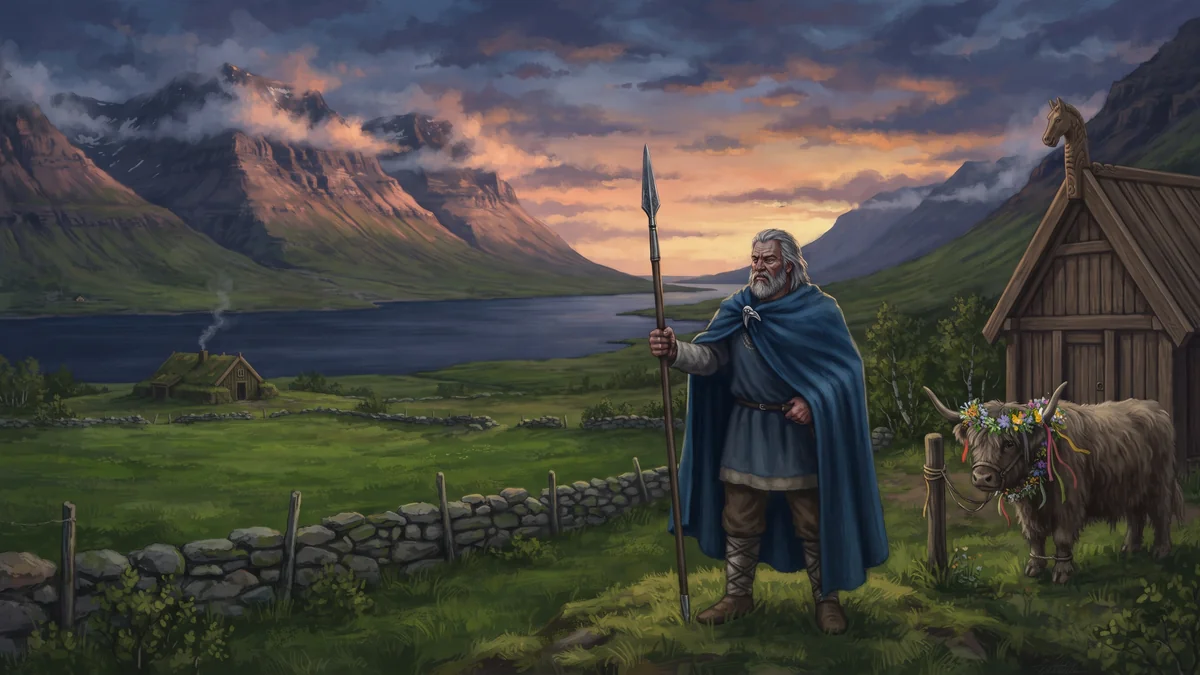
Víga-Glúms saga, the “saga of Glúmr the slayer”, is a saga of Icelanders about Glúmr Eyjólfsson. The source consulted for this piece describes the plot, the manuscript in which the saga survives, the probable date of composition and the debate among scholars about what it shows of paganism. This piece separates what the source states from what it treats as debated.
The setting and the plot
The saga is set in Eyjafjörður, in northern Iceland, and the protagonist, Glúmr Eyjólfsson, lives at Þverá. Vigfúss gives him a cloak, a spear and a sword. Among the places named is the field called Vitazgjafi. Glúmr kills Sigmundr. The source lists these elements as part of the plot, without going into every episode, and this piece keeps to that same measure.
The cult of Freyr
Part of the saga’s interest lies in religion. There appear Þorkell’s ox, a temple of Freyr and oaths. Near the end, Glúmr loses his sight and is baptised three years before he dies. The saga thus joins a pagan cult to a Christian conclusion.
The manuscript and the date
The saga survives in the Möðruvallabók, from the mid-14th century. The probable date of composition is the 13th century. The source cites Turville-Petre, who suggests the years 1230 to 1240, and the remark that, if the saga alludes to certain events, it would be later than 1232.
Interpolations and sources
The saga carries interpolations, among them the episodes of Víga-Skúta and of Ǫgmundr dytt. The episode of Ingólfr resembles a Latin text, the Disciplina Clericalis.
The debate about paganism
DuBois and Turville-Petre disagree about what the saga reveals of pagan religion. The source records the disagreement without deciding between the two readings.
Terms
Saga of Icelanders is a genre of prose narrative about the settlers of Iceland. An interpolation is a passage added to a text later. Möðruvallabók is a great Icelandic manuscript of the 14th century. Freyr is a Norse god tied to fertility. Þverá is Glúmr’s farm, and Eyjafjörður is the fjord of northern Iceland where it lies.
What remains uncertain
The date of composition is estimated. Whether the episodes of Víga-Skúta and Ǫgmundr dytt belong to the original form of the saga is debated. The resemblance to the Disciplina Clericalis does not prove that the author read that text. And, since DuBois and Turville-Petre differ about what the saga shows of paganism, any reading of the cult of Freyr in it should be taken as an interpretation, not as a direct portrait of the old religion. The saga was written in the 13th century, and the story it tells is set long before.
To divide a field into rectangular plots, each with the right number of squares, play The plots of the field.
Sources.
- Wikipedia, "Víga-Glúms saga" (Glúmr Eyjólfsson, Eyjafjörður, Þverá, Vigfúss, Vitazgjafi, Freyr cult, blindness and baptism, Möðruvallabók, date of composition, interpolations, DuBois, Turville-Petre)