Gull-Þóris saga: the settler who grew rich on dragon gold
Gull-Þóris saga, or Þorskfirðinga saga, tells how Þórir won gold from dragons, quarrelled over its division in Iceland and ended up linked with a dragon. See what two sources say and where they differ.
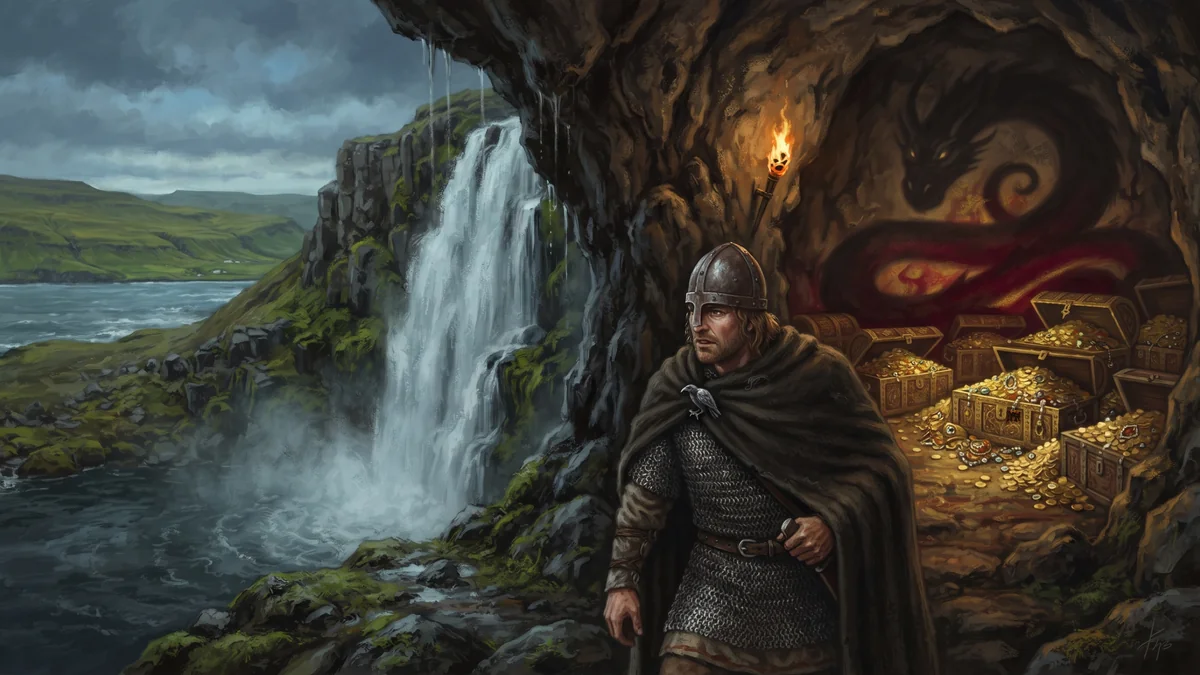
Gull-Þóris saga, also called Þorskfirðinga saga, is a saga of Icelanders about an ambitious settler who grows rich on the gold of dragons and pays dearly for it. This piece uses two sources, an encyclopaedia in English and the entry of the Danmarks Nationalleksikon, and separates what they state from what they leave open.
The setting
According to the first source, the saga is set in west Iceland during the Settlement, in the second half of the 9th century. Þórir Oddsson, Gull-Þórir (“Gold-Þórir”), arrives on the island with his father, Oddr skrauti, and marries Ingibjörg, daughter of Gísl, who had settled Gilsfjörður. He is chieftain at Þorskafjörður. The second source places the work before 930 and says its second part is set in Torskefjord.
The gold of the dragons
The two sources tell how the gold was won with different details. In the first, Þórir goes raiding with Hyrningr, son of Hallr of Hofstaðir, and in Finnmark he obtains gold and defeats dragons in a cave north of Dumbshaf. In the second, Gull-Tore opens a burial mound in Norway. Its occupant warns him but gives him magic weapons and treasure. The mound curses him: his eyes would be satisfied with wealth only late in life. The occupant points to a treasure guarded by dragons and gives a magic drink, with instructions that Tore ignores. He gets past a waterfall, defeats the dragons in a cave and keeps the hoard.
The division and the feud
Back in Iceland, Hallr wants a share of the gold for his son. This opens a dispute between Þórir and Hallr, and Þórir kills Hallr and Rauðr. Later he is reconciled with Hyrningr, who had not joined the feud. The second source adds other quarrels, over a stranded whale, grazing and missing sheep, and two witches, Turid Møgkind and Kælling.
The end
In the first source, at the end of his life Þórir hides his gold, and a rumour says he became a dragon. The second says the curse takes hold in old age: he ends up turning into a dragon lying on his chests of gold. The source states that this is the only saga of Icelanders to bring a dragon into the Icelandic landscape.
Terms
A saga of Icelanders is a saga about the first settlers of Iceland and their families. The Settlement is the period when the Norse established themselves on the island. A burial mound here is a funerary mound shaped like a hill. Stylometry is the statistical study of the style of a text.
What remains uncertain
The sources do not agree on the date or on the authorship. The second speaks of about 1350, while the first gives no date and reports arguments that Sturla Þórðarson wrote it, with studies from 2015 and 2021 (the latter by stylometry) in favour and a review that questions the vocabulary approach. The only surviving manuscript is from about 1400, with scraped pages, and parts of the text were completed from 19th-century copies. The two summaries differ on where and how the gold was won, and the first source treats the transformation into a dragon as a rumour, while the second narrates it as a fact of the story.
To jump gold coins on a board until only one is left, as in a guarded hoard, play The dragon’s coins.
Sources.
- Wikipedia, "Gull-Þóris saga" (setting, plot, authorship attributed to Sturla Þórðarson)
- Danmarks Nationalleksikon (lex.dk), "Guld-Tores saga" (dating, manuscript, plot, dragon motif)