The Vinland Map: what Yale's analyses showed about the ink
The Vinland Map, held at Yale, was presented in 1965 as a medieval map with the Norse Vinland. In 2021, analyses of the ink showed titanium of modern use. See what two sources say and what remains unanswered.
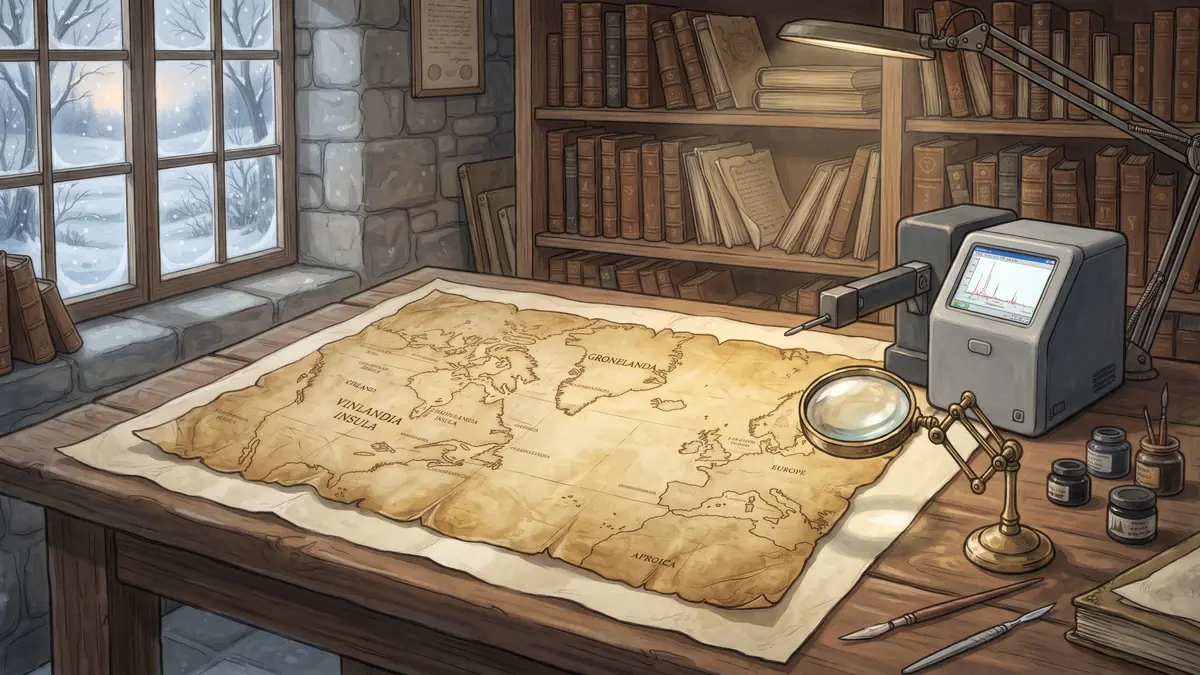
The Vinland Map is a map held in the Beinecke Library of Yale University, presented as a medieval map that would show the Norse Vinland. This piece uses two sources, a news item from the site medievalists.net and another from the Yale Library, from 2021, and separates what they state from what they leave open.
The map’s path
According to the sources, the map passed to a Swiss dealer after the Second World War. The British Museum declined it in 1957. Paul Mellon gave it to Yale, and the map was published in 1965. Before the dealer, its history is unknown, and the sources do not say how the dealer came to have it.
The 2018 research
The sources recall that Yale research from 2018 had already judged the map a modern creation, based on an 18th-century map.
The 2021 analyses
In 2021, analyses by X-ray fluorescence and Raman spectroscopy examined the ink. Both techniques examine the chemical composition of the ink, which is why they can date it by the elements present and not by the style of the drawing. They found an ink with titanium and barium, of a type first made in 1923, that is, in the 1920s. A medieval map could not have this ink. The analyses also showed that an inscription on the back of the map was rewritten in modern ink. It probably comes from a Speculum Historiale.
Yale’s conclusion
Raymond Clemens, of the Beinecke Library, summed up the result in one sentence: “The Vinland Map is a fake.”
Timeline
The dates the sources give, in order, are these: after the Second World War, the map reaches a Swiss dealer. In 1957, the British Museum declines it. Then Paul Mellon gives it to Yale. In 1965, the map is published. In 2018, Yale research judges it a modern creation. On 2 September 2021, the Yale Library releases the analyses of the ink.
Terms
X-ray fluorescence is a technique that identifies the chemical elements of a material without destroying it. Raman spectroscopy is a technique that identifies compounds by the light they scatter. The Speculum Historiale is a medieval historical encyclopaedia. Provenance is the history of the owners of an object. A forgery is an object made to look older or more authentic than it is.
What remains uncertain
The sources do not say who made the map, when, or why. The provenance before the Swiss dealer remains unknown. It also remains to be known what the forger had in front of him, since the 2018 research points to an 18th-century map, and the 2021 one links the back to a medieval text.
To find differences between a map and its copy, as in a forgery examined closely, play The map and the copy.
Sources.
- medievalists.net (2021), news item on the analyses of the Vinland Map at Yale (history, ink, inscription on the back, conclusion)
- Yale University Library, Beinecke Rare Book and Manuscript Library, news item of 2 September 2021 on the Vinland Map (analyses, titanium ink, statement by Raymond Clemens)