Nótt and Dagr: Night and Day in the Eddas, each with a chariot and a horse
In the Eddas, Odin gives Night, Nótt, and Day, Dagr, a chariot and a horse each and sets them in the sky. See what the sources say about their family, the horses and a disagreement between manuscripts.
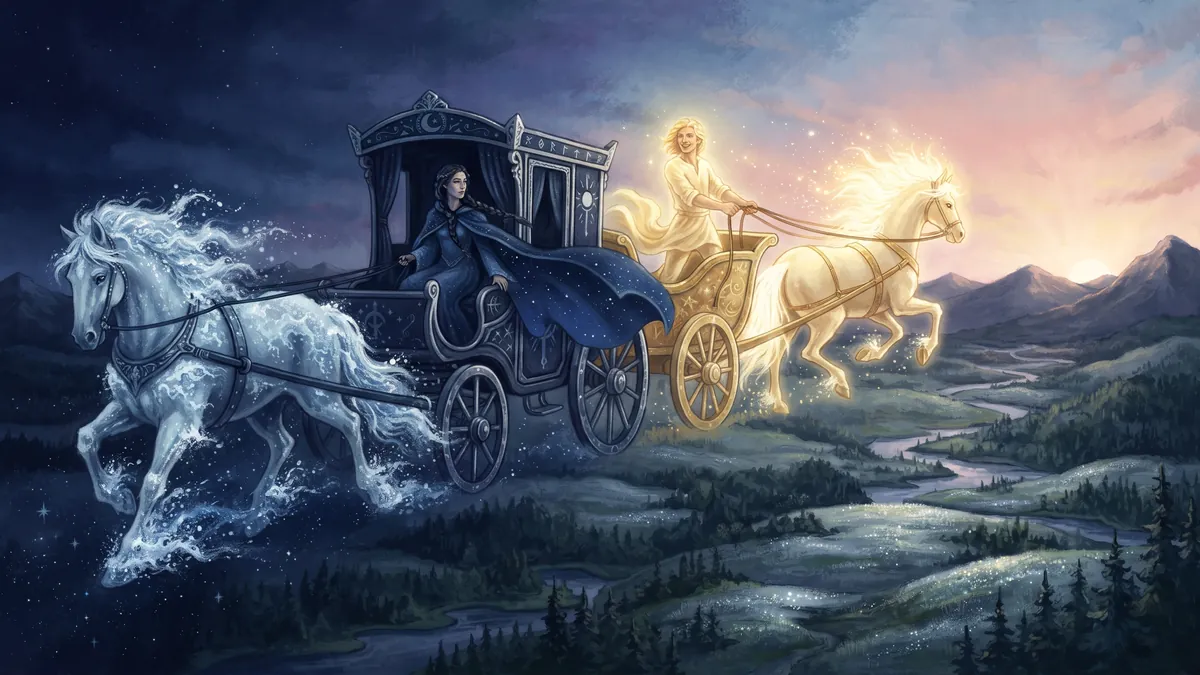
Nótt is the goddess who personifies night, and Dagr is day personified. Both appear in the Eddas, the Poetic Edda and the Prose Edda, as figures who cross the sky in chariots. This piece uses two sources, the entries of an encyclopaedia in English on Nótt and on Dagr, and separates what they state from what they leave open. Since these are myths, everything here is presented as what the texts tell.
The chariot and the horse
According to the Gylfaginning (chapter 10), Odin gave Nótt and Dagr a chariot and a horse each and set them in the sky, to travel around the Earth every 24 hours, with Nótt going ahead of Dagr. Nótt’s horse is Hrímfaxi. The Vafþrúðnismál (stanza 14) says the foam from its bit becomes the dew. The Skáldskaparmál (chapter 58) also gives Hrímfaxi the name Fjörsvartnir.
The horse of day
Dagr’s horse is Skinfaxi. The Vafþrúðnismál (stanza 12) says he lights up the sky, and the Skáldskaparmál calls him “Skinfaxi or Glad”. According to the Gylfaginning, Dagr is as bright and beautiful as his father’s people.
The family
The Gylfaginning calls the father of Nótt, Nörvi, also written Norfi or Narfi, a giant. According to it, Nótt had three marriages: to Naglfari, from whom came Auðr; to Annar, from whom came Jörð, the earth personified; and to Dellingr, from whom came Dagr. The Alvíssmál (stanza 30) gives names for night. The Sigrdrífumál mentions the “sons of Dagr”.
The sources side by side
The Gylfaginning, in prose, tells that Odin set Nótt and Dagr in the sky and gives the marriages of Nótt. The Vafþrúðnismál, in verse, is the source for the horses and the dew, and the Skáldskaparmál adds alternative names for them. The Alvíssmál gives names for night, and the Sigrdrífumál cites the “sons of Dagr”. None of these passages describes the face of Nótt, and the sources used here do not say how the Norse pictured her.
Terms
Edda is the name of two works of medieval Iceland, one of poems and one of myths in prose, by Snorri Sturluson. To personify is to give the form of a person to something abstract. Gylfaginning, Skáldskaparmál and Vafþrúðnismál are titles of texts in the Eddas. A stanza is the unit of a poem.
What remains uncertain
The manuscripts disagree on the mother of Dagr. The oldest, U, makes Jörð the wife of Dellingr and mother of Dagr, while R, W and T give Nótt as mother. Haukur Thorgeirsson argues that the U version arose from an accidental shortening of the text by a scribe. The father of Nótt appears as Nörvi, Norfi or Narfi. Otto Höfler proposed that Dagr may be linked to Svipdagr, but this is theory, not established fact. The sources also do not explain the other name of the night’s horse, Fjörsvartnir.
To balance suns and moons on a grid, with as many of one as of the other, play Day and night.
Sources.
- Wikipedia, "Nótt" (family, the horse Hrímfaxi, Eddic sources)
- Wikipedia, "Dagr" (parentage, the horse Skinfaxi, chariot, disagreement between manuscripts)