Harald Klak: the Danish king baptized in 826, ally of Louis the Pious
Harald Klak was a king in Jutland, lost the throne, asked the Franks for help and was baptized in 826. See what an entry says about the struggle, the baptism, the county of Rüstringen and what the sources leave open.
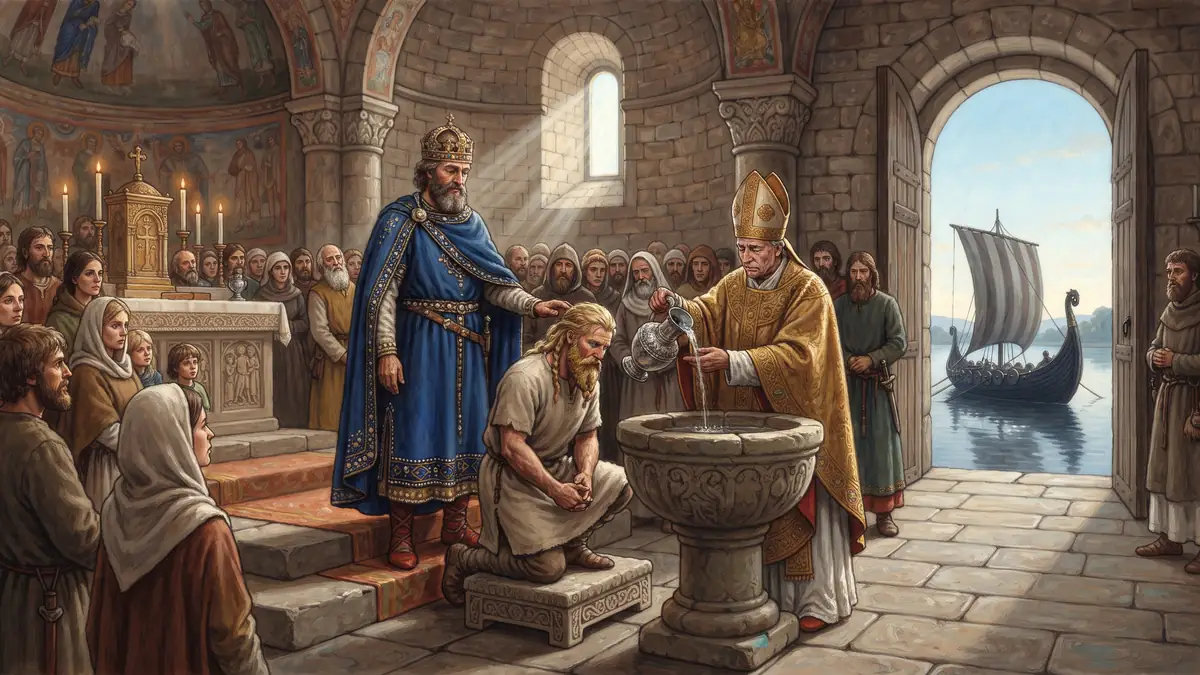
Harald Klak, or Heriold in the Frankish sources, was a king in Jutland, possibly in other parts of Denmark, in the early 9th century. This piece uses one source, an entry of an encyclopaedia in English, which gathers what the Frankish annals and other texts say. The dates and the kinships vary between sources, and this is marked.
Who he was
The entry gives Harald’s life as from about 785 to about 852. He was of the House of Harald and followed the Norse religion until 826, when he became a Christian. As for the reign, the text gives the years from about 812 to 814 and from 819 to 827, and the infobox gives 812 to 813 and 819 to 827. His father is uncertain. The only mention in a source of the time of a common father is an entry of 837 of the Annals of Fulda, which calls Hemming a son of Halfdan. The known brothers are Anulo, who died in 812, Ragnfrid, who died in 814, and Hemming.
The struggle of 812
According to the Royal Frankish Annals, after the death of King Hemming, Sigifrid and Anulo fought for the throne. Both died, Anulo’s side won, and Heriold, that is, Harald, and Reginfrid were made kings. The sources give for this battle the figure of 10,940 dead. In 813, Harald and Reginfrid were expelled by the sons of Godofrid. In 814, Reginfrid and the eldest son of Godofrid died in fighting, and Harald fled to Louis the Pious, who sent him to Saxony to await support. The campaign of 815, with Saxon and Obotrite forces, failed: the weather delayed the crossing of the Elbe, and the expedition returned without restoring Harald.
The second attempt
In 817, Louis gave aid to Heriold against the sons of Godofrid, who had sought peace. In 819, with Obotrite help, Louis had Harald taken to his ships. He sailed home and, by 821, shared rule with two sons of Godofrid, among them probably Horik the Elder. The Royal Frankish Annals say the arrangement may have been achieved “by trickery”.
The baptism of 826
The sources differ on the place. The Royal Frankish Annals, the Vita Hludovici and Adam of Bremen place it at Mainz, at St Alban’s, and the Annals of Xanten at an episcopal synod at Ingelheim. According to the Royal Frankish Annals, Harald came with his wife and many Danes, was baptized with his companions and received many gifts. The Vita Ansgari says Louis urged him to convert, partly so that a Christian people would support him more readily, and that Louis was his godfather and adopted him as a son. The Annals of Xanten speak of more than 400 people baptized with him.
Rüstringen
Louis gave Harald the county of Rüstringen, in Frisia, as a refuge in case he was ever in danger. The fief lay in northwestern Germany, west of Oldenburg, and may have been the first Frankish territory given to a Dane. It may also have been meant for Harald to defend the Frisian coast against Viking raids, since Louis had no effective fleet. According to Rimbert and the Vita Ansgari, after the baptism Harald and two monks, among them Saint Ansgar, went back to Denmark. The entry says that perhaps from this came a church in Hedeby and a school for twelve Danish boys.
The final loss
In 827, Horik I and his brothers expelled Harald, with no reason given. His Christianity may have made him unpopular. He probably retreated to Rüstringen. In 828, he broke a peace agreement and burned villages, and the border war continued into 829. After about 829, Harald disappears from the Frankish sources. The Annals of Fulda, in the entry of 852, say he fled Horik’s anger, was well received by Louis and baptized, and that later Frankish leaders, suspecting disloyalty, killed him.
In brief
Harald Klak lost the throne twice, sought Frankish support and was baptized in 826, with Louis the Pious as godfather. He received Rüstringen as a refuge. He was expelled again in 827 and disappears from the sources around 829.
Terms
Royal Frankish Annals are chronicles of the Frankish court. County is a region given to a count to govern. Godfather is the one who presents the baptized person to the Church. Obotrites are a Slavic people allied with the Franks.
What remains uncertain
Harald’s father and the exact dates of his reign are uncertain. It is not known whether he ruled beyond Jutland, nor whether the families of Sigifrid, Anulo and Harald were linked as some genealogists suppose. The place of the baptism is Mainz or Ingelheim, depending on the source. A Harald who dies in 852 may be another. His sons and daughter are disputed, and the sagas give different genealogies.
To link the numbers in sequence through neighbouring squares, up to the river mouth, play To the river mouth.
Sources.
- Wikipedia, "Harald Klak" (who he was, struggle of 812, exile, baptism of 826, Rüstringen, last years, family, sources)