The giant who had no heart in his body: the Norwegian tale of Asbjørnsen and Moe
A prince, a raven, a salmon and a wolf face a giant who kept his heart in an egg. See the plot of the Norwegian tale collected by Asbjørnsen and Moe and what the entry says about versions around the world.
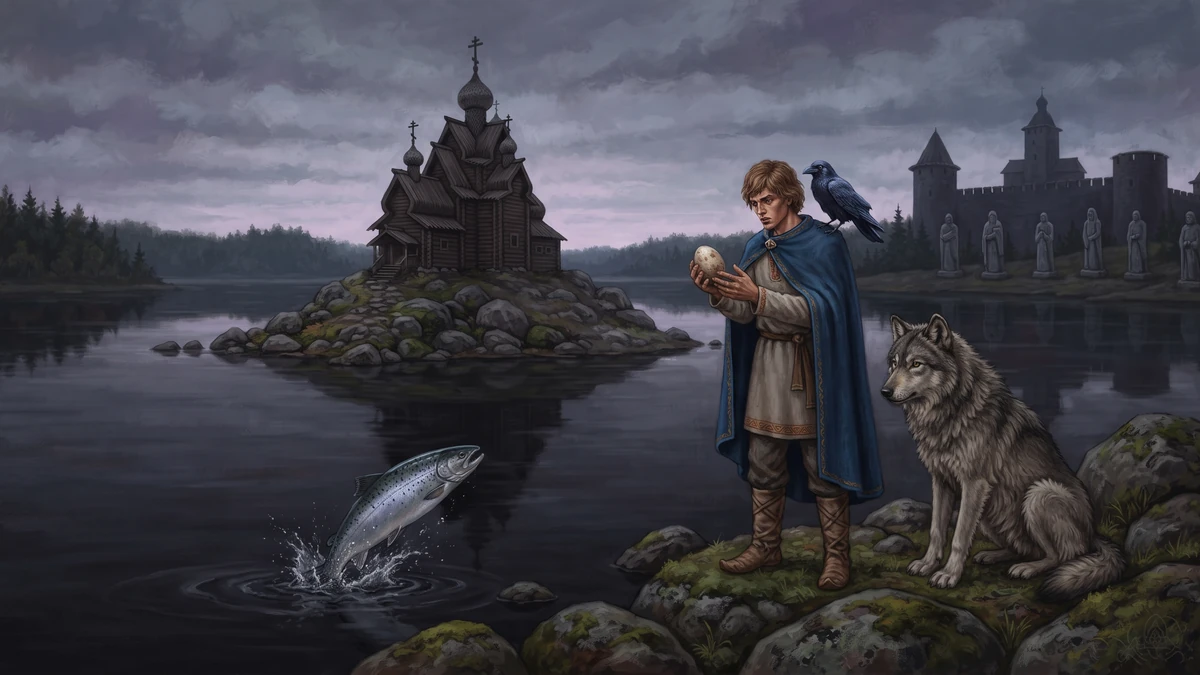
The Giant Who Had No Heart in His Body (in Norwegian, Jetten uten hjerte) is a Norwegian folk tale, collected by Asbjørnsen and Moe. This piece uses one source, an entry of an encyclopaedia in English, which summarizes the plot and compares versions. It is a tale, not history: everything that happens in it is fiction of tradition.
The beginning: seven sons and a forgotten bride
A king had seven sons. He kept the youngest at home because he could not bear to be parted from them all. The six older ones set out to look for brides and were to bring one for the youngest too, but they found a king with six daughters, wooed them and forgot their brother. On the way home, they passed too close to the castle of a giant. In a rage, the giant turned the six princes and their brides to stone.
The youngest sets out
As his brothers did not return, the king tried to stop the youngest son from leaving, but he went. On the journey, he fed a starving raven, helped a salmon back into the river and gave his horse to a starving wolf. The wolf let him ride it, showed him the giant’s castle and persuaded him to enter. Inside he would not find the giant, but a prisoner, a very beautiful princess. She told him that the giant could not be killed, because he did not keep his heart in his body.
Where the heart is
When the giant returned, the princess hid the prince and asked where the heart was kept. The giant said under the door sill, and the two dug and found nothing. The princess strewed flowers on the door sill and told the giant that the heart was there. He answered that it was not, that it was in the cupboard. They searched the cupboard and found nothing, and she decked the cupboard with garlands. Then the giant revealed the true place: a distant lake, with an island, a church on it, a well inside the church, a duck swimming in the well, an egg in the duck’s nest, and the heart inside the egg.
The egg
The prince rode to the lake, and the wolf jumped to the island. The raven he had saved brought him the keys of the church. Inside, he coaxed the duck, but the duck dropped the egg into the well. The prince called the salmon, which retrieved the egg. The wolf told him to squeeze the egg. When he did, the giant screamed. The wolf told him to squeeze again, and the giant promised anything to spare his life. The prince ordered him to restore the brothers and their brides to human shape, and the giant did so. The prince split the egg in two and went home with the princess as his bride. The brothers and their brides came along, and the king rejoiced.
A harsher version
The entry mentions a version in which the boy splits the heart in two, eats it with the wolf, chops off the giant’s head and keeps it as a trophy.
The tale type and the versions
The tale is classified as ATU 302, “The Giant (Ogre) who had no heart in his body” or “Ogre’s Heart in the Egg”. According to the entry, the type has about 250 recorded versions across Europe, Asia, America and North Africa. By Stith Thompson, in Asian versions the heart is in a bird or insect, and in European tales it is guarded in an egg. The entry cites The Golden Bough, by James George Frazer, for the motif of the external soul, which it describes as ancient and widespread. It also cites the version of Haltrich, from the Transylvanian Saxons, in which an old witch petrifies the brothers and the youngest frees her light of life, hidden in an egg inside a duck, and a Hungarian version in which the heart is in a bird inside a mountain.
In brief
The youngest of seven princes saves six petrified brothers because he helped a raven, a salmon and a wolf. The giant’s heart was in an egg, inside a duck, in a well, in a church, on an island. The tale has about 250 recorded versions.
Terms
Folk tale is a story of oral tradition, later collected in writing. ATU is an international system of classification of tale types. External soul is the motif of keeping someone’s life outside the body. Variant is a different version of the same tale.
What remains uncertain
The entry does not give the date or the exact source of the collection by Asbjørnsen and Moe, does not name the king, the princes, the princess or the castle, and does not explain how the heart came to be in the egg or why the wolf helps. Nor does the entry’s plot mention a chest or a ring. Some claims are attributed to scholars without further detail.
To find the right numbers on a grid and leave only the repeated ones in stone, play The brothers of stone.
Sources.
- Wikipedia, "The Giant Who Had No Heart in His Body" (plot, Asbjørnsen and Moe, type ATU 302, variants, external soul)