The St Brice’s Day massacre of 1002: Æthelred’s order and what is found at Oxford
On 13 November 1002, King Æthelred ordered the killing of Danes in England. See what two sources say about the order, the finds at Oxford and in Dorset and what historians debate.
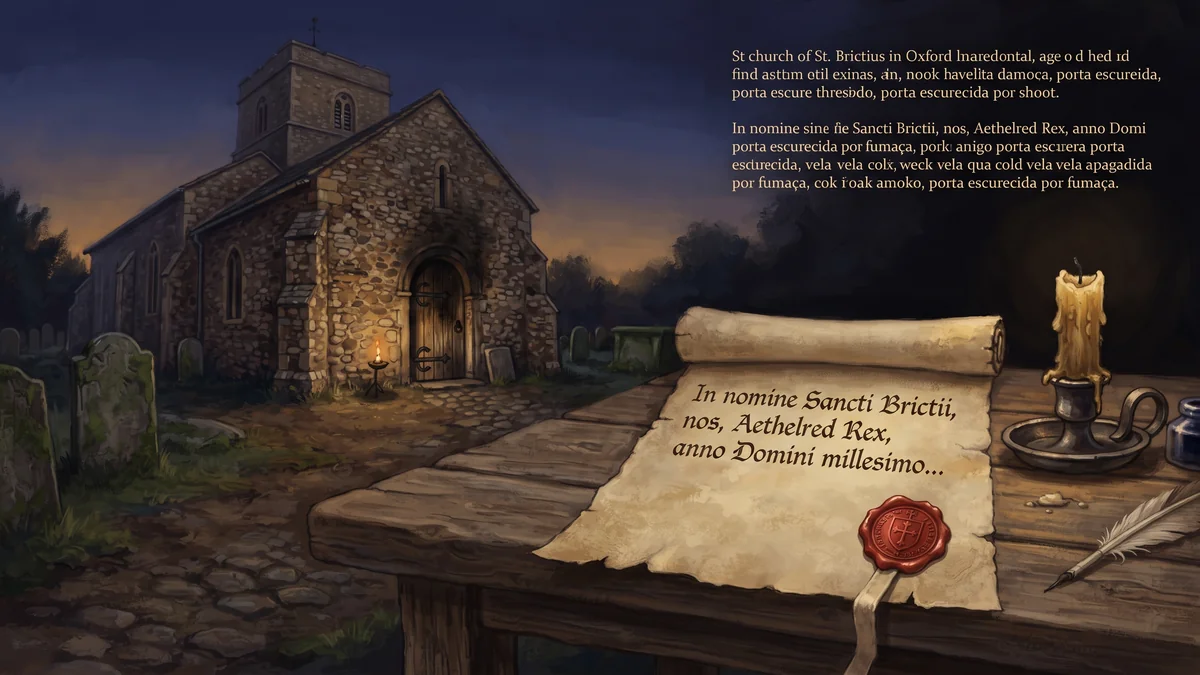
On 13 November 1002, the feast day of St Brice, King Æthelred the Unready ordered the killing of Danes in England. This piece uses two sources, an entry of an encyclopaedia in English and an article of the magazine History Today. The subject is the violent death of people, and the texts point out how much is still unknown.
The context
According to the entry, Danish raids resumed in earnest in the 980s and became much more serious in the early 990s. After the Battle of Maldon, in 991, Æthelred paid tribute, the Danegeld, to the Danish king. The kingdom was raided every year from 997 to 1001, and in 1001 a Danish army rampaged across southern England burning many towns. In spring 1002, Æthelred married Emma of Normandy, and the History Today article sees it as an alliance. The entry recalls that some Danes had arrived as traders and intermarried with the Anglo-Saxon population, and others settled in Wessex as farmers.
The order
In 1002, Æthelred was told that the Danish men in his territory would take his life, with that of his counsellors, and seize the kingdom. The Anglo-Saxon Chronicle says the king “gave an order to slay all the Danes that were in England”. For the entry, historians generally assume the order targeted the Danish army, recent settlers and remnants of Æthelred’s mercenary force, some of whom had joined the invaders. The History Today article speaks of “all the Danish men who were among the English race”.
The charter of 1004
At Oxford, according to the entry, Danish families fled into the church of St Frideswide, which was set on fire. A charter of 1004 by Æthelred himself calls the Oxford killings “a most just extermination” of Danes who had “sprung up in this island”, and says the church burnt with its ornaments and books and that he rebuilt it. It is now Christ Church Cathedral. The History Today article says he described them as sprouting “like a cockle amongst the wheat”.
What was found at Oxford
In 2008, an excavation at St John’s College, Oxford, found the remains of 37 people, presumed victims of the massacre. All were male except two who were too young to be sexed, and most were aged 16 to 25. A chemical analysis of 2012 suggested the remains were Viking. The chief archaeologist concluded that the victims had no defensive wounds, were unarmed and were killed while fleeing the burning church, with wounds on their backs. Radiocarbon dating gives a burial between 960 and 1020. DNA from one body closely matched that of a man excavated at Otterup, on the island of Funen, in Denmark.
The pit at Ridgeway Hill
At Ridgeway Hill, near Weymouth, in Dorset, road building revealed a pit with 54 Scandinavian men, all beheaded, from between 970 and 1038. The entry says there may be a link with Oxford and with the decree, but that this is not confirmed.
What historians debate
The entry gives several readings: Simon Keynes sees the reaction of a people attacked repeatedly, with mercenaries turning on their employers, Ian Howard sees a response to the treachery of the mercenary army, and Ryan Lavelle proposes that the massacre was confined to frontier towns and to larger towns with small Danish communities. He notes that the charter shows no remorse. Most historians agree that an extermination across all of England was implausible. Afterwards, Sweyn invaded in 1003, and the entry cites scholars who link the massacre to Cnut’s taking of the throne in 1016.
In brief
On 13 November 1002, Æthelred ordered the killing of Danes in England. At Oxford, the church of St Frideswide was burnt, and a charter of 1004 admits the fact. Excavations found the remains of 37 people at Oxford and a pit in Dorset, but the link is not certain.
Terms
Danegeld is the tribute paid to invaders so that they would leave. Anglo-Saxon Chronicle is the medieval chronicle in Old English. Charter here is a royal document of grant. Radiocarbon dating measures the age of bones and wood.
What remains uncertain
There is no estimate of how many died. Ian Howard assumes no more than a few hundred, nearly all from the invading army and their families. The historian Levi Roach notes that it is impossible to link conclusively the Oxford and other graves to St Brice’s Day, since violence between groups was regular in this period. The entry says that Gunhilde, sister of Sweyn, would have died with her husband Pallig, but the only source is William of Malmesbury, and the historian Ann Williams considers it a myth. History Today gives her as “apparently” killed at Oxford, which shows the divergence between the two sources.
To rebuild the order of the numbers of a square in which all the lines add up to the same, play The square of numbers.
Sources.
- Wikipedia, "St Brice's Day massacre" (date, order, Anglo-Saxon Chronicle, charter of 1004, finds at Oxford and in Dorset, debate)
- History Today, "The St Brice's Day Massacre" (context, order, Oxford, interpretations)