Urnes: Norway’s stave church and the carving style that bears its name
The stave church of Urnes, on the Lustrafjord, holds carvings of interlaced animals that gave the Urnes style its name. See what two sources say about the dates, the reused parts and the readings of the portal.
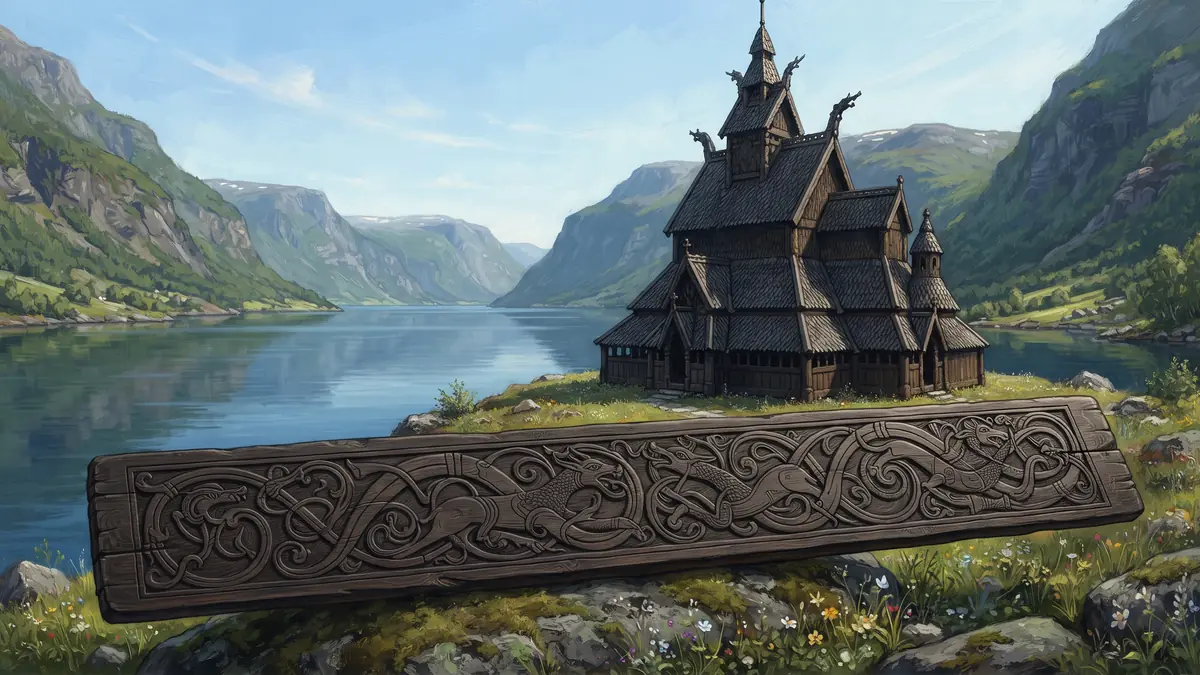
The stave church of Urnes, in Norway, is known for the design of interlaced animals on the north portal. This piece uses two sources, an entry of an encyclopaedia in English and the text of the UNESCO World Heritage Centre. The mythical readings of the portal are marked as interpretation.
Where it is
The church is at Ornes, on the Lustrafjord, in Luster municipality, in Vestland county. It stands on the eastern side of the fjord, across from Solvorn, and about five kilometres east of Hafslo. UNESCO places it on a promontory in the Sognefjord. The entry says it was inscribed as a World Heritage Site in 1979, under criteria i, ii and iii.
The dates
According to the entry, the church was completed around 1132, by dating from tree rings, or, as the text puts it, around 1130 or shortly after. Parts of the timber are from the second half of the 11th century. An excavation in 1956 revealed two earlier churches on the same site. The first was built in the transition to Christianity, in the palisade style, with parts embedded in the ground. The second is from the second half of the 11th century. Both were small, with a nave and a chancel. UNESCO says the church dates from the 12th and 13th centuries and is one of the oldest stave churches in Norway.
What came from the earlier church
The building reused parts of the church of the 11th century. From the earlier building remain the portal, two wall planks in the north wall, the corner post of the chancel, the west gable of the nave and the east gable of the chancel. The entry says that the portal and the gable planks are “probably relics” of one of the earlier churches, and speculates that the portal may originally have been the main one, facing west. UNESCO stresses this large-scale reuse of elements of a church built about a century earlier.
The Urnes style
The Urnes style is an animal-ornamentation style, named by art historians, and the north portal is its defining example. The carving shows interlaced animals, snakes and dragons, with plants reduced to vine-like forms. According to the entry, the main point of the design is the intertwinedness itself of all living things, animal or vegetable. The decoration is described as one of the last examples of Viking Age animal ornamentation. On the right side, about a third of the way up, a serpent emits a fleur-de-lis from its mouth. UNESCO speaks of interlaced fighting animals on the north wall, with similar carvings on the west and east gables.
Readings of the portal
The entry presents mythical readings as possibilities. The struggle between the serpent and the “great beast” on the portal may represent the onset of Ragnarök, and the animal may be Níðhöggr gnawing the roots of Yggdrasil. It also speculates that the earlier church may have had scenes from Norse mythology, which would explain its “premature” rebuilding in the 12th century. In a Christian sense, the portals would symbolise the struggle with evil in daily life.
The architecture
It is a stave church on a long basilica plan, with a raised central space and lower side aisles. The roof of the central compartment is 2 m higher than those of the aisles, and the framework has 16 large staves. The columns are cylindrical, with cubic capitals, and the arches are semicircular, which recalls Romanesque stone architecture. The interior capitals carry human, animal and plant figures.
In brief
Urnes is a stave church of about 1130 that reused the portal and other parts of an earlier church. The design of interlaced animals on the north portal gave the Urnes style its name. The readings linked to Ragnarök are interpretations.
Terms
Stave church (stavkirke) is the Norwegian medieval church with a frame of wooden posts. Urnes style is the style of ornamentation with interlaced animals. Gable is the triangular wall under the roof. Capital is the top of a column. Tree-ring dating uses the rings of wood to know when the tree was cut.
What remains uncertain
The readings of the portal, such as Ragnarök and Níðhöggr, are interpretations, and the original position of the portal and the decoration of the earlier church are speculation. The entry says the church is “believed” to be the oldest of its kind. The sources give slightly different counts of surviving stave churches in Norway, 28 or 30, and slightly different dates for the completion.
To remake the portal plank, sliding the pieces until the design returns to its place, play The planks of the portal.
Sources.
- Wikipedia, "Urnes Stave Church" (place, dates, earlier churches, reused parts, Urnes style, readings of the portal, UNESCO)
- UNESCO, World Heritage Centre, "Urnes Stave Church" (description, criteria, integrity, authenticity)