Uunartoq: the wooden disc found in Greenland and the idea of the sun compass
In 1948, in Norse Greenland, an archaeologist found a fragment of a wooden disc with notches. One hypothesis says it was a sun compass for Viking navigators. See what is known and what is debated.
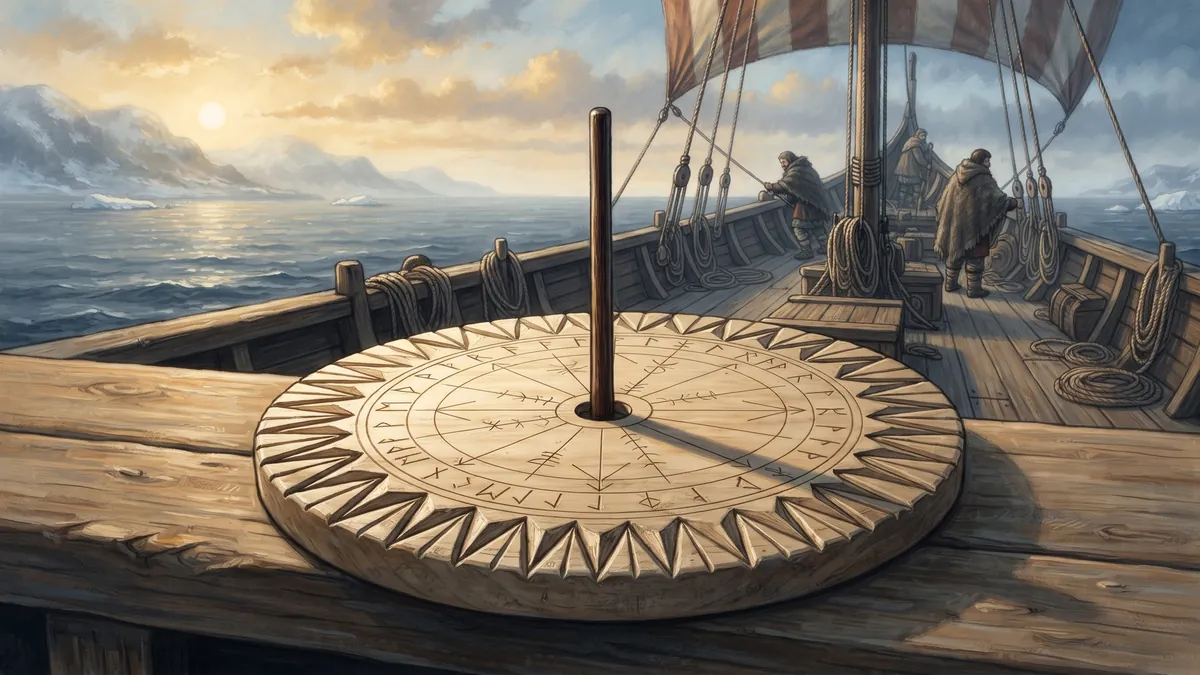
The Uunartoq disc is a fragment of a wooden disc, with triangular notches on the rim and a hole in the centre. This piece follows the article “Uunartoq Disc”, which uses careful language, with phrases such as “generally accepted” and “appears to”, and that shows here too.
The find
In 1948, the Danish archaeologist Christen Vebæk found the disc while excavating site Ø149, on the western shore of a fjord that the Norse called Siglufjord and that is now called Uunartoq, in Norse Greenland. The site has a church that is generally accepted to be the Benedictine convent mentioned by Ivar Bardarson in the mid-14th century.
The object
It is a fragment of a wooden disc, probably softwood, perhaps larch or spruce, although some sources say oak. The article gives 7 cm in width, 1 cm in thickness and a central hole 1.7 cm in diameter. There are triangular notches chip-carved on the rim. The disc has eight increments in each quadrant, 32 in all, which matches the traditional mariner’s compass, and a small round dimple on the ninth increment marks east.
The idea of the sun compass
Carl V. Sølver examined the notches and the scored lines and concluded it was a sun compass for finding true north. The central hole would take a handle with a horizontal directional pin and a vertical pin that casts a shadow. Sølver made a speculative illustration, a replica was built from it, and Vebæk ended up accepting the explanation. The gnomonic lines would be consistent with the summer solstice and the equinoxes, and in 1990 it was shown under the microscope that they were deliberately traced twice. In use, the disc is held level, the positions of the shadow are marked through the day, and the line of closest approach, at noon, indicates north.
What was tested later
In 1984, the expedition of Ragnar Thorseth, on a replica of a Norse ship, tested replica discs against a modern compass on the passage between Iceland and Greenland, and the deviation was described as “negligible”. In 2013, researchers at Eötvös University, in Hungary, proposed that the disc could also measure latitude. In 2018, another study from the same university concluded that sky-polarimetric navigation worked well at the spring equinox and the summer solstice, even with clouds. A similar object found near Wolin, in Poland, in 2000, strengthened the hypothesis.
In short
The disc is a small fragment, and the sun compass hypothesis is the most accepted, but it is not a proof. Even so, it changed the idea that the Norse sailed only by eye.
Terms
Gnomon is the rod that casts a shadow to mark the hour or the direction. Equinox is the day when night and day have the same length. Sunstone is a crystal, perhaps Iceland spar, that would help find the sun.
What remains uncertain
The material, softwood or oak, is debated. The magnetic compass only appears in Europe in the early 13th century, and the article recalls that, with land out of sight, finding true north by day would be hard. Some scholars continue to argue against Norse navigation instruments. The use for measuring latitude and the twilight compass are proposals of researchers, not conclusions.
To hold a ship on course by the shadow of the disc, correcting the drift, play Course by the sun.
Sources.
- Wikipedia article "Uunartoq Disc"
- Carl V. Sølver, study on the disc, as cited in the article
- Eötvös University studies (2013 and 2018), as cited in the article