Herjólfsnes: the wool clothes found in the graves of Norse Greenland
In 1921, the archaeologist Poul Nørlund dug the churchyard of Herjólfsnes in Greenland and found hoods, hats and dresses of wool in European fashion. See what the clothes say about the Norse who lived there.
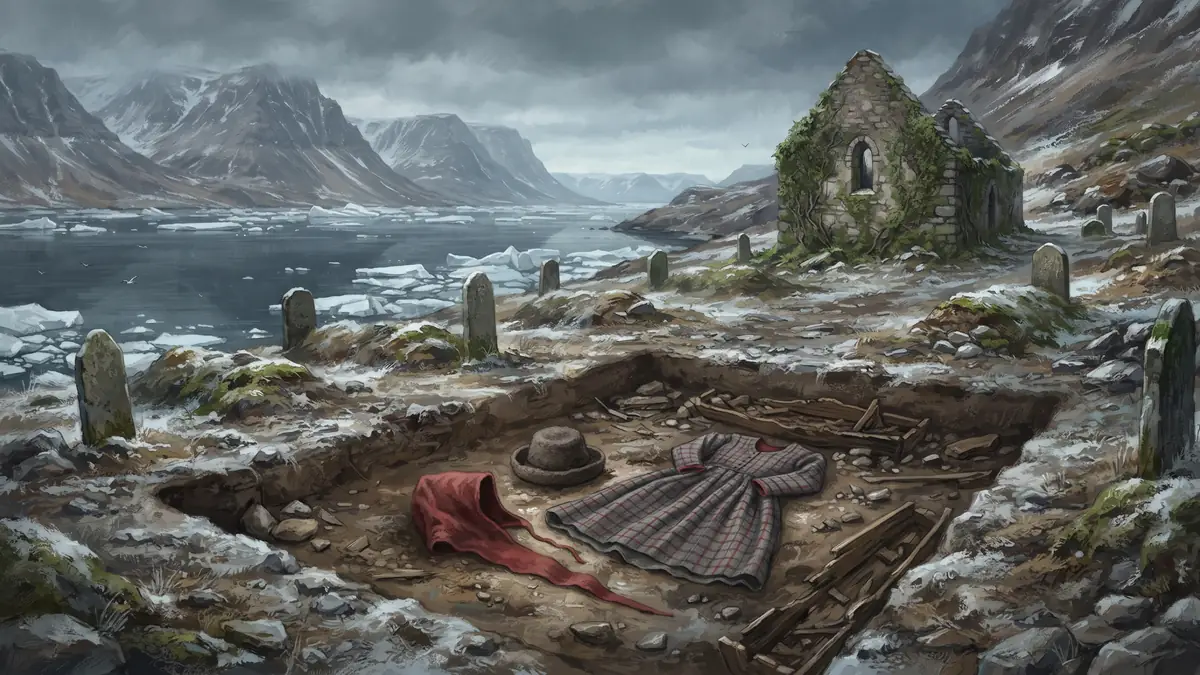
Almost everything we know about the Norse of Greenland comes from stone ruins and a few lines of sagas. At Herjólfsnes the earth kept something else: the clothes people wore to be buried. They show a people far more tied to Europe than was imagined.
The place
Herjólfsnes lies in Greenland, some 50 kilometres northwest of Cape Farewell. The name comes from Herjólf Bárðarson, an Icelander who joined the colonists of Erik the Red around 985. He settled at the end of a fjord facing the open sea, which suggests he wanted to make a port for ships there, more than a farm.
The excavation of 1921
In 1921, the National Museum of Denmark began an urgent dig in the churchyard, led by the archaeologist Poul Nørlund, because the rising sea was eroding the ground. Many of the dead lay wrapped in layers of wool clothing instead of wooden coffins, probably because wood was scarce. Some who were lost at sea were commemorated with rune sticks placed in the graveyard.
What was found
Nørlund’s team recovered whole and partial costumes, hats, hoods and stockings. Among the pieces are cotehardies, close-fitting garments of European fashion, hoods with a long tip, the liripipe, and hats in the “Burgundian” style and in a round shape. This shows the community followed the fashion of Europe. Carbon dating indicates that garments were still being made around 1430.
What the clothes suggest
The quality of the work and the care for fashion point to a community that was not destitute. The historian Helge Ingstad said these people were “certainly not” on the brink of extinction. The clothes also feed the question of the colony’s end, since the Norse presence in Greenland is poorly documented after about 1410.
Why fashion matters
A hat or a hood seems a small thing on which to discuss a whole colony, but clothing depends on cloth, on pattern and on news. Someone who makes a hood with a long tip in the right style knows how people in Europe dress at that time. It is an inference by the authors, not a sentence from any source, but it is a clue that news and ideas were still reaching the island.
In short
Herjólfsnes, in Greenland, yielded in 1921 hoods, hats and dresses of wool in the European fashion of the 14th and 15th centuries. They show a colony tied to Europe, but they do not explain its disappearance.
Terms
A cotehardie is a close-fitting medieval garment. A liripipe is the long tip hanging from certain hoods. Carbon dating measures the age of organic material. A rune is a letter of the ancient Norse.
What remains uncertain
Whether the community was thriving or in decline, and why the Norse presence vanishes from the sources after about 1410, is still debated. The clothes say how people dressed, not why they disappeared.
To weave a wool cloth by checking the order of the coloured threads, play The wool cloth.
Sources.
- Poul Nørlund, Buried Norsemen at Herjolfsnes (1924)
- Else Østergård, Woven into the Earth: Textiles from Norse Greenland (2004)
- Wikipedia, "Herjolfsnes"