Ukko: the Finnish god of thunder and the feast of the vessel that asked for rain
Ukko is the "old man" of the Finnish sky, tied to thunder, rain and the harvest. See the May feast at which a vessel of drink was offered, what Agricola wrote in 1551 and what stays uncertain.
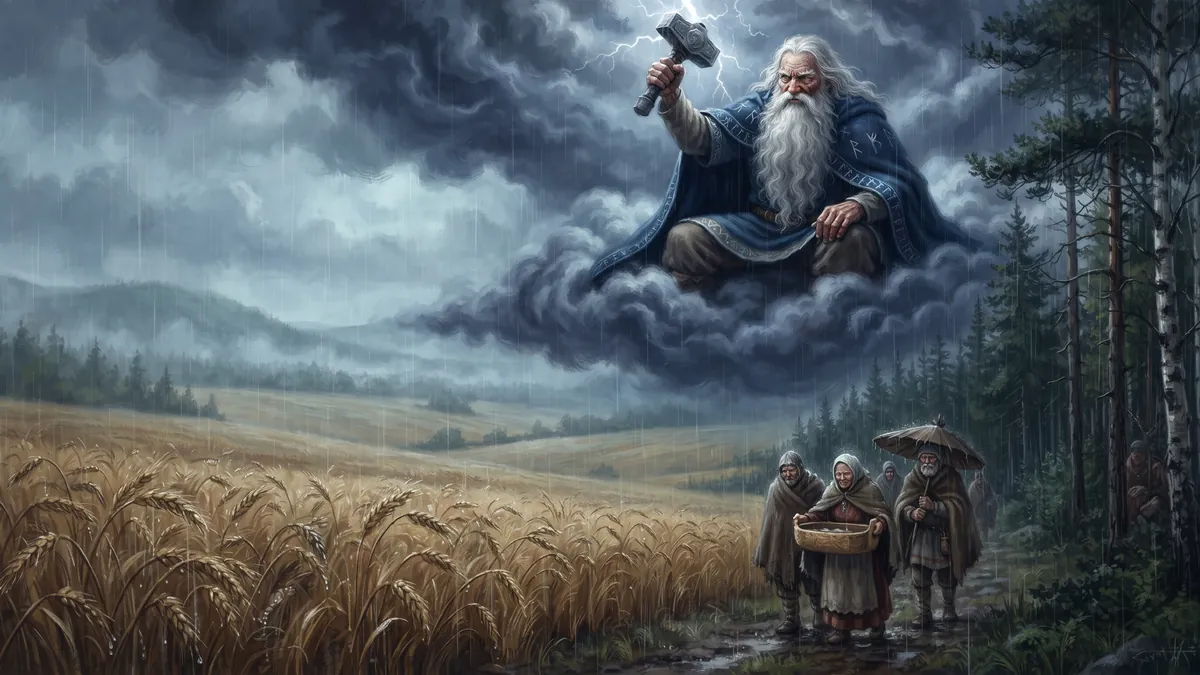
For anyone sowing barley in the north, the sky decided almost everything, and the Finns had a name for whoever ruled it: Ukko, the “old man”. Little is known about him for certain, because his cult was written down late, and by people who wanted it gone. What the sources allow us to say is enough to see why thunder and rain were treated as a matter of faith.
The old man of the sky
Ukko means “old man” or “grandfather”, and ukkonen, the Finnish word for thunder, is a diminutive of the same name. Ukko was the god of thunder, weather and harvest. The rain that came with him made the crops grow, so people also asked him for help with work, weddings, healing, hunting and fishing. The weapons the old songs give him are a golden axe, a club, a sword and a hammer, the Ukonvasara, which recalls Thor’s Mjölnir. The thunderstones that country people found in the soil were called Ukon naula, “Ukko’s nail”.
The feast of the vessel
The best-known ceremony is the Ukon vakat, also called vakkajuhlat, the “feast of the vessel”. It took place in May, at sowing time. The community brought a vessel, the vakka, full of drink or food, usually to a sacred grove, and sometimes sacrificed an animal. The request was simple: good weather and a good harvest. The last clear reports of the feast date from the 19th century, with scattered accounts in the 20th.
Agricola and the Kalevala
The first written mention of Ukko is from 1551, in the preface that Mikael Agricola, the reformer who wrote the first book in Finnish, put into his Psalter. He listed the gods of the Finns to show what the new faith was meant to replace, and described the feast of the vessel as idolatry. Modern readings of that text, including a link to a figure called Rauni, are still debated. Centuries later, Elias Lönnrot gathered the folk songs in the Kalevala and presented Ukko as the supreme god. Julius Krohn disagreed: for him, Ukko was not the chief of the other gods.
After the conversion
Ukko did not vanish at once. He took on features of a Christian protector and a ruler of the sky. The summer feast that honoured him, the Ukon juhla, went on under the name of the feast of John the Baptist, Juhannus, which Finns still celebrate.
In short
Ukko is the old man of the Finnish sky: thunder, weather and harvest. His best-known rite was the May feast, with a vessel offered in the grove, and what we know comes mainly from Agricola in 1551 and from later collectors.
Terms
Vakka is the vessel of the offering. Ukkonen is thunder. Juhannus is the midsummer feast, tied to Saint John. A Psalter is the book of psalms.
What remains uncertain
Because the cult appears in writing only in 1551, we cannot tell how much of what Agricola and later collectors describe was old and how much was mixed with Christian belief. Ukko’s own place among the gods, supreme or one among several, is still debated.
To steer a thunder cloud over the fields and let the rain fall in the right place, play Rain on the field.
Sources.
- Mikael Agricola, preface to Dauidin Psaltari (1551)
- Elias Lönnrot, Kalevala (1849 edition)
- Wikipedia, "Ukko"