Bifröst: the three-coloured bridge the gods cross every day
Bifröst joins earth to heaven in Norse mythology. See what Snorri and the Poetic Edda say about its colours, its fire, Heimdall and the day the bridge breaks, and what remains uncertain.
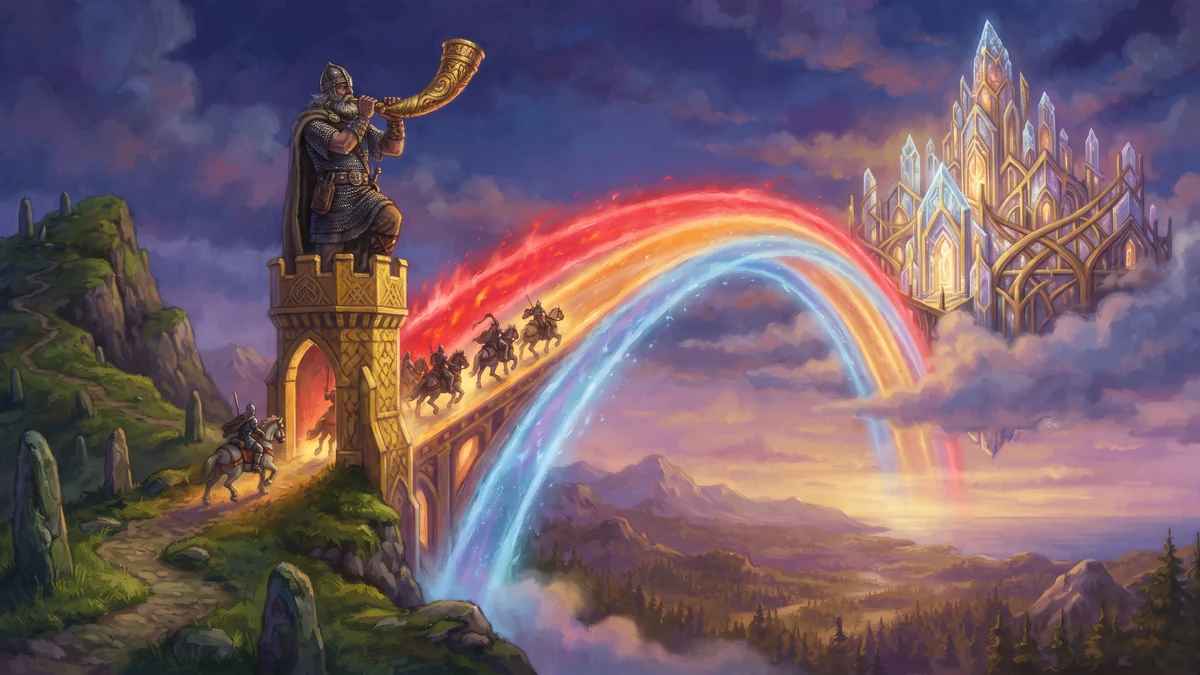
When the Norse wanted to explain how the gods travel from their home to the world of men, they spoke of a bridge. It appears in poems and in Snorri’s work under similar names, and the descriptions are short but say a lot: the bridge has colours, burns in part, is guarded and, at the end of time, does not hold.
Three names for one bridge
In the poems of the Poetic Edda, in Grímnismál and Fáfnismál, the bridge is called Bilröst. In the Prose Edda, in Gylfaginning and Skáldskaparmál, it appears as Bifröst. Both texts also call it Ásbrú, the “bridge of the Æsir”. In Grímnismál, Odin calls it the best of bridges. In the tenth century, the skald Úlfr Uggason already called it “the way of the powers”.
Colours, fire and Thor’s exception
In Gylfaginning (chapter 13), Snorri says the bridge was made by the gods with art and skill and that it has three colours. In chapter 15 he tells that the gods ride across it every day, and that the red part is burning fire. Only Thor goes on foot: he wades through the rivers Körmt and Örmt and the Kerlaugar, so that the bridge does not catch fire under him, which fits the idea that it grows hot. The bridge reaches heaven at Himinbjörg, the home of Heimdall (chapter 17).
The guard and the end
According to chapter 27, Heimdall lives at Himinbjörg and guards the bridge against the mountain giants. In chapter 51, Snorri describes Ragnarök: the sky opens, the sons of Muspell ride over the bridge and it breaks. In Fáfnismál, the dying dragon says the gods meet at Óskópnir and that, when they cross Bilröst, it will break apart and their horses will have to cross a great river. In Snorri’s text, Gangleri finds it odd that the gods built a bridge that breaks, and High answers that nothing is safe when the sons of Muspell attack.
What might the bridge be?
Scholars propose different readings. The most famous is the rainbow, but there are objections: a rainbow does not touch the sky at a fixed point and has steady colours, while the bridge burns. Some suggest the Milky Way, and others the aurora borealis, whose moving light would suit the fire and the changing colours. Andy Orchard links the name to the idea of a “shimmering path”, and Rudolf Simek proposes “the swaying road to heaven”.
In short
Bifröst is the bridge of the gods, three-coloured, partly fire, guarded by Heimdall and fated to break at Ragnarök. Almost everything we know comes from Snorri, in the thirteenth century, and from a few stanzas of the Poetic Edda.
Terms
Gylfaginning is the first part of the Prose Edda. A skald is a Norse court poet. Himinbjörg is the “mountain of heaven”, Heimdall’s home. Muspell is the realm of fire.
What remains uncertain
The sources do not say what the bridge is made of or what the three colours are, only that one of them is red. It is also unclear whether the bridge was seen as a rainbow, as another sky phenomenon or as a poetic image.
To repeat the colours of the bridge in the right order and keep the gods safe, play The three colours.
Sources.
- Snorri Sturluson, Prose Edda (Gylfaginning, chapters 13, 15, 17, 27 and 51; Skáldskaparmál, chapter 16)
- Poetic Edda, Grímnismál and Fáfnismál
- Wikipedia, "Bifröst"