Hogbacks: the house-shaped gravestones of the Vikings in England and Scotland
Hogbacks are arched, house-shaped gravestones made in northern England and southwest Scotland in the tenth and eleventh centuries. See the stone shingles, the bears of Brompton, the five of Govan and what is still debated.
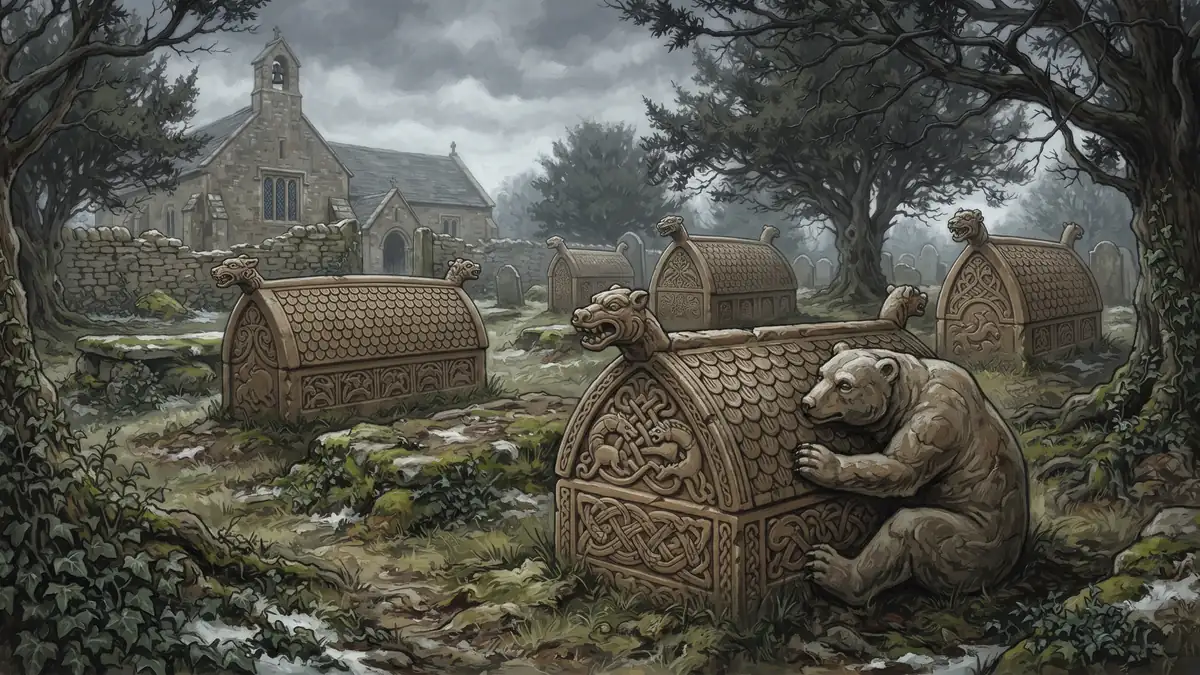
In some churchyards of northern England and southern Scotland there are gravestones that look like miniature houses: a long body, arched on top, with carved shingles on the sides and, sometimes, an animal at each end. Archaeologists call them hogbacks, and they tell something about how the Norse who settled there buried their dead.
Shape and decoration
Hogbacks are recumbent monuments, with a curved top and often bowed sides. Many have carved “shingles” on both sides of the ridge, as on a roof. The Brompton type has large beasts at the ends. The type called “warrior’s tomb”, more like a house, lacks them. On the Brompton pieces, bears hug the slabs, with strapwork coming from their mouths.
Where they are
They are concentrated in Yorkshire, Cumbria and Govan, and Yorkshire and Cumbria are the likely origin of the type. There are examples scattered from Derbyshire to central Scotland, with stray finds in the northern isles. Ireland has one, at Castledermot, and Wales has one, at Llanddewi Aberarth. Brompton, at St Thomas’s church in Northallerton, has the largest collection. Six were moved to Durham in 1867, leaving four whole ones and fragments. Govan has five hogbacks in the church museum, including the four largest known, and one is the only piece with beasts at both ends. Other notable pieces are at Inchcolm, in the Firth of Forth, and at Heysham.
What they were for
It is generally accepted that they were grave markers. The shingles, the curved shape and the longhouse type suggest stylised “houses” for the dead, linked to the idea of feasting in the hall of Valhalla in Norse religion. The hypothesis that the type began among the Danes who settled in northern England in the 870s still lacks enough research to be confirmed or refuted. One suggestion is that the type was invented around 920.
The road to Scotland
Their presence in Scotland is probably explained by the Forth-Clyde route, which linked York and Dublin: most Scottish sites lie along waterways. The monuments of Govan and Penrith are linked to local rulers who spoke Cumbric, which shows how the Norse fashion was adopted by elites of other origins.
In short
Hogbacks are house-shaped gravestones made between the tenth and twelfth centuries in northern England and southwest Scotland, with carved shingles and beasts. They were grave markers, and their origin and meaning remain under discussion.
Terms
Hogback describes the arched shape, like the back of a hog. Cumbric is the Celtic language of the kingdom of Strathclyde. Interlace is the design of crossing ribbons.
What remains uncertain
The source consulted gives dates that do not match, speaking of the fashion ending at the start of the eleventh century and, at the same time, of production into the twelfth. We also do not know for certain who made the hogbacks or what the images of bears and beasts meant.
To complete the pattern of stone shingles with the right piece, play The stone tiles.
Sources.
- Corpus of Anglo-Saxon Stone Sculpture, volume VI
- Wikipedia, "Hogback (sculpture)"