Easter witches in Sweden: from Blåkulla to children with Easter cards
In Sweden, children dress up as witches on Maundy Thursday or Easter Eve. See what the Nordiska museet says about the origin in the belief in Blåkulla and about today’s custom.
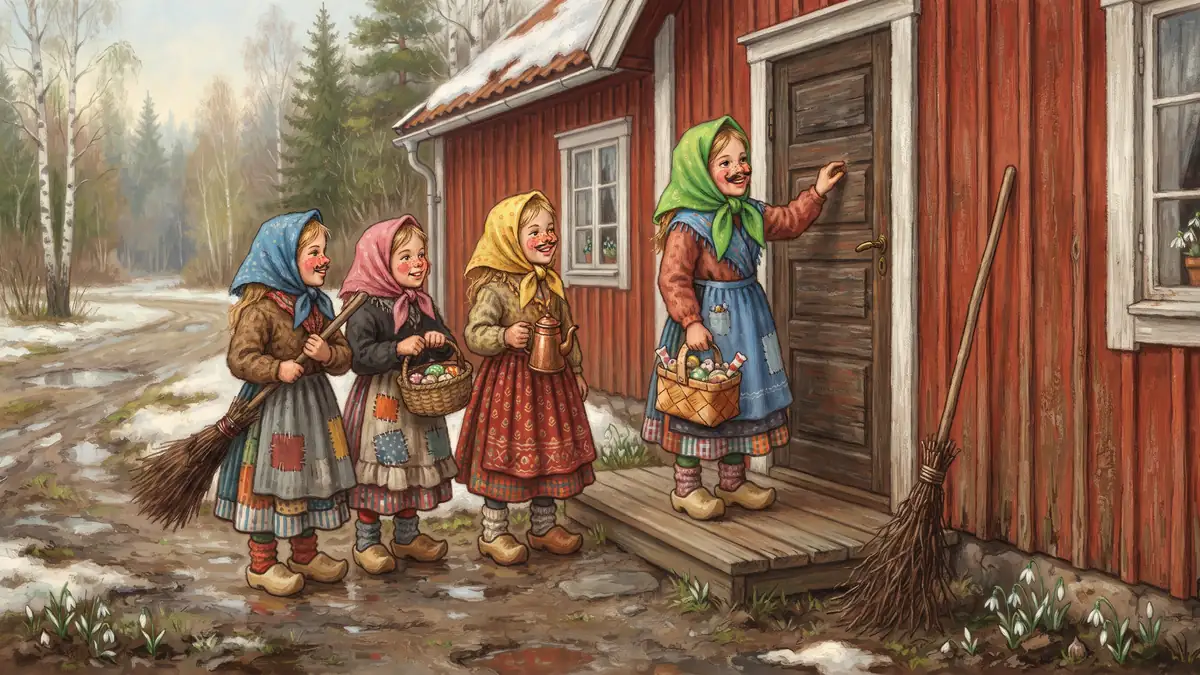
In Sweden, children dress up as witches at Easter. It is a cheerful custom, with headscarves and baskets in hand, but the origin is much darker. The information below comes from the Nordiska museet, in Stockholm.
Today’s custom
According to the museum, dressing up as an Easter witch (påskkärring) is a common custom throughout Sweden and takes place on Maundy Thursday or Easter Eve. In Finland, children dress up on Palm Sunday. The children wish people “Happy Easter” with cards, in the hope of receiving sweets or a small coin. The museum says that today’s witches are inspired by those of the old farming society, and that the baskets or coffee pots recall the witches’ ointment containers.
The origin in Blåkulla
The custom, the museum says, originally refers to the belief that witches travelled to the mythical mountain Blåkulla to meet the Devil before Easter. During the witch trials of the seventeenth century, witches were thought to be especially active before that journey. The text says nothing about broomsticks.
When it began
The oldest written records of Easter witches date from the early nineteenth century, but the museum states that the tradition is probably older. At first, it was adults who dressed up to imitate and frighten people. Today, the practice belongs to children.
The cards and the baskets
The cards the children hand out carry an Easter greeting, and in return they hope for sweets or a coin. The museum observes that the baskets and coffee pots the children carry recall the witches’ ointment containers, which shows how a detail of the old belief survived as a costume accessory.
From fear to play
The change is large. In the seventeenth century, the belief in the journey to Blåkulla was part of the real fear that accompanied the witch trials. Today, the same figure is a child in a headscarf who knocks on the door to wish a happy Easter. The museum describes this passage without giving an exact date: it says only that, at the beginning, it was adults who dressed up, and that today the practice belongs to children. It also notes that Finland has its own version, on Palm Sunday.
In short
The Swedish Easter witch was born from a belief about a journey to Blåkulla and ended up as a children’s game, with cards, sweets and coins. The date is Maundy Thursday or Easter Eve, and the custom is almost national.
Terms
Påskkärring is the “Easter old woman”, as the Easter witch is called in Swedish. Blåkulla is the mythical mountain where, according to belief, witches met the Devil. An ointment is a salve.
What remains uncertain
The museum says the oldest written records are from the early nineteenth century, but that the tradition is probably older, so the starting date is uncertain. It also does not explain when the practice passed from adults to children. The text I read does not cite the museum’s specific sources for this custom.
To find the pairs of cards of the Easter children, play The Easter cards.
Sources.
- Nordiska museet, "Easter" (nordiskamuseet.se, section on traditions and celebrations)
- Nordiska museet, description of its collections and documentation of folk traditions