Fimbulvetr: the three-year winter with no summer that comes before Ragnarök
Before the Norse end of the world come three winters in a row, with no summer between them. See what Snorri and the Poetic Edda say about Fimbulvetr and what scholars debate about the year 536.
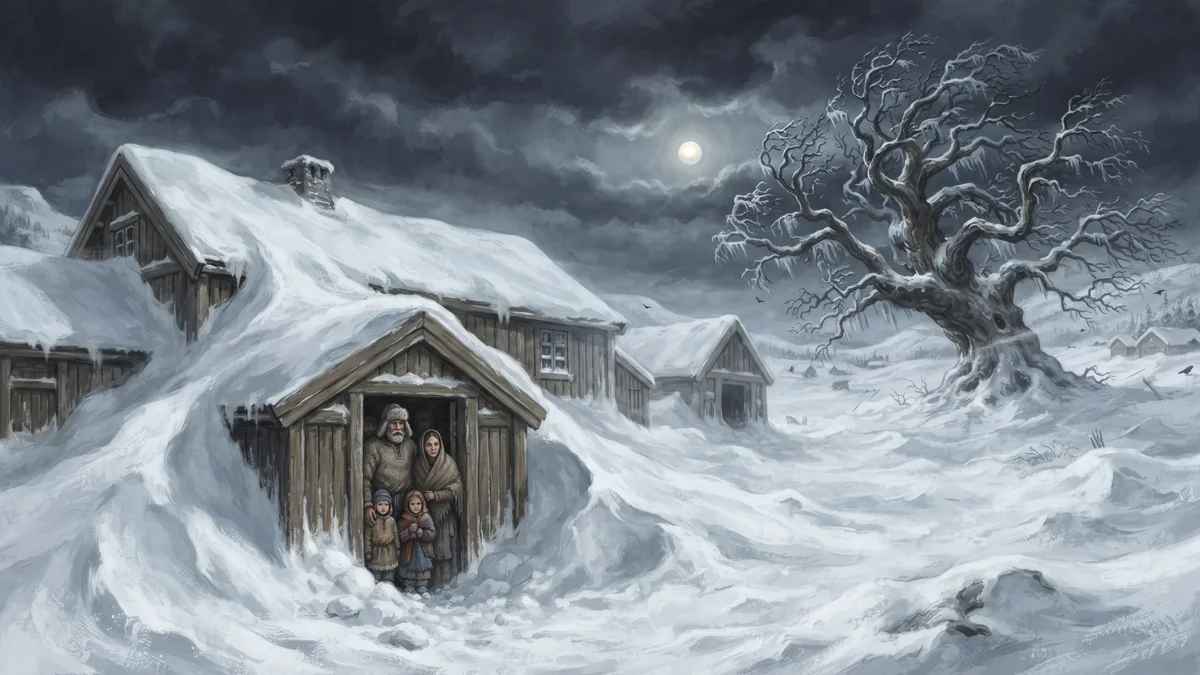
In Norse mythology, the end of the world does not arrive all at once. Before Ragnarök, the sources announce a winter that does not end, and the texts give it a name: Fimbulvetr. What we know comes from one passage in Snorri and two stanzas of a poem in the Edda.
The winter Snorri describes
In Gylfaginning, chapter 51, Snorri presents Ragnarök through its signs. The first is a winter that the translation consulted calls “the Awful Winter”. In it, snow drives in from all quarters, the frosts are great, the winds are sharp, and there is no virtue in the sun. Snorri adds that these winters will come three in succession, with no summer between them. In that time, the text says, brothers will slay each other for greed’s sake. After that, the Wolf will swallow the sun, and this will seem to men a great harm.
What the poem asks
In Vafþrúðnismál, Odin contests knowledge with the giant Vafþrúðnir. In stanza 44, he asks who will live among men when “the mighty winter” comes, in Old Norse fimbulvetr. In stanza 45, the giant answers that Líf and Lífþrasir will hide in Hoddmímir’s wood and have the morning dew for food. A note in Bellows’s edition points out that, before the final destruction, three winters follow one another with no summers between, and that this wood is probably the tree Yggdrasil.
A real winter?
Some researchers ask whether the image came from a memory of bad climate. Bo Gräslund and Neil Price examined the summer of AD 536 in a 2012 article. They question the popular idea that a natural catastrophe directly caused social collapse. Setting aside the cause of the event, they argue that the science shows a climatic downturn that coincides with archaeological signs of abandoned settlements and displaced populations in the north. The two authors also discuss how the episode may have influenced Scandinavian poetry and sculpture. They do not claim that Fimbulvetr is the memory of that year.
In short
Fimbulvetr is the winter that opens the Norse end of the world: three winters in a row, with no summer, snow from every side, a weak sun and quarrels among kin. Snorri describes it in the thirteenth century, and the poem Vafþrúðnismál already mentioned it when it asks who would survive it.
Terms
Ragnarök is the end of the gods and of the world. Gylfaginning is the first part of the Prose Edda. Vafþrúðnismál is the poem of the wisdom contest between Odin and Vafþrúðnir. Líf and Lífþrasir are the pair who survive.
What remains uncertain
The sources do not say that the myth was born from a real event. The link with the year 536 is a hypothesis that scholars themselves discuss with caution. The two texts also describe the winter in different ways: Snorri speaks of three winters in a row, while the poem’s stanza speaks only of “the mighty winter”. From these sources, I cannot say whether Snorri took his details from the poem or from another tradition.
To sweep away the snow that comes from four sides before it reaches the house, play Snow from four sides.
Sources.
- Snorri Sturluson, Prose Edda (Gylfaginning, chapter 51)
- Poetic Edda, Vafþrúðnismál, stanzas 44 and 45 (translation by Henry Adams Bellows, 1936)
- Bo Gräslund and Neil Price, "Twilight of the Gods? The 'dust veil event' of AD 536 in critical perspective", Antiquity 86 (332), 2012, pp. 428-443