The Ribe skull: runes on an amulet against a dwarf, around the year 725
A piece of human skull with runes, found at Ribe in 1973, seems to be an amulet against a dwarf who caused illness. See what the inscription invokes, who re-read it and what remains debated.
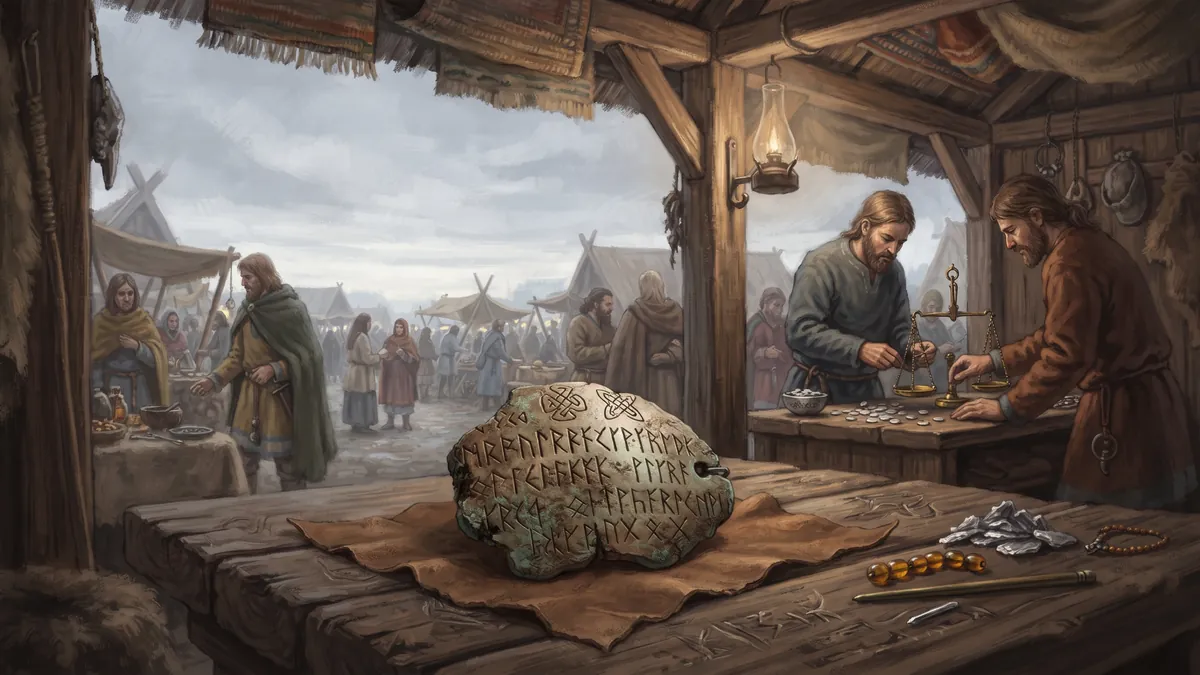
In 1973, an excavation at Ribe, in Denmark, brought to light a piece of human bone with runes. Ribe was one of the first markets of the Norse, and the object is one of the oldest runic texts of the region. The runes seem to form an amulet, and the reading of them has changed several times.
The object
It is a fragment from the top of a human skull, about 6 by 8.5 centimetres, with a hole made on purpose. The date is about 725. The runes belong to a transitional stage: they are from the newer alphabet, the Younger Futhark, but still keep two forms of the old one, for H and M. It was found among remains of a market site, so it may never have been sold or used. The hole shows no wear from a cord, so the object may not have been worn on the neck.
What the inscription says
According to the most cited reading, the inscription invokes Ulfr, Óðinn and Hó-Týr, “High Týr”. The word hiálp, “help”, appears, and the text seems to protect whoever carries the object against a dwarf and a dwarfess called Bóur. Dwarves were seen as a cause of illness, and there are similar amulets, such as the Near Fakenham plaque, the Kvinneby amulet and an Anglo-Saxon charm called “Against a Dwarf”.
A reading that changes
Marie Stoklund published a study of the runes in 1996, and later readings revised several signs. Jackie Nordström re-examined the runes with a digital microscope and revised several signs. In an article in the journal ANF, she reads the terms burin and dvärg, “dwarf”, and proposes that the text is a kind of bjargrúnar, “runes of protection”, like those described in the poem Sigrdrífumál, with parallels in the Anglo-Saxon wið dweorh charms.
Why a skull?
The bone is human, which makes the object unusual. The sources I read do not explain why a piece of skull was chosen, and that silence is one of the reasons the object is still studied.
In short
The Ribe skull is a bone with runes that invokes Odin, Týr and a certain Ulfr to protect against a dwarf, and it may never have been used. The inscription is read a little differently by each researcher.
Terms
The Younger Futhark is the 16-letter runic alphabet used in the Viking Age. An amulet is a protective object. Bjargrúnar are “runes of help”, in Old Norse.
What remains uncertain
Part of the reading is disputed, such as the name of the dwarf and the presence of a dwarfess, and the date of 725 comes from a single estimate. It is also uncertain whether the hole was meant to hang the object, and the unworn hole suggests it was not. It is also debated whether the text deals with an illness, and that point depends on the reading.
To stop the dwarves before they reach the market stalls, play The dwarves of the market.
Sources.
- Ribe skull fragment, found in an excavation at Ribe, Denmark, in 1973 and dated to about 725
- Jackie Nordström, "Dvärgen på Ribekraniet", journal ANF, vol. 136
- Marie Stoklund, study on the Ribe runes (1996)