 MMXXVI
Jörð: the Earth as a goddess, mother of Thor and "bride of Odin" in the Norse sources
Jörð is the Earth itself, personified, and the mother of Thor. The sources say little about her and do not always agree on her parents. See what the Edda and the skalds record.
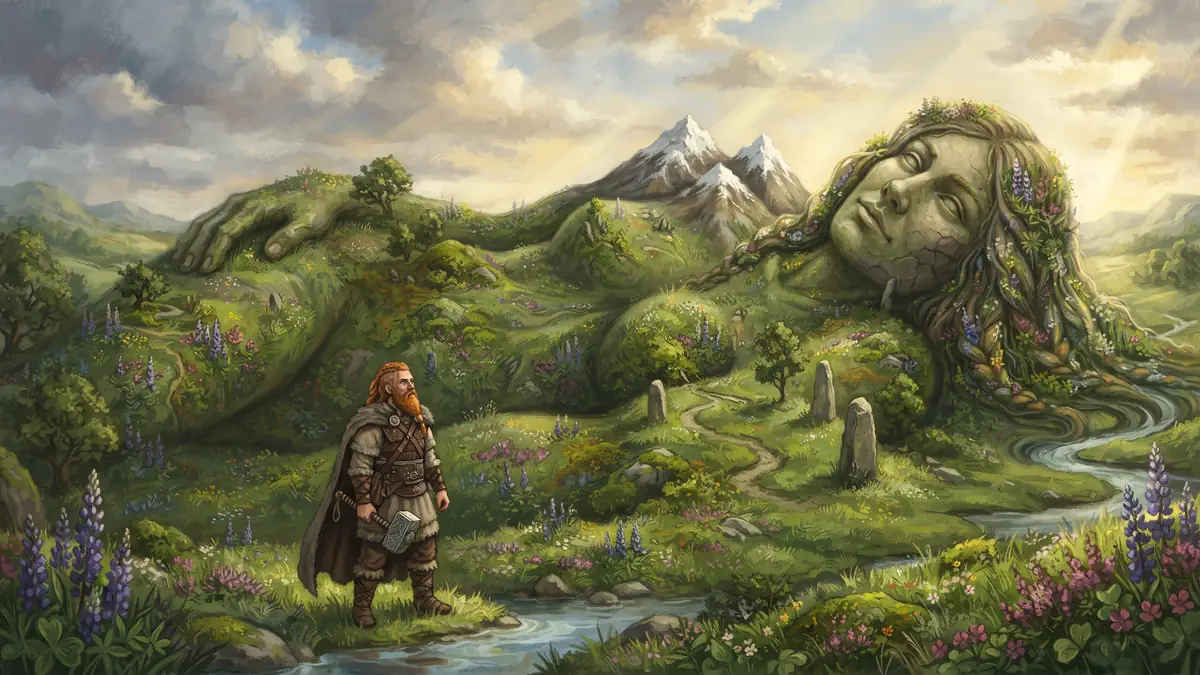
In Old Norse, jörð means “earth”, and it is also the name of a goddess. She appears in the sources almost always because of her son: Thor. She is almost never a character in a scene. So what can be said about her is short, and it is worth separating what each text says.
Her parents, according to Gylfaginning
In Gylfaginning, section 10, the Prose Edda tells that a giant named Narfi has a daughter, Nótt, Night. She marries Naglfari and then Annar, and their daughter is Jörð, “Earth”. Wikipedia notes that this passage varies by manuscript. In the oldest manuscript, U, Jörð is the wife of Dellingr and mother of Dagr, Day. In manuscripts R, W and T, it is Nótt who fills that role.
The mother of Thor
Here the sources agree. In Gylfaginning, section 25, the mother of Thor appears among the ásynjur under the name Iord, which is Jörð in the spelling of the translation used. In Lokasenna, stanza 58, Thor is called Jarðar burr, “son of Jörð”. In Skáldskaparmál, section 4, a kenning for Thor says “son of Odin and Iord”. The skalds do the same: Þjóðólfr of Hvinir, in the poem Haustlöng, calls Thor “son of Iord” twice, and Eilífr Goðrúnarson does the same in Þórsdrápa.
In Hárbarðsljóð, stanza 9, Thor presents himself as the son of Odin and brother of Meili, who may also be a son of Jörð.
Other names: Hlóðyn and Fjörgyn
In Völuspá, Thor is called mögr Hlóðyniar and Fjörgyniar burr. Scholars understand Hlóðyn as another name for Jörð. The etymology is uncertain, but it may be related to the goddess Hludana, known from votive tablets of the Lower Rhine. Fjörgyn is also considered another name for her and, in skaldic poetry, it is used as a poetic word for “land”.
“Bride of Odin”
In Skáldskaparmál, section 90, there is a long list of kennings for the earth. Among them, Jörð is “bride of Odin”, “daughter of Önar” and “mother of Thor”, as well as “floor and base of the winds’ hall”. In section 19, a kenning for Frigg calls her “rival of Iord and Rind”. This shows that the poets thought of Odin as having had a link with Jörð, but the sources do not tell how it came about. The scholar John Lindow, cited on Wikipedia, argues that the relationship was probably not a marriage.
A goddess who is the ground
What stands out is that Jörð is, at the same time, a person and the place where everyone walks. The same word serves for the mother of Thor and for solid ground, which explains why the poets used it both as a name and as a kenning for “earth”. There is no myth devoted to her. She lives in names and family ties.
In short
Jörð is the personified Earth, mother of Thor, linked to Odin. Gylfaginning gives different versions of who her parents were, depending on the manuscript, and the Edda and the skalds agree in calling her the mother of Thor. Fjörgyn and Hlóðyn seem to be other names for her. Almost everything we know comes from names and kennings, not from stories.
To match each mention to its source, play Every mention in its source.
Sources.
- English Wikipedia, article "Jörð", with the passages from Gylfaginning, Skáldskaparmál, Völuspá, Lokasenna and Hárbarðsljóð
- Prose Edda, Gylfaginning (sections 10 and 25) and Skáldskaparmál (sections 4, 19 and 90)
- Poetic Edda, Völuspá and Lokasenna (stanza 58)