 MMXXVI
Norna-Gest: the man who lived three hundred years as long as a candle did not burn out
A guest at King Óláfr Tryggvason's court claims to have seen Sigurd, the slayer of Fáfnir. See the tale of Norna-Gest, the candle by the cradle and the end the Norns' prophecy gave him.
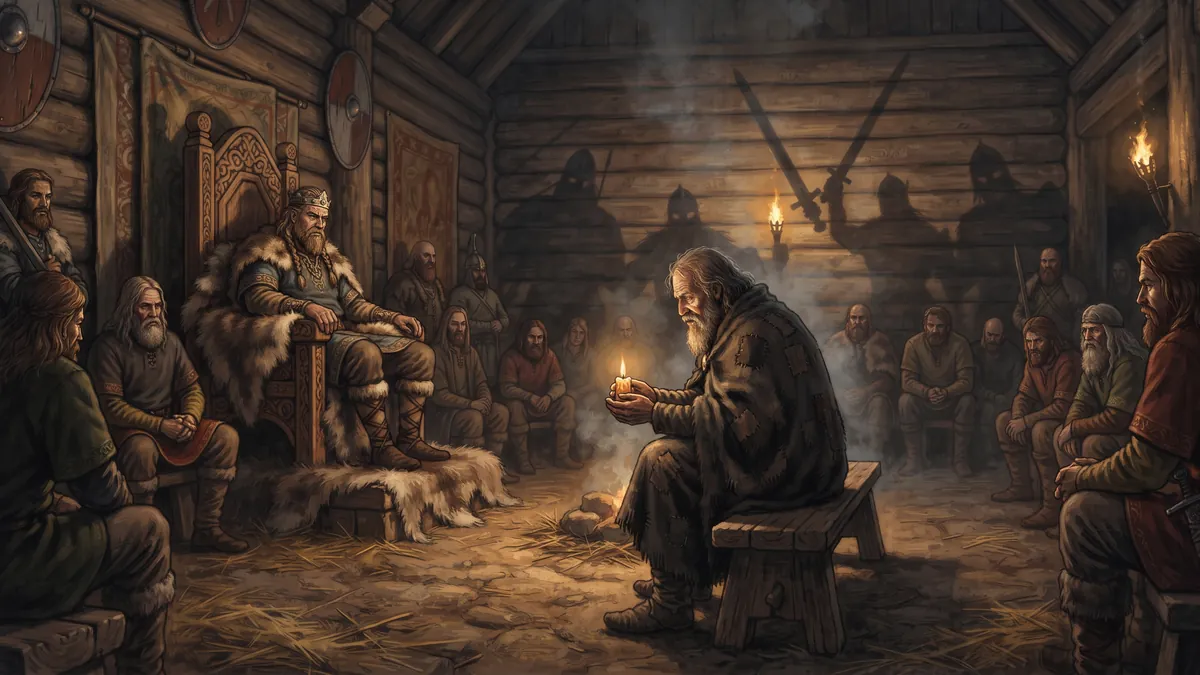
In the third year of King Óláfr Tryggvason’s reign, a guest arrives at his court who says he has seen things three hundred years old. He is Norna-Gest, the “guest of the Norns”. The tale that tells of him, Norna-Gests þáttr, is one of the most curious in Norse literature: in it, a man passes through the lives of legendary heroes and dies when a candle goes out. This text gathers the plot and what is known about the manuscript.
The manuscript and the date
The tale appears inside the Longest Saga of Óláfr Tryggvason. The main manuscript is the Flateyjarbók, and there are other copies. Tradition dates it to the early fourteenth century, but the oldest surviving manuscripts are from the late fourteenth century.
The guest and his birth
Gest says he is the son of Þórðr þingbítr, a Dane from Grøning. He tells that three seeresses, the Norns, came to his birth. Two gave him good gifts. The youngest, who had not been invited and was pushed aside by the crowd, said he would live only as long as a candle beside the cradle stayed lit. The eldest put out the flame, and his mother hid it.
The wager and the saddle buckle
The king and Gest wager over which treasure is worth more: the arm-ring Hnituðr, which belonged to King Hálfr and which King Óláfr received from Úlfr the Red, or a gold piece that Gest says he has. The next day, Gest shows a piece of a saddle buckle from the horse of Sigurd, the slayer of Fáfnir. The gold is judged greater, and Gest begins to tell his life.
Three hundred years of stories
Gest served Sigurd in the lands of the Franks. He saw Sigurd’s training with the dwarf Regin, the forging of the sword Gramr, the death of the dragon Fáfnir and the vengeance against the sons of Hundingr. In another episode, when the sons of Gandálfr demand tribute from Gunnar and Högni, Sigurd knocks out two molars of the giant Starkaðr, and Gest keeps one of them. The tooth weighed seven aurar and later became a church bell at Lund. Gest says he also met Ragnarr loðbrók, Björn Ironside, King Eiríkr at Uppsala and Haraldr Fairhair.
The end
King Óláfr criticises Gest for having only the primsigning, the mark of the cross that came before baptism, and asks him to be baptised. Gest agrees, lights the candle of his life and dies when it burns down, as the Norn had said.
A framed tale
The tale uses the frame of a long-lived character who narrates stories within the story. The page consulted cites the idea of a life tied to a candle as a known folklore motif, with parallels such as Meleager and the romance of Ogier the Dane. The Faroese ballad Nornagests ríma has four variants and follows only the Sigurd part.
In short
Norna-Gest arrives at the court of Óláfr Tryggvason with a gold piece from Sigurd’s saddle, tells his life of three hundred years and is baptised. When he lights the candle from the cradle, he dies when it ends.
Terms
Þáttr is a short tale in Norse literature, usually inside a larger saga. Norns are the women of fate. Primsigning is the rite of marking with the cross that came before baptism.
What remains uncertain
The page consulted notes that King Eiríkr of Uppsala is identified in several ways, and that the tale has details, such as the death of Lyngvi, that the Völsunga saga does not. The date of composition is approximate.
To shield the candle’s flame from the winds that come, play The flame of the candle.
Sources.
- Norna-Gests þáttr, part of the "Longest Saga of Óláfr Tryggvason" in the Flateyjarbók manuscript (late 14th century)
- English Wikipedia, article "Norna-Gests þáttr", consulted to check plot, manuscripts and dating