 MMXXVI
Olof Skötkonung: the Swedish king who minted the first coins and was baptized in four versions
Olof Skötkonung (c. 995 to 1022) was the first Swedish king to mint coins. See what we know about the nickname, the Sigtuna coins, the baptism told four ways and Thorgny's speech.
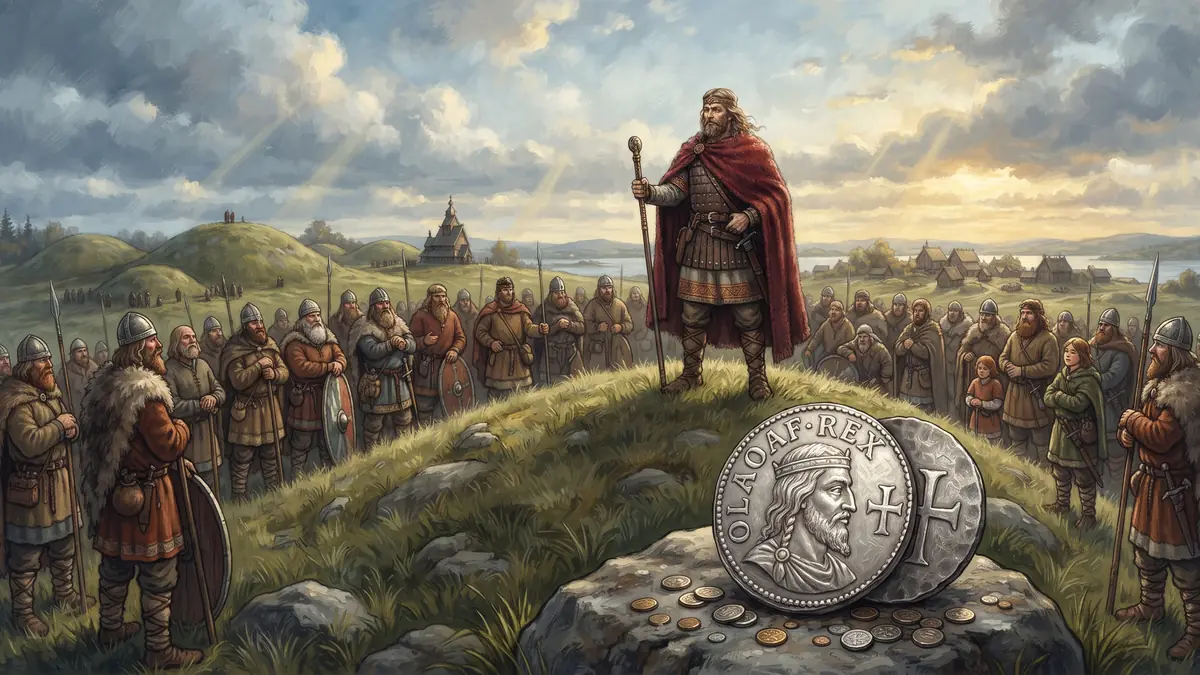
Olof Skötkonung ruled Sweden from about 995 to 1022, succeeding his father, Eric the Victorious. He was born around 980. He is the first Swedish king whose coins are known. Most of what is told of him rests on Adam of Bremen and on Snorri Sturluson, writing about two centuries later, and scholars question both.
The nickname
Skötkonung is debated. Lund and Sawyer read it as “tributary king”, which would make Sweyn Forkbeard his overlord, but Bagge says the relationship between them is unknown. Other proposed origins are the Swedish word skatt (“taxes” or “treasure”), his coins, or a land-ownership ceremony. In the Icelandic sources he appears as Óláfr sœnski, “Olaf the Swede”, to distinguish him from the Norwegian kings named Olaf.
The Sigtuna coins
Olof is the first Swedish king known to have minted coins, and a few hundred survive. They were struck at Sigtuna, in Uppland, and use the Latin rex (OLUF REX, OLAF REX). The first read “king in Sigtuna”, and later ones “king of the Swedes”. The coins imitate English pennies in type and style. His son Anund Jacob also minted coins, and then the practice stopped until Knut Eriksson in the late 12th century.
The baptism, told four ways
The sources differ. The Westrogothic law chronicle, of about 1240, says he was baptized at Husaby in Västergötland by the missionary Sigfrid. A document of 1008 says a bishop sent by Archbishop Bruno of Querfurt baptized the king among the “Suigi”, although the identity of the “Suigi” with the Swedes is disputed. Adam of Bremen, around 1075, praises Olof as a good Christian, says he planned to tear down the Uppsala temple and gave it up because many Swedes were still pagan, and speaks of a bishopric in Västergötland, with Thurgot as the first bishop at Skara. The 13th-century legend of Sigfrid speaks of an English archbishop who baptized him with his family, and may have been written to justify the bishopric of Växjö around 1170. The coins, according to Hellström, suggest he was already Christian when he took the throne.
Thorgny’s speech
According to the Heimskringla, in 1018 Ragnvald Ulfsson and Norwegian envoys went to the Uppsala assembly to propose peace and the marriage of Olof’s daughter Ingegerd to King Olaf II of Norway. Olof grew angry and threatened to banish Ragnvald. Thorgny, the Lawspeaker and Ragnvald’s foster-father, gave a speech warning that the people wanted peace. Olof yielded for the time being. He married Ingegerd to Yaroslav the Wise, and Astrid went to Olaf II around 1019.
The children and the death
With Edla, Olof had Emund the Old, Astrid and Holmfrid. With Estrid of the Obotrites he had Anund Jacob, who succeeded him, and Ingegerd. Snorri’s chronology puts a natural death in the winter of 1021 to 1022. Adam of Bremen places it near 1035, which Wikipedia itself calls certainly too late.
In short
Olof is known for coins, a debated nickname and a baptism told four ways. What is solid is the Sigtuna coins. The rest rests on texts written later.
To strike the Sigtuna coins at the right moment, play The Sigtuna coins.
Sources.
- English Wikipedia, article "Olof Skötkonung", which summarizes Adam of Bremen, Snorri's Heimskringla and other sources
- Adam of Bremen, Gesta Hammaburgensis ecclesiae pontificum (around 1075)
- Snorri Sturluson, Heimskringla (around 1230)