 MMXXVI
Sankthans and Jonsok: Norway's midsummer night of bonfires
The night of 23 June is St. John's Eve in Norway. See what the sources say about the bonfires, the holiday abolished in 1770 and the herbs, and what is only assumption about pagan origins.
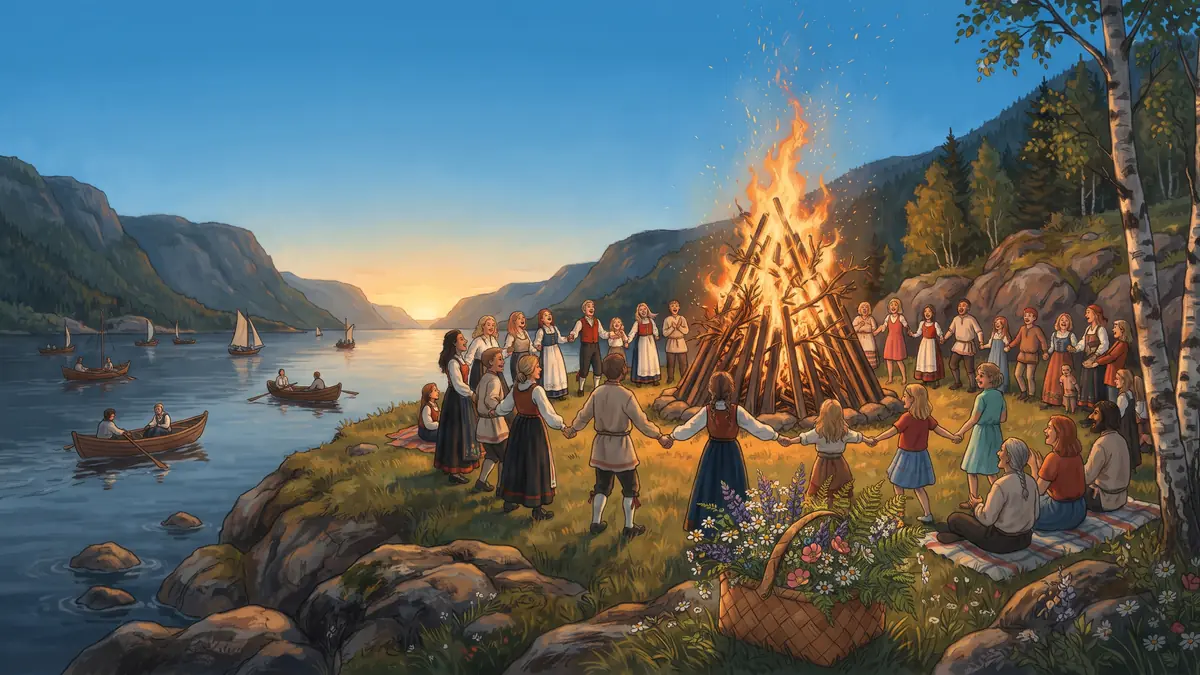
On the night of 23 June, Norwegian shores fill with bonfires. It is Sankthans, also called Jonsok. Many people think the festival comes straight from the Viking Age, but the written sources tell a rather different story.
A Christian feast
According to Herleik Baklid, a professor of cultural history quoted by ScienceNorway, 23 June was a Christian feast dedicated to John the Baptist, hence “St. John’s Eve”. In Catholic Norway, saints mattered greatly. The Evangelical Lutheran Church, now the largest, has no saints.
The old laws
The Frostathing law ordered farmers to drink beer on Jonsok and banned work. Jon Raude’s Christian law of 1270 set a “non-holiday” from three in the afternoon the day before, with fasting and a ban on work. The feast ceased to be a public holiday in 1770, under Johann Friedrich Struensee, the physician who effectively ran Denmark. Struensee also removed the third day of Christmas, Easter and Pentecost.
The bonfires
The oldest evidence of midsummer bonfires comes from Jacobus de Voragine, an Italian writer of the 13th century. The oldest Swedish source is a 1550 account by the priest Olaus Magnus. In Norway, there is historical evidence of bonfires from at least the late 18th century, though the tradition is older. According to Baklid, fire was seen as protection against evil. Witches were believed to gather on the Brocken in Germany or on Lyderhorn in Bergen. The Slinningsbål in Ålesund passed 47 metres in 2016 and for many years was the world’s tallest midsummer bonfire.
Herbs and flowers
In local traditions, medicinal plants were gathered on Sankthans, ideally by a naked person. It was also said that seven kinds of flowers under the pillow brought a dream of your future husband or wife. Pilgrims visit Røldal stave church, where a crucifix is believed to have healing powers, and holy springs were thought to be stronger on this night. ScienceNorway says the “ok” of Jonsok would come from “wake”, meaning vigil, an explanation of the article’s own.
What is assumption
The ScienceNorway article does not discuss pagan origins and does not claim pre-Christian roots. The idea that the bonfires come from the Vikings is frequent, but in the sources cited here the oldest evidence of the bonfires is Christian and medieval. Customs such as the witches and the herbs are folk beliefs recorded later, not proven Viking Age rituals.
In short
Sankthans is a Christian feast of St. John that ended up associated with bonfires, herbs and superstition. What the sources support is this: a medieval feast with laws of its own, abolished as a public holiday in 1770, and a bonfire tradition recorded since the 13th century.
To light the right bonfires and leave the others unlit, play The witches and the bonfire.
Sources.
- ScienceNorway (University of South-Eastern Norway), "Why do Scandinavians celebrate midsummer?", with Professor Herleik Baklid
- Jacobus de Voragine, Golden Legend (13th century), as the oldest source on St. John's bonfires
- Olaus Magnus, 16th-century account of bonfires in Sweden
- The Frostathing law and Jon Raude's Christian law (1270)