 MMXXVI
Snæfríðr, the Sami wife of Harald Fairhair, and the three years the king would not leave her body
According to Heimskringla, King Harald Fairhair married Snæfríðr, daughter of the Finn (Sami) Svási, and stayed three years beside her body, which did not decay. See the story and the sources.
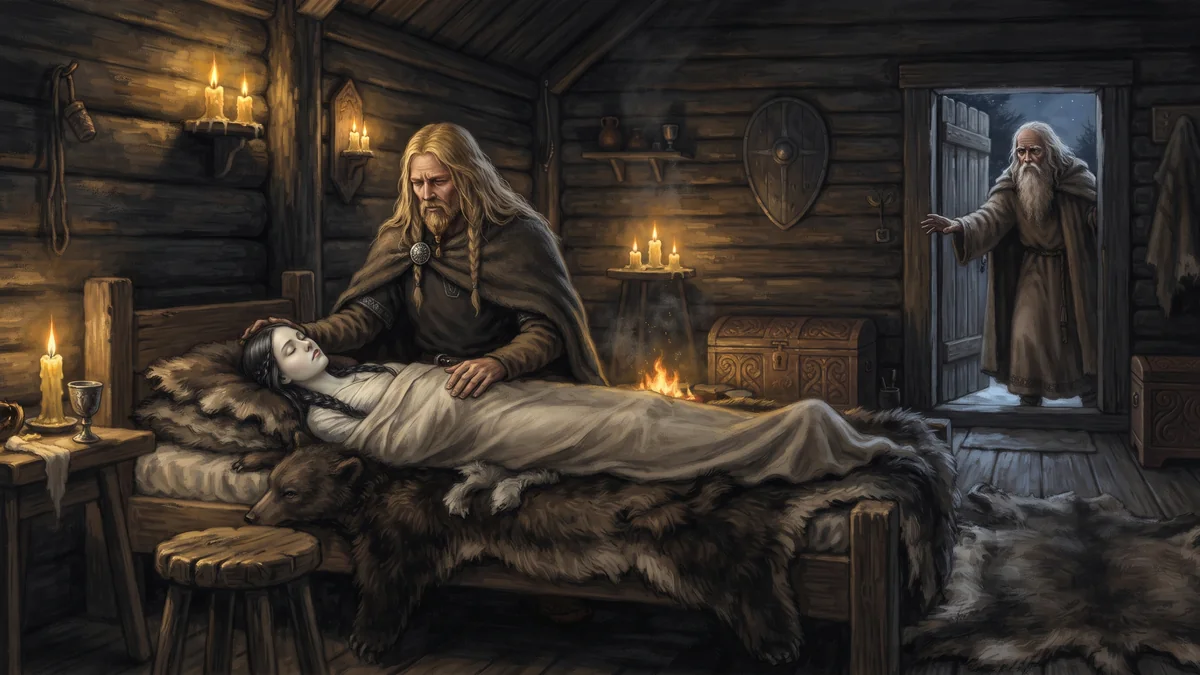
In the sagas of the kings of Norway, Harald Fairhair is the king who unifies the country. But one of the strangest stories about him has no battle at all: it is about a young woman, a drink and a body that seemed to sleep.
Who she was
According to medieval tradition, Snæfríðr Svásadóttir (also Snjófríðr) was one of the wives of Harald Fairhair. She is described as a Sami woman, and the sagas make her an ancestor of Harald Hardrada. Wikipedia notes that, apart from Ragnhild the Mighty, she is the only wife of Harald named outside Heimskringla.
The feast
Harald was at a Yule feast at the Tofti estate in Gudbrandsdalen when a Finnish (Sami) giant named Svási arrived and invited him to his hut. There the king met Svási’s daughter Snæfríðr, who poured him a drink. Harald was overcome with desire and wanted to take her as a concubine, but Svási refused, and they married.
The marriage
Harald spent all his time with Snæfríðr and neglected his kingdom. Over three years of marriage she bore him four sons: Sigurðr hrísi, Hálfdan háleggr, Guðrøðr ljómi and Rǫgnvaldr réttilbeini.
The death and the three years
Snæfríðr died suddenly, and Harald was overcome with grief. Her body was laid in state and did not decompose or grow pale: she appeared to sleep peacefully. Harald sat weeping beside her for three years, hoping she would return to life, while his people suffered from the neglect of the king’s duties.
The end of the illusion
An old man named Þorleifr the Wise persuaded the king to leave the chamber. He argued that it was dishonourable to leave the dead in the clothes they died in. When the servants moved the body to change her clothes, it turned blue and began to smell. Before it could be burned on a pyre, toads, snakes and lizards crawled out of it, and it soon crumbled to dust.
Afterwards
Wikipedia reports that Harald concluded she had been a witch, grew furious and exiled all the sons he had had with her. From then on he was hostile to magicians. When Rǫgnvaldr followed his mother’s path, Harald sent his loyal son Eiríkr Bloodaxe to kill him. The page does not describe Harald’s recovery beyond this point.
The sources
The main story is in Heimskringla, in Haralds saga hins hárfagra, chapters 25 and 26. The legend also appears in Ágrip. Orkneyinga saga mentions her briefly, and the poem Málshattakvæði alludes to her. In Flateyjarbók, the first chapter of Haralds þáttr hárfagra centres on her and credits Harald with the Snæfríðardrápa, a skaldic poem about her. Wikipedia cites Gro Steinsland, Fornnordisk religion (2007), on the point that she is a wife of Harald outside Heimskringla. The page has no scholarly discussion of her Sami identity, beyond the description.
In short
Snæfríðr is a wife of Harald Fairhair, daughter of Svási, described as Sami. The king fell for her, married, had four sons and stayed three years by her body. When the body was moved, it fell apart with toads and snakes, and Harald took her for a witch. It is one of the strangest stories in Heimskringla, and the sources differ in details.
To repeat the order of the creatures that came out of the body, play Toad, snake and lizard.
Sources.
- English Wikipedia, article "Snæfríthr Svásadottir"
- Snorri Sturluson, Heimskringla, Haralds saga hins hárfagra, chapters 25 and 26, cited on Wikipedia
- Ágrip af Nóregskonungasögum, Orkneyinga saga, Málshattakvæði and Flateyjarbók (Haralds þáttr hárfagra), cited on Wikipedia