 MMXXVI
The hólmganga: the duel on the ox hide, the three shields and the ban of 1006
The hólmganga was the regulated duel of the Norse sagas: an ox hide on the ground, three borders around it, three shields each and a fight to first blood. See the rules according to Wikipedia and Kormáks saga, what the winner gained and why Iceland banned the duel in 1006.
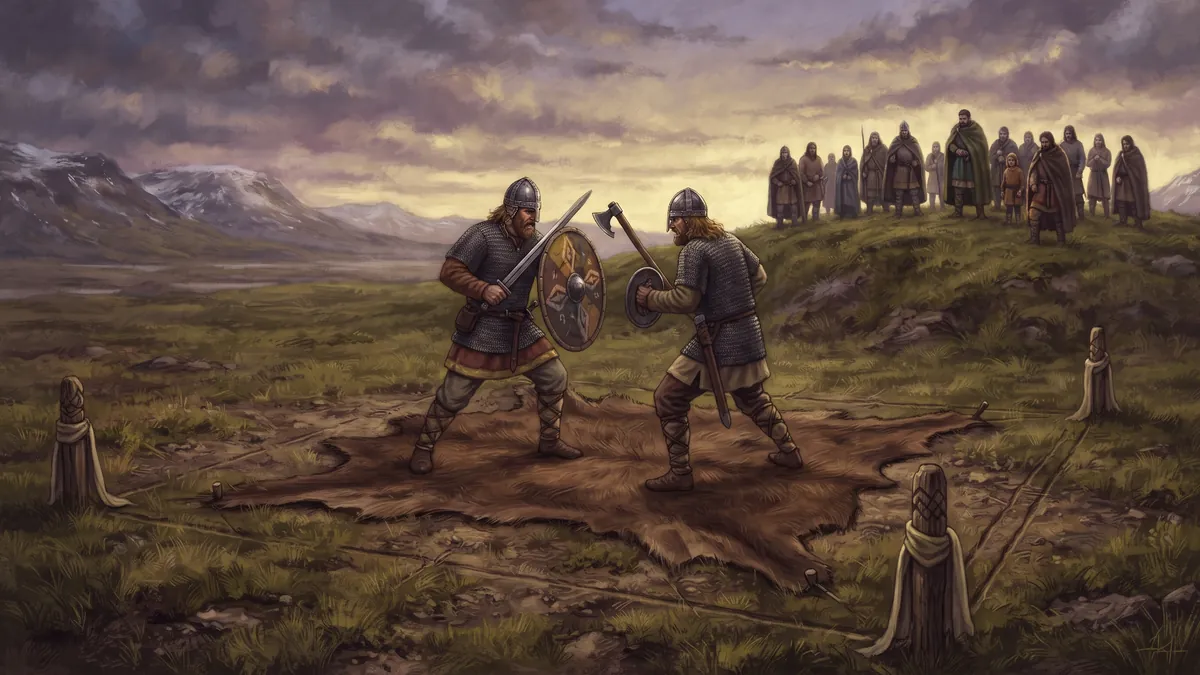
When two Norsemen disagreed and no settlement could be reached, they could resolve the matter with a duel. The hólmganga had rules, and the sagas tell of several of them.
The field
According to Wikipedia, the hólmganga was fought on an ox hide or a cloak about 3 metres (9.8 ft) per side, staked to the ground with stakes used only for this purpose. Around the hide three borders were drawn, each about a foot (0.30 m) from the next. Hazel staves marked the outer corners. Kormáks saga hints that a bull might be sacrificed beforehand, with its hide stretched over the fighting ground. Wikipedia says it is unknown how the stakes were placed.
The rules
- The fighters had to stay within the borders. Stepping out meant forfeit, and running away was cowardice.
- Each could use a set number of shields, usually three. The opponent’s blows could break a shield.
- The challenged party struck first. Then the two struck in turn.
- The fight normally ended at first blood. The winner received three marks of silver, unless the dispute concerned a specific property.
- It was fought 3 to 7 days after the challenge.
- If the challenged party did not appear, the challenger was considered justified. If the challenger did not appear, he was a niðingr, a man without honour, and could be sentenced to outlawry.
- Equal numbers could fight on each side, not only one against one.
The older duels
In early duels, the fight ended with the death or incapacitation of one of the fighters. Killing the opponent was not murder and carried no outlawry or weregild. In Norway, according to Egils saga, cited in Wikipedia, the winner could claim everything the loser owned.
The texts
Wikipedia cites Kormáks saga, which describes the hide, the stakes, the borders and the hazel staves, and Egils saga, which gives the rules of the challenge and the winner’s rights. It also mentions the Västgötalagen, a thirteenth-century fragment of the law of Västergötland, with provisions on the hólmganga or einvígi, trial by combat.
The end of the hólmganga
Iceland outlawed the hólmganga in 1006, largely because of the duel between Gunnlaugr ormstunga and Hrafn Önundarson. Norway outlawed it in 1014.
Two countries, eight years
Iceland banned the hólmganga in 1006 and Norway in 1014, eight years later.
In short
The hólmganga shows a society with law but without a strong court: two people, a hide, three shields and rules everyone knew. In time, the deaths the duel caused led to its ban.
To train your attention with the shields and the borders of the hide, play Defend the hide.
Sources.
- English Wikipedia, article "Holmgang", with the rules from Kormáks saga, Egils saga, the Västgötalagen fragment and the ban
- English Wikipedia, article "Gunnlaugr ormstunga", cited for the duel with Hrafn Önundarson