 MMXXVI
Ymir: the giant born of ice and venom whose body the gods made into the world
Ymir is the first giant of the Norse sources. See what the Prose Edda, the Völuspá, the Vafþrúðnismál and the Grímnismál say about his birth and death, and what is only hypothesis.
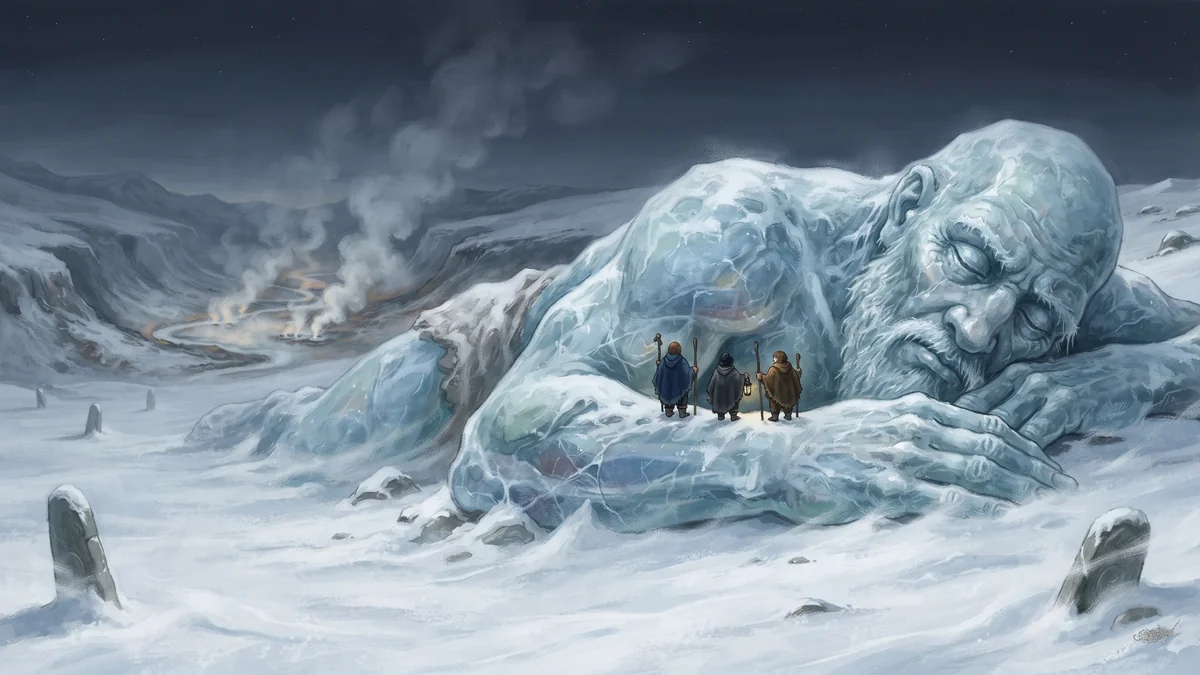
Before the Norse gods, before earth and sea, the sources place a giant. He is called Ymir, and he also appears as Aurgelmir, Brimir and Bláinn. The poems and Snorri Sturluson treat him as the ancestor of all the giants, the jötnar. This text gathers what is written about his birth, his death and the world that came out of his body.
Where Ymir comes from
In the poems of the Poetic Edda, Ymir is born from venom that dripped from the frozen rivers called Élivágar into the void of Ginnungagap. Snorri tells it differently in the Gylfaginning: the ice from Niflheim met the heat from Muspell, the ice thawed and the drops took the shape of a man, who was named Ymir. It is the same figure told by two different traditions.
The cow and the giant’s family
Snorri adds a cow, Auðumbla, who fed Ymir with her milk. She licked salty blocks of ice, and from one of them came Búri. Búri’s son Borr married the giantess Bestla, and their sons were Odin, Vili and Vé. Ymir also had offspring: according to the Vafþrúðnismál and the Gylfaginning, as he slept and sweated, a man and a woman grew under his arm, and from his legs was born a giant with six heads.
The world made from a body
Odin and his brothers killed Ymir. His blood gushed out and drowned almost all the frost giants. Only Bergelmir escaped, with his wife, in a boat, and the later giants descend from him. Then the three made the world from the fallen body. According to the Gylfaginning, the flesh became the earth and the blood became the sea and the lakes. The bones became mountains, and the teeth and molars became stones and boulders. The skull became the sky, held up at the four corners by four dwarfs, Norðri, Suðri, Austri and Vestri. The brains became clouds, and the eyelashes formed the wall of Midgard. The sparks of Muspell were set in the sky as lights.
The Grímnismál repeats the idea in another way: earth from the flesh, sea from the blood, hills from the bones, trees from the hair and the sky from the skull. Skaldic poetry kept the same world in kennings. The sky could be called “Ymir’s old skull”, and the earth “Ymir’s flesh”.
What is hypothesis
Scholars compare Ymir with Tuisto, the being Tacitus describes in the Germania, through a name that may mean “twofold”. Adams and Mallory also note that a primordial being dismembered to create the cosmos appears in other Indo-European traditions, such as the Vedic Purusha sukta. These are comparisons, and the Norse sources say nothing of the kind.
In short
Ymir is born from ice and venom, feeds on a cow’s milk and dies at the hands of Odin, Vili and Vé. From his body come the earth, the sea, the mountains and the sky. The sources differ in details: venom or thawed ice, and the order of the body parts. What all of them keep is the idea that the world was made from a dead giant.
To give each part of Ymir’s body back to the place in the world it belongs to, play Every part in its place.
Sources.
- Snorri Sturluson, Prose Edda (Gylfaginning, chapters 5 to 8)
- Poetic Edda: Vafþrúðnismál, Grímnismál and Völuspá
- Snorri Sturluson, Prose Edda (Skáldskaparmál, for the kennings of sky and earth)
- English Wikipedia, article "Ymir", consulted to check the passages and the scholars' comparisons